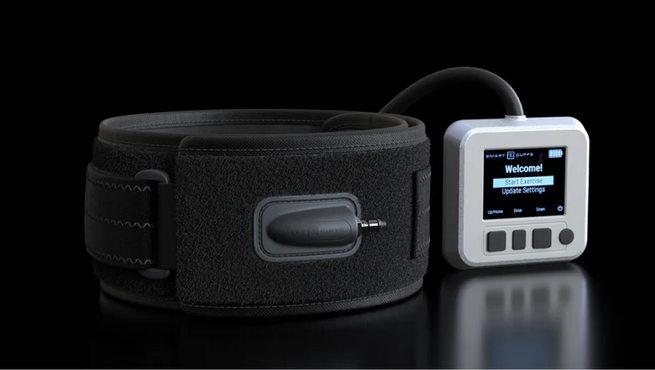



If you've narrowed your search for a BFR product down to SmartCuffs or AirBands, the choice usually comes down to one question: are you looking for precision or a lower price point? Both are wireless, app-controlled BFR cuffs that calibrate automatically to a percentage of your limb occlusion pressure (LOP), but they're built around different priorities, and that can shape your ultimate choice.
In short, SmartCuffs tends to fit clinical and rehabilitation settings where LOP accuracy and consistent dosing matter most for blood flow restriction training, while AirBands is the lower-cost option for home and on-the-go training where price carries more weight than validated accuracy. Neither positioning is absolute, and the right pick depends on how you plan to use the system day to day.
Beyond accuracy and price, this comparison also looks at comfort, portability, and app functionality, so you can weigh the full picture rather than a single spec.
SmartCuffs vs. AirBands: Head-to-Head Comparison
|
Feature |
SmartCuffs 4.0 |
AirBands (now owned by SAGA) |
|---|---|---|
|
Peer-Reviewed LOP Validation |
||
|
Clinical-Grade LOP Repeatability |
✓ |
✗ |
|
Medical Grade Materials |
✓ |
✗ |
|
Multi-Cuff Capability |
✓ |
✓ |
|
Quick Start Mode (app-free) |
✓ |
✗ |
|
Free App (core features don’t require a subscription) |
✓ |
✓ |
|
FDA-Listed* |
✓ |
✗ |
|
Purpose-Built for BFR |
✓ |
✓ |
|
Made in USA |
✓ |
✗ (China) |
|
Price Range |
$499–$1,699 |
$440-$1780 |
*Pricing is volatile. Verify against current product pages before procurement.
Why SmartCuffs Wins Every Professional and Clinical Category
For a PT clinic, sports medicine practice, or any setting focused on rehabilitation and prescribing pressure to a patient rather than dialing in a home workout, three things separate SmartCuffs from AirBands: measured accuracy, clinical validation, and the ability to treat more than one person at a time.
Accuracy against a surgical reference, not just a marketing claim. An independent study compared five commercial BFR devices, including SmartCuffs and AirBands, against a Zimmer surgical-grade tourniquet, the reference standard for limb occlusion pressure [1]. SmartCuffs produced the closest measurements to that reference standard in the standing position, the posture most BFR protocols actually use. AirBands showed the greatest deviation from the reference standard of any device tested, in both supine and standing positions. When a device consistently overestimates or underestimates true occlusion pressure, the patient isn't training at the percentage of LOP the protocol calls for. That gap matters more in a clinical setting than a home gym.
Clinical validation that AirBands doesn't have. SmartCuffs' automated pressure measurement was found equivalent to the Doppler ultrasound gold standard across 96 upper- and lower-extremity measurements in a clinical study (Mayo Clinic, 2022). No comparable independent validation study exists for AirBands. For a clinic that has to document why it chose a device, that's the difference between a citable clinical basis and a marketing claim.
Standalone Mode: treat more than one patient at once. Once a SmartCuffs cuff is calibrated to a patient's individual LOP, it holds pressure independently while the clinician moves to the next patient, up to 8 cuffs running concurrently. AirBands is built for one person at a time. In a clinic seeing a full schedule of patients, that throughput difference adds up over a single afternoon, not just over a year.
Read the full BFR cuff buying guide for physical therapy clinics for the complete six-criteria clinical evaluation framework, including FDA listing requirements and total cost of ownership.
How About AirBands?
AirBands started as a separate company before being acquired by SAGA Fitness. As of June 2026, AirBands 2.0 has been folded into SAGA's single, unified app and product line, and anyone still running the standalone AirBands app won't receive further updates or new features going forward, per SAGA's own announcement.
AirBands is a reasonable fit for someone doing individual blood flow restriction training at home or in a commercial gym, not for a clinic treating patients. A dedicated professional or clinical system is generally built for frequent use across multiple patients, clinic-based supervision and recordkeeping, institutional purchasing and support, and formal validation.
AirBands failed an independent validation study assessing limb occlusion pressure accuracy, a bar most clinical BFR products are expected to clear before being used to prescribe pressure for a patient's rehabilitation. It's a device built for individual training, not one designed or validated for a clinical setting.
App Functionality and Control
For core BFR app functions, SmartCuffs and AirBands cover the same ground: both support automatic LOP calibration, real-time pressure control, automatic inflation and deflation, continuous BFR, session monitoring, and training history, with iOS and Android support on either side. Where they diverge is philosophy. AirBands leans toward guided automation, while SmartCuffs leans toward configurability and independence from the phone.
The AirBands/SAGA Proximity Pairing simplifies the Bluetooth connectivity step, which is useful in a group training setting with multiple sets of cuffs nearby. The tradeoff is that the app is required for all operation, so if your phone isn't in hand and connected, the cuffs aren't running.
The SmartCuffs app is built around a TriPressure system, which is Continuous BFR, Intermittent BFR, and Resting BFR treated as three distinct, selectable modes rather than variations on one setting. It supports calibration, live pressure changes, built-in exercise timers, and workout tracking, and pairs over standard Bluetooth rather than a proximity-based connection. SmartCuffs 4.0 can also run basic sessions from the cuffs themselves, which matters in a setting where a clinician or trainer doesn't want a session interrupted by a phone issue.
|
App Feature |
SmartCuffs |
AirBands (SAGA) |
|
Automatic LOP Calibration |
✓ |
✓ |
|
Real-Time Pressure Control |
✓ |
✓ |
|
Automatic Inflation/Deflation |
✓ |
✓ |
|
Continuous BFR Mode |
✓ |
✓ |
|
Distinct Pressure Modes |
✓ (TriPressure: Continuous, Intermittent, Resting) |
✗ (single continuous mode with programmable cycles) |
|
Passive Recovery / Programmed Cycles |
✗ |
✓ |
|
Session Monitoring & Training History |
✓ |
✓ |
|
Bluetooth Pairing Method |
Standard |
Proximity Pairing |
|
Operable Without Phone (basic sessions) |
✓ (SmartCuffs 4.0) |
✗ |
|
iOS/Android Support |
✓ |
✓ |
If you want a more automated, session-logging-forward experience for personalized pressure cycles and passive recovery, AirBands' app is a reasonable fit. But for most users, especially clinicians and trainers who need mode-level control and can't afford a session to depend entirely on a phone connection, SmartCuffs' app is the stronger option: it offers finer control over how pressure is applied and more flexibility if the phone drops out mid-session.
Materials, Fit, and Pressure Distribution
SmartCuffs is built around several comfort-oriented design choices. The interior uses a thick, anti-microbial neoprene lining for a softer, more cushioned feel against the skin, especially over longer sessions of blood flow restriction training. Its proprietary urethane air bladder inflates uniformly, expanding evenly around the limb like a gel rather than pushing pressure unevenly against one point, which reduces pinching. On lower-body cuffs, an anatomically contoured shape, wider at the top than the bottom, follows the natural taper of the thigh, which supports a more even fit than a straight band.
AirBands uses a sweat-resistant fabric band wrapped over a medical-grade air bladder, secured with Velcro loops. It doesn’t include the anatomical contouring found on SmartCuffs' lower-body cuffs, which can affect how evenly pressure sits against the limb during a session.
Fit plays a direct role in both comfort and accurate pressure measurement, since a cuff that doesn't match the limb's shape can shift or concentrate pressure unevenly.
SmartCuffs vs. AirBands: Which One Should You Buy?
|
Use Case |
Recommended Device |
Why |
|---|---|---|
|
General outpatient PT (mixed caseload) |
SmartCuffs 4.0 |
Peer-reviewed validation, FDA-listed, multi-patient standalone operation, no subscription. Best fit for a practice with diverse patient types and appointment volumes. |
|
Postoperative orthopedic rehab (ACL, TKA, rotator cuff) |
SmartCuffs 4.0 |
Meets the same clinical validation bar as Delfi at a fraction of the cost. Standalone Mode supports throughput in a high-volume post-surgical schedule. |
|
Sports medicine and athletic training |
SmartCuffs 4.0 |
Multi-patient capability and durability for court-side or field use. Used at professional sports facilities and major health systems |
|
Home training and general hypertrophy |
AirBands or SmartCuffs 3.0 |
Both work well for standard BFR protocols; SmartCuffs 3.0 gives you the same LOP detection approach as the 4.0 at a lower price point if you want to stay in the SmartCuffs ecosystem |
|
Budget-constrained solo practitioner or individual buyer |
SmartCuffs 3.0 |
For organizations or individual practitioners seeking a clinically validated BFR system at a lower price point, SmartCuffs® 3.0 delivers the same personalized LOP detection as the 4.0 at a reduced cost. |
Choosing Between SmartCuffs and AirBands
The decision comes down to setting and risk tolerance. In a clinic or any supervised environment where a specific pressure protocol matters, the case for validated LOP accuracy is straightforward. For solo training where price can carry more weight than clinical-grade precision, a lighter system is a reasonable trade-off.
For PT clinics, sports medicine practices, and any setting treating patients under a prescribed BFR protocol, SmartCuffs® 4.0 is the starting point. Its independent LOP validation and multi-patient Standalone Mode are built for the realities of a clinical workflow, not just individual use. The exception is the solo or home user prioritizing a lower-cost setup over clinical-grade calibration -- for that use case, AirBands remains a workable option, provided you're comfortable with less precise pressure accuracy and slightly less comfort.
If you're outfitting a practice, find the right SmartCuffs® configuration for your caseload or contact the SmartTools clinical team to talk through patient volume, protocol needs, and bulk pricing.
Frequently Asked Questions
Which device is more accurate for measuring limb occlusion pressure?
SmartCuffs. In an independent study comparing five commercial BFR devices against a surgical-grade reference tourniquet, SmartCuffs produced the closest measurements to the reference standard in the standing position, while AirBands showed the greatest deviation of any device tested in both supine and standing positions [1].
How does personalized pressure calibration work on SmartCuffs and AirBands?
Both systems calculate a personalized pressure based on an individual's limb occlusion pressure (LOP), then apply a percentage of that number during training. The calibration step is similar in concept on both devices. Where they differ is accuracy: independent testing found SmartCuffs' personalized pressure measurements closely tracked the surgical reference standard, while AirBands showed the largest deviation of the devices tested [1].
Does BFR training with these cuffs actually cause muscle fatigue?
Yes. Both SmartCuffs and AirBands work on the same underlying mechanism: restricting venous return at a percentage of LOP drives localized muscle fatigue at a lower external load than traditional resistance training. The training effect itself isn't unique to either device. What differs is how precisely each one measures and holds the pressure meant to produce that effect.
References
- Bommasamudram et al. "A comparison of blood flow restriction devices to assess limb occlusion pressure in supine and standing positions." Frontiers in Sports and Active Living (2025). https://www.frontiersin.org/journals/sports-and-active-living/articles/10.3389/fspor.2025.1654522/full
- Mayo Clinic study on automated LOP measurement equivalence to Doppler ultrasound (2022), cited in SmartTools' BFR cuffs buying guide for physical therapy.
- FDA MAUDE Adverse Event Report, "VALD Performance AirBands Wireless BFR Cuffs; Tourniquet, Pneumatic," product code KCY. https://www.accessdata.fda.gov/scripts/cdrh/cfdocs/cfmaude/detail.cfm?mdrfoi__id=11163353&pc=KCY


