


In injured service members, low-load BFR has matched heavy resistance training for strength and muscle size [6], and in healthy operators it adds most alongside moderate loads rather than in place of a heavy block [7]. For a unit, that makes it a readiness tool before it's a fitness tool: noncombat musculoskeletal injuries may account for nearly 60 percent of limited duty days among active component Army soldiers, and for 65 percent of the soldiers who can't deploy for medical reasons [1].
Operators need strength, power, and fatigue resistance at the same time. An injury can make heavy loading painful or put it out of reach for a few weeks under a profile or a surgeon's restrictions. Blood flow restriction training has been studied in both settings where that gap opens up: military rehabilitation, and more recently performance training with healthy tactical personnel.
Here is what the military evidence shows, how to program BFR around the operational calendar, and what equipment holds up outside a clinic.
Why BFR fits the tactical training problem
Blood flow restriction sends a strength and hypertrophy signal at 20 to 40 percent of one-rep max [2]. For tactical athletes, that means an operator on a profile, in a deployed gym with a rack and a few dumbbells, or between high-load blocks can keep training a limb without the joint and tissue cost of heavy loading.
The people who run it already exist in your organization. The Army's Holistic Health and Fitness program names strength and conditioning coaches, athletic trainers, physical therapists, and dietitians among the experts embedded in its programs [3], and the same roles appear wherever a law enforcement or fire-rescue agency has built a performance program. BFR doesn't add a job title; it gives the people already in the room a method for the weeks when the barbell is off the table.
Those weeks exist because of pain. Heavy-load training above 70 percent of one-rep max is the standard way to build strength, and in military rehabilitation it's often contraindicated by the pain of the injury being rehabbed [4]. Low-load BFR gets a comparable adaptation from a load the injured tissue tolerates.
What the military rehabilitation evidence shows
Military rehabilitation is where BFR carries its most direct evidence. Two studies in injured service members, a 2015 case series and a 2018 randomized trial at the UK Defence Medical Rehabilitation Centre, reported real strength and muscle gains at 30 percent of one-rep max, with no adverse events and no dropouts in the trial.
The 2015 case series treated seven patients with traumatic lower-extremity injuries who still carried 35 to 75 percent peak torque deficits after conventional therapy. Two weeks of low-load BFR improved strength in people who could not perform high-resistance exercise [5]. It was uncontrolled, so read it as early evidence that the method reaches patients conventional loading misses.
The 2018 trial is the one to put in a briefing. Twenty-eight injured male service members, 14 per group, completed three weeks of inpatient rehabilitation with either heavy resistance training three days a week or twice-daily low-load BFR at 30 percent of one-rep max and 60 percent of limb occlusion pressure [6]. Both groups significantly increased quadriceps cross-sectional area and five-rep-max strength over the three weeks. The BFR group also improved endurance by 29 percent and Y-balance by 15 cm where the heavy group did not, and it gained more quadriceps muscle volume once baseline values were adjusted for. Everywhere else the two were statistically indistinguishable.
Keep the claim where the data puts it. This was a pilot, not powered to prove the two methods equivalent, and the arms trained on different exercises by design. What it does establish is that patients who could not tolerate heavy loading still made comparable progress, with full adherence to twice-daily sessions inside a working rehabilitation centre. A 2025 UK protocol is now testing 40 against 80 percent LOP [4]. For a unit PT building a return-to-duty progression, the guide to BFR for outpatient orthopedic post-surgical rehab lays out the phased structure the same evidence supports.
BFR for operator performance, not only rehab
In healthy operators, BFR pays off most when it is added to moderate loads rather than very light ones. An eight-week trial in male tactical personnel found the largest gains in pull-ups, jumps, throws, and sprint time at 50 and 70 percent of one-rep max, with the 30 percent group trailing.
The trial randomized 60 healthy male tactical personnel aged 18 to 25 into four groups of 15: BFR at 70, 50, and 30 percent of one-rep max, plus a 70 percent group training without cuffs. All four trained three times a week for eight weeks, with cuffs at 50 percent of each man's measured limb occlusion pressure [7]. The moderate and high-load BFR groups cut 30-meter sprint time by 0.37 and 0.35 seconds against 0.18 at 30 percent, and countermovement jump improved in all four groups equally.
Only the 70 percent condition had a matched group training without cuffs, so it compares load-and-cuff combinations rather than the effect of BFR by itself, and at that load the cuffs added no consistent advantage over heavy lifting alone. That puts BFR where it earns its place in a tactical program: a load-management option for the weeks when heavy work is unavailable or unwise, not a replacement for a heavy block.
A 2024 meta-analysis of 18 studies points the same way, reporting improved vertical jump height and maximal oxygen uptake with BFR training but no significant sprint gain [8]
Programming BFR around the operational calendar
Program blood flow restriction for tactical athletes by scenario. It works as an accessory inside a pre-deployment strength block, as the main strength stimulus when equipment is limited, as the bridge on a profile, and as low-cost volume on a recovery day.
|
Scenario |
What BFR does |
|---|---|
|
Pre-deployment strength block |
Accessory volume after heavy compound lifts, without adding joint load |
|
Deployed with limited equipment |
Main strength stimulus with dumbbells, bands, or bodyweight |
|
On profile after injury (PT-led) |
Keeps muscle on the limb the surgeon or PT has restricted |
|
Selection or school prep |
Extra quad, calf, and arm volume that doesn't steal from ruck or run recovery |
|
Recovery day |
Low-load pump work; passive low-pressure sessions for athletes who can't load |
One caution on the rehabilitation row. The twice-daily dose from the 2018 trial ran inside a supervised inpatient rehabilitation program, with clinicians present at every session and a three-week admission built around it [6]. Do not carry that frequency into a deployed gym or a unit weight room.
Screening and supervision for people who train through pain
Screening comes first, and it is not a formality. A history of deep-vein thrombosis, a hereditary clotting tendency, antiphospholipid antibody syndrome, uncontrolled hypertension, or other cardiovascular disease are conditions that call for medical assessment and possible exclusion, not a judgment call by whoever is running the session [2]. Pressure is then set to each person's measured limb occlusion pressure, because a number that suits one operator's arm is wrong for another's thigh.
Tactical populations add a wrinkle. People who are used to training through pain under-report symptoms, and that is an argument for a written screening step, not for skipping it. The 2026 athletic-population review recommends a point-based risk stratification with physician clearance once relative risk factors accumulate [2]. A 2022 review in Military Medicine adds caution for anyone with cardiovascular comorbidity while concluding that BFR is a safe resource in the hands of trained professionals [9].
That same review pooled 25,813 people across the published literature and found 6.47 percent reporting an adverse event, of which 99.4 percent required no pharmacologic, surgical, or radiographic intervention [9]. The bulk of those reports came from one national survey, so treat the figure as reassuring rather than precise. Roles are what keep it that way. The unit PT or physician screens and clears, the strength staff programs, and nobody skips the screen because the operator says they feel fine.
During sessions, cuffs sit high on the limb and never over a joint. The pressure should feel tight without erasing the pulse below the cuff, and any numbness or sharp pain means the cuffs come off.
Equipment that works in a field house, a clinic, or a deployed gym
The equipment test for tactical use is short: the device measures each operator's limb occlusion pressure on its own, runs without an app once calibrated, runs several cuffs per session, recharges fast, and is FDA-listed with no prescription required.
The table below compares the four most commonly evaluated BFR systems in professional and clinical settings across the criteria that matter most in a high-performance environment.
|
Feature |
SmartCuffs |
Delfi PTS |
Airbands by Saga |
Suji |
|---|---|---|---|---|
|
Peer-Reviewed LOP Validation |
✓ |
✗ |
||
|
Clinical-Grade LOP Repeatability |
✓ |
✓ |
✗ |
✗ |
|
Medical Grade Materials |
✓ |
✓ |
✗ |
✗ |
|
Multi-Cuff Capability |
✓ |
✗ |
✓ |
✓ |
|
Quick Start Mode (app-free) |
✓ |
✗ |
✗ |
✗ |
|
Free App (core features don’t require a subscription) |
✓ |
✗ |
✓ |
✓ ($5/m for guided programs. Full access is free to verified PTs/trainers) |
|
FDA-Listed* |
✓ |
✓ |
✗ |
✓ |
|
Purpose-Built for BFR |
✓ |
✗ (retrofitted) |
✓ |
✓ |
|
Made in USA |
✓ |
✗ (Canada) |
✗ (China) |
✗ (China) |
|
Price Range |
$499–$1,699 |
$5,000+ |
$440-$1780 |
<$500 |
Matching the system to the use case
BFR supports hypertrophy and strength at loads a healing or irritated joint tolerates, which is why it fits return-to-duty rehabilitation, in-season load management, and any block where heavy loading is off the table [2][6]. For most professional settings, SmartCuffs 4.0 is the default recommendation.
|
Use Case |
Recommended Product |
Why |
|---|---|---|
|
Post-surgical rehab |
Personalized LOP detection ensures clinically precise, repeatable pressure, critical when tissue is healing and loading tolerance is narrow. (Mayo Clinic, 2022). Used at Mayo Clinic, Cleveland Clinic, Rush, and HSS. |
|
|
In-season or in-cycle load management |
Quick Start Mode re-inflates to each athlete's stored pressure without the app, enabling fast deployment in training rooms, hotel gyms, or on the sideline. |
|
|
Recovery days |
Dedicated Resting BFR Mode is designed for passive recovery at low occlusion pressures. Not available on any competing system. |
|
|
High-risk patients |
Delfi PTS |
For high-risk patients with complex comorbidities in a hospital or surgical setting, Delfi may be appropriate where institutional procurement requirements or physician preference dictate a higher-cost solution. |
|
Return to duty with several people at once |
Standalone Mode supports up to eight cuffs simultaneously, enabling small-group return-to-sport progressions under a single control interface. |
|
|
Budget-constrained general training |
For organizations or individual practitioners seeking a clinically validated BFR system at a lower price point, SmartCuffs® 3.0 delivers the same personalized LOP detection as the 4.0 at a reduced cost. |
Why SmartCuffs for tactical and military programs
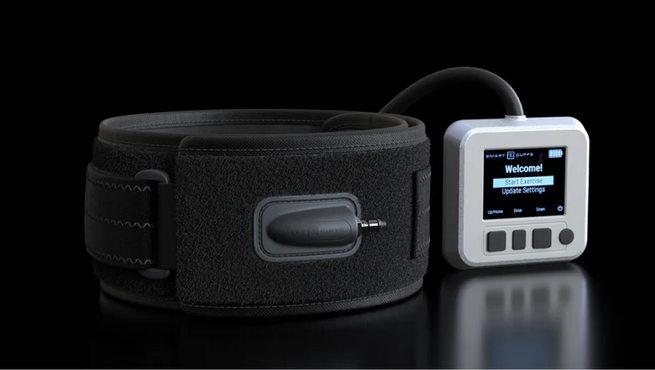
SmartCuffs fits a tactical program because it measures each operator's LOP in about 30 seconds, stores it, re-inflates to that pressure without an app in Quick Start Mode, and runs up to eight cuffs at once in Standalone Mode. A group moves through a block while the coach watches form instead of a phone.
The build is meant for daily use. The battery recharges fully in 30 minutes, the cuffs come in four sizes, and the system carries an emergency pressure release and configurable pressure caps so an administrator can bind what a new user can set. Resting BFR Mode gives an operator who can't load at all a passive low-pressure session. The device is FDA-listed as a Class I pneumatic tourniquet, requires no prescription, and is made in the USA.
Education closes the loop. SmartTools runs a Level 1 BFR certification as live and online courses under its director of education, Ed Le Cara, DC, PhD, ATC, MBA, and the personalized LOP method anchors that curriculum. Putting the unit PT, the athletic trainer, and the strength coach through the same course gives a program one standard across the rehab room and the weight room.
Bringing BFR into a tactical program comes down to evidence, equipment, and education. If your team is ready to scope it, the SmartCuffs 4.0 Clinical Set covers a group from one case, and the Level 1 BFR certification gives your staff a shared standard for running it.
FAQ
Is BFR training used in the military?
Yes. A 2015 case series reported strength gains in service members with traumatic lower-extremity injuries who could not perform high-resistance exercise, and a 2018 pilot randomized trial at the UK Defence Medical Rehabilitation Centre found significant strength and muscle-size gains in both its low-load BFR arm and its heavy resistance training arm, with no statistically significant difference between the two on any outcome [5][6]. A 2025 UK military trial protocol is now testing 40 percent against 80 percent LOP [4].
Can BFR replace heavy lifting for operators on deployment?
For holding strength when equipment or an injury limits heavy work, it is a practical option. As a blanket replacement for heavy training, no. In a 2026 trial of 60 male tactical personnel, BFR at 50 and 70 percent of one-rep max produced larger performance gains than BFR at 30 percent, and adding cuffs at 70 percent gave no consistent advantage over heavy lifting without them [7]. Only the 70 percent condition included a group training without cuffs, so the trial compares specific load-and-cuff combinations rather than the effect of BFR by itself.
Who should clear a service member before BFR?
A physician, unit physical therapist, or another qualified professional trained in BFR screens and clears the service member before the first session. A history of deep-vein thrombosis, a hereditary clotting tendency, antiphospholipid syndrome, uncontrolled hypertension, or other cardiovascular disease are conditions that call for medical assessment and possible exclusion, and physician clearance is recommended when relative risk factors accumulate [2]. Post-injury cases follow the treating clinician's restrictions.
What load and pressure should tactical athletes use for BFR?
Published guidance for athletic populations sets the load at 20 to 40 percent of one-rep max, with continuous cuff time under 15 minutes on the arms and 20 minutes on the legs [2]. Consensus recommendations set cuff pressure at 40 to 80 percent of the individual's measured limb occlusion pressure, adjusted for cuff width, with the arms at the lower end of that range and the legs at the higher [10]. The 2018 military rehabilitation trial used 30 percent of one-rep max at 60 percent LOP [6]. Applying those percentages requires knowing each person's LOP, which is what SmartCuffs 4.0 measures and stores per user.
How many BFR sessions per week should tactical personnel do?
Two to three sessions per limb per week is the range published guidance supports, with upper and lower body on separate days when BFR is the main stimulus [2]. The 2018 military trial ran twice-daily sessions for three weeks [6], but that was a clinician-supervised inpatient rehabilitation dose and is not a template for a deployed gym or a unit weight room. Keep total cuff time per session under 15 to 20 minutes per limb.
References
- Molloy JM, Pendergrass TL, Lee IE, Chervak MC, Hauret KG, Rhon DI. Musculoskeletal Injuries and United States Army Readiness Part I: Overview of Injuries and their Strategic Impact. Military Medicine, 2020. PubMed 32175566
- Gaviglio C, Cook CJ, Bird SP. Blood Flow Restriction in Athletic Populations, Part 1: Safety Considerations, and Methodological Frameworks. Journal of Functional Morphology and Kinesiology, 2026. PMC13214901
- U.S. Army. Holistic Health and Fitness (H2F). goarmy.com
- Gray L, et al. Efficacy and acceptability of different blood flow restriction training interventions during the rehabilitation of military personnel with lower limb musculoskeletal injuries: protocol for a two-phase randomised controlled trial. BMJ Open, 2025. PMC12107567
- Hylden C, Burns T, Stinner D, Owens J. Blood flow restriction rehabilitation for extremity weakness: a case series. Journal of Special Operations Medicine, 2015. PubMed 25770798
- Ladlow P, Coppack RJ, Dharm-Datta S, Conway D, Sellon E, Patterson SD, Bennett AN. Low-Load Resistance Training With Blood Flow Restriction Improves Clinical Outcomes in Musculoskeletal Rehabilitation: A Single-Blind Randomized Controlled Trial. Frontiers in Physiology, 2018. Frontiers in Physiology
- Hou C, Zhang Z, Zhao Y, et al. The effect of blood flow restriction combined with different resistance training on the improvement of athletic performance in male tactical personnel. Frontiers in Physiology, 2026. PMC13283836
- Li R, et al. Effects of blood flow restriction training on sports performance in athletes: a systematic review with meta-analysis. Journal of Sports Medicine and Physical Fitness, 2024. PubMed 37902798
- Anderson KD, Rask DMG, Bates TJ, Nuelle JAV. Overall Safety and Risks Associated with Blood Flow Restriction Therapy: A Literature Review. Military Medicine, 2022. PubMed 35284924
- Patterson SD, et al. Blood Flow Restriction Exercise: Considerations of Methodology, Application, and Safety. Frontiers in Physiology, 2019. PubMed 31156448
- Abbas MJ, et al. An Automated Technique for the Measurement of Limb Occlusion Pressure During Blood Flow Restriction Therapy Is Equivalent to Previous Gold Standard. Arthroscopy, Sports Medicine, and Rehabilitation, 2022. PubMed 35747637
- Moreno E, Figueroa A, Heath J, Buckner SL. An examination of acute physiological and perceptual responses following blood flow restriction exercise using a traditional research device or novel, automated system. Physiological Measurement, 2024. DOI 10.1088/1361-6579/ad548c
- U.S. Food and Drug Administration. Product Classification: Tourniquet, Pneumatic (KCY). FDA product classification database


