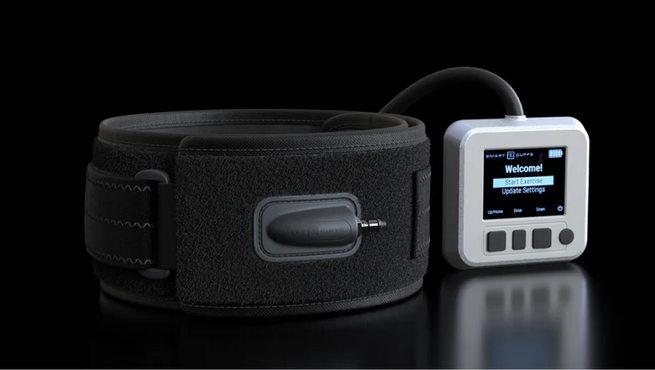



Pre-surgical orthopedic patients are often limited to low loads — not because heavy resistance training is universally contraindicated, but because articular pain, neuromuscular inhibition, and surgeon restrictions frequently make higher loading impractical or poorly tolerated. For patients scheduled for TKR, THR, ACL reconstruction, or rotator cuff repair who cannot complete training at heavier intensities, BFR offers a structured alternative: 20 to 40 percent of 1RM with a metabolic stimulus that, in some studies, produces strength and hypertrophy gains comparable to higher-load training.
The strength lost before surgery compounds the post-surgical muscle atrophy that follows. Patients who arrive at surgery with greater quadriceps strength return to function faster and show better outcomes at six months (Carter et al., 2023, PMID 37296390). For patients whose pain or loading restrictions prevent heavy lifting or conventional resistance training in the 4 to 12 weeks before surgery, a structured BFR prehab program provides a pathway to preserve or build strength at loads they can actually complete.
How BFR Prehab Builds Strength Before Surgery
At 20 to 40 percent of 1RM, a BFR cuff set to 60 to 80 percent of limb occlusion pressure (LOP, the pressure needed to occlude the limb) restricts venous return while maintaining arterial inflow. The resulting metabolite accumulation triggers growth hormone release, satellite cell activation, and cellular swelling that together drive muscle protein synthesis at rates comparable to high-load training. Centner et al. (2019, PMID 30306467) confirmed in a systematic review that BFR training produces strength and hypertrophy gains comparable to high-load resistance training, establishing the evidence base for 20 to 40 percent 1RM as a viable clinical prescription.
The pre-surgical application is supported specifically. A 2025 systematic review by Tiss et al. (PMID 41155865) on BFR training in knee arthroplasty found meaningful improvements in post-operative muscle strength and function. A perioperative BFR program in ACL reconstruction patients at Mayo Clinic produced significant early quadriceps strength improvements and better patient-reported outcomes compared to standard rehabilitation (Okoroha et al., 2023, PMID 38035216). For a full blood flow restriction training overview covering the mechanism and evidence base, the SmartTools primer provides foundational context.
BFR Prehab Protocols by Surgery Type
Protocol parameters are not interchangeable across surgery types. The table below gives the shared framework; the notes below cover what differs per population.
|
Parameter |
TKR |
THR |
ACL Reconstruction |
Rotator Cuff Repair |
|---|---|---|---|---|
|
Load |
20-40% 1RM |
20-40% 1RM |
20-40% 1RM |
20-40% 1RM |
|
Rep scheme |
30-15-15-15 |
30-15-15-15 |
30-15-15-15 |
30-15-15-15 |
|
Rest intervals |
30-45 sec |
30-45 sec |
30-45 sec |
30-45 sec |
|
Frequency |
3x/week |
3x/week |
3x/week |
3x/week |
|
Duration |
4-12 weeks pre-op |
4-12 weeks pre-op |
4-12 weeks pre-op |
4-12 weeks pre-op |
|
Cuff placement |
Proximal thigh |
Proximal thigh |
Proximal thigh |
Proximal upper arm |
|
Cuff pressure |
60-80% of LOP |
60-80% of LOP |
60-80% of LOP |
40-50% of LOP |
TKR: Target quadriceps strengthening and quad-to-hamstring symmetry. Exercise selection: leg press, knee extension, straight-leg raise. Avoid terminal knee extension if medial compartment loading pain is present. TKR candidates frequently present with bilateral deficits; consider bilateral BFR therapy sessions where the non-operative side has lost significant muscle mass. See BFR for knee rehab for the full post-op protocol.
THR: Target hip abductor strengthening and quadriceps preservation. Exercise selection: hip abduction, clamshell with resistance, short-arc leg press. Avoid deep flexion beyond 90 degrees and adduction across midline. THR candidates carry a higher comorbidity burden; screen for peripheral vascular disease, uncontrolled hypertension, and coagulopathy before initiating.
ACL Reconstruction: Target quadriceps strength and quad-to-hamstring symmetry. Pre-operative quad strength is a consistently identified predictor of post-operative function and return to sport (Carter et al., 2023, PMID 37296390). A quad symmetry index below 80 percent at the time of surgery is associated with delayed return to sport. Exercise selection: leg press, straight-leg raise, hamstring curl, single-leg balance progressions. See BFR for ACL rehabilitation for the post-surgical phase.
Rotator Cuff Repair: Upper extremity LOP is lower than lower extremity LOP; do not apply the 60 to 80 percent lower extremity parameter to upper extremity BFR. Target rotator cuff muscle activation and scapular stabilizer strengthening. Exercise selection: external rotation, internal rotation, side-lying abduction, prone Y/T/W. Avoid overhead loading where subacromial impingement is active. Patients with large-to-massive tears may require working at the lower end of the 20 to 40 percent range or supplementing with BFR-assisted isometric loading.
Choosing a BFR Cuff System for Pre-Surgical Patients
Two clinical gates narrow the field: peer-reviewed LOP validation against the Doppler ultrasound gold standard, and FDA Class 1 device listing under product code KCY. Only two systems pass both: SmartCuffs and Delfi PTS. Airbands failed published LOP validation and is not FDA-listed. Suji holds FDA listing but has no published peer-reviewed LOP validation study. For a full BFR training safety overview covering patient selection and contraindications, the SmartTools safety resource provides the clinical framework.
|
Feature |
SmartCuffs |
Delfi PTS |
Airbands by Saga |
Suji |
|---|---|---|---|---|
|
Peer-Reviewed LOP Validation |
✓ |
✗ |
||
|
Clinical-Grade LOP Repeatability |
✓ |
✓ |
✗ |
✗ |
|
Medical Grade Materials |
✓ |
✓ |
✗ |
✗ |
|
Multi-Cuff Capability |
✓ |
✗ |
✓ |
✓ |
|
Quick Start Mode (app-free) |
✓ |
✗ |
✗ |
✗ |
|
Free App (core features don’t require a subscription) |
✓ |
✗ |
✓ |
✓ |
|
FDA-Listed* |
✓ |
✓ |
✗ |
✓ |
|
Purpose-Built for BFR |
✓ |
✗ (retrofitted) |
✓ |
✓ |
|
Made in USA |
✓ |
✗ (Canada) |
✗ (China) |
✗ (China) |
|
Price Range |
$499–$1,699 |
$5,000+ |
$388-$1346 |
<$500 |
Note: Delfi comparison is based on publicly available clinical and regulatory information.
Use Cases
Multiple studies show BFR can promote hypertrophy and reduce mechanical and joint load during exercise, making it a valuable clinical tool for pre- and post-surgical rehabilitation, chronic pain management, and return-to-sport progressions where heavy loading is contraindicated or not yet appropriate.
|
Use Case |
Recommended Product |
Why |
|---|---|---|
|
Osteoarthritis patients awaiting joint replacement |
Advanced OA candidates for TKR or THR often cannot tolerate heavy loading in the weeks before surgery; low-load BFR delivers a meaningful strength stimulus without the joint stress, preserving muscle heading into the operation. |
|
|
Pre-op strength and symmetry building (e.g., ACL reconstruction candidates) |
Pre-operative quadriceps strength and quad-to-hamstring symmetry predict post-surgical function and return to sport; stored LOP profiles hold a consistent pressure prescription across the full pre-op program and carry into post-op rehab on the same profile. |
|
|
Budget-constrained practices |
For organizations or individual practitioners seeking a clinically validated BFR system at a lower price point, SmartCuffs® 3.0 delivers the same personalized LOP detection as the 4.0 at a reduced cost. |
|
|
High-risk patients |
Delfi PTS |
For high-risk patients with complex comorbidities in a hospital or surgical setting, Delfi may be appropriate where institutional procurement requirements or physician preference dictate a higher-cost solution. |
Why SmartCuffs 4.0 for PT Clinic Prehab Programs
SmartCuffs® 4.0 is used in over 10,000 U.S. clinics, including Mayo Clinic, Cleveland Clinic, Rush, and Hospital for Special Surgery. For a physical therapy practice building a structured BFR prehab program, the distinguishing feature is Standalone Mode: up to 8 cuffs operating simultaneously after LOP calibration, without requiring the clinician to stay connected to the app. A single physical therapist can run four patients using two cuffs each, all in parallel. No other BFR cuff system currently matches this concurrent capacity, and for practices offering BFR prehab as a programmatic service, that throughput is what makes the service economically viable. The SmartCuffs® 4.0 Clinical Set is the configuration built for group clinical programs.
For practices where upfront cost is the primary constraint, SmartCuffs® 3.0 is the budget-appropriate option, sharing the core validated LOP technology without the 8-cuff Standalone Mode.
For a fuller list of conditions BFR can help treat beyond post-surgical contexts, see the SmartTools clinical resource.
Browse all SmartCuffs options to compare configurations before purchasing. For individual help matching a configuration to your practice volume and patient mix, use the SmartTools cuff selector or reach out to the clinical team directly.
FAQ
What is BFR prehab and how does it work?
BFR prehab uses blood flow restriction cuffs to deliver a meaningful strength stimulus at 20 to 40 percent of 1RM, loads most surgical candidates can complete. The cuff restricts venous return while maintaining arterial blood flow, generating metabolite accumulation that drives muscle protein synthesis at rates comparable to high-load training. Patients scheduled for TKR, THR, ACL reconstruction, and rotator cuff repair are the primary candidates.
Does BFR prehab improve post-surgical outcomes?
Yes. A systematic review on BFR in knee arthroplasty found meaningful improvements in post-operative muscle strength and function (Tiss et al., 2025, PMID 41155865). Patients who complete BFR prehab arrive with higher pre-operative strength reserves, shortening the post-surgical deficit recovery phase.
Is BFR safe for pre-surgical patients with comorbidities?
BFR is generally safe for pre-surgical patients without active vascular contraindications. Absolute contraindications include active DVT, active peripheral vascular disease, and open wounds in the cuff zone. For patients with severe cardiac or vascular comorbidities, Delfi PTS in a hospital setting is the appropriate choice. See the BFR training safety overview for the full contraindication protocol.
How far out from surgery should a PT start BFR prehab?
The evidence-supported window is 4 to 12 weeks pre-operatively. Beginning 8 to 12 weeks out maximizes cumulative training volume. Even 2 to 4 weeks of consistent BFR prehab produces measurable strength differences compared to no pre-surgical training, making early referral worth pursuing regardless of how close the surgery date is.
What cuff system is best for PT clinics running BFR prehab programs?
SmartCuffs® 4.0: peer-reviewed LOP validation, FDA Class 1 listing under product code KCY, Standalone Mode supporting up to 8 concurrent cuffs, 30-minute full recharge, no subscription for core features. For budget-constrained practices, SmartCuffs® 3.0 shares the core LOP validation technology at a lower entry price.
What are the contraindications for BFR in pre-surgical patients?
Absolute contraindications: active DVT, open wounds in the cuff zone, compartment syndrome history, severe peripheral arterial disease. Relative contraindications requiring clinical judgment: controlled hypertension, pregnancy, lymphedema, sickle cell trait, coagulopathy. LOP must be measured individually per patient per session; do not apply a fixed pressure target across a pre-surgical population with elevated comorbidity burden.
How does BFR prehab build muscle without heavy loads?
BFR prehab builds muscle through metabolic stress rather than the mechanical load that drives muscle growth in conventional resistance training. At 20 to 40 percent of 1RM, a correctly applied cuff restricts venous return while maintaining arterial blood flow, causing metabolite accumulation — lactate, hydrogen ions, inorganic phosphate — that replicates the intramuscular environment of heavier training. The resulting hormonal and cellular response, including growth hormone release and satellite cell activation, supports muscle growth at loads that impose minimal joint stress on compromised tissue.
For pre-surgical patients, that separation between load and stimulus is what makes BFR clinically useful. Low load resistance training without BFR at the same 20 to 40 percent range does not generate sufficient metabolic stress to drive meaningful adaptation. The cuff is what closes the gap — turning a load most surgical candidates can tolerate into a training stimulus capable of preserving or building muscle mass in the weeks before surgery.
Is BFR safe for patients concerned about blood clots?
Active DVT is an absolute contraindication for BFR. For patients without active vascular pathology, the evidence does not show that BFR meaningfully elevates blood clot risk beyond what is already present with low load exercise in a pre-surgical population. A 2019 review by Patterson et al. found no clinically significant increase in DVT incidence with properly applied BFR protocols (PMC6389769). That said, pre-surgical patients carry elevated baseline coagulation risk; screen for coagulopathy and recent immobility before initiating, and apply LOP individually per patient rather than using a fixed pressure target across the group.
Why does low load resistance training with BFR build muscle when regular low load exercise does not?
Low load resistance training without BFR, performed at 20 to 40 percent of 1RM with normal blood flow, does not generate sufficient metabolic stress to drive meaningful muscle growth. BFR changes that equation by restricting venous return while maintaining arterial blood flow, causing metabolite accumulation — lactate, hydrogen ions, inorganic phosphate — that replicates the intramuscular environment of high-load training. The result is increased growth hormone release, satellite cell activation, and cellular swelling that together support muscle growth at loads that impose minimal joint stress. That combination — low mechanical load, high metabolic stress — is what makes BFR clinically useful for patients who cannot tolerate heavier training before surgery.
References
- Tiss B, et al. (2025). Blood Flow Restriction Training in Knee Arthroplasty: A Systematic Review of Current Evidence on Postoperative Muscle Strength and Function. Medicina. PMID 41155865
- Okoroha KR, et al. (2023). Effects of a Perioperative Blood Flow Restriction Therapy Program on Early Quadriceps Strength and Patient-Reported Outcomes After Anterior Cruciate Ligament Reconstruction. Orthopaedic Journal of Sports Medicine. PMID 38035216
- Centner C, Wiegel P, Gollhofer A, König D. (2019). Effects of Blood Flow Restriction Training on Muscular Strength and Hypertrophy in Older Individuals: A Systematic Review and Meta-Analysis. Sports Medicine. PMID 30306467
- Carter HM, Lewis GN, Smith BE. (2023). Preoperative predictors for return to physical activity following anterior cruciate ligament reconstruction: a systematic review. BMC Musculoskeletal Disorders. PMID 37296390
- Abbas MJ, Dancy ME, Marigi EM, et al. (2022). An Automated Technique for the Measurement of Limb Occlusion Pressure During Blood Flow Restriction Therapy Is Equivalent to Previous Gold Standard. Arthroscopy, Sports Medicine, and Rehabilitation. PMID 35747637
- Patterson SD, et al. (2019). Blood flow restriction exercise: considerations of methodology, application, and safety. Frontiers in Physiology. PMC6389769

