


A collegiate strength coach faces a recurring problem: preserving strength and muscle mass when heavy loading isn't practical. In-season contact limits, road trips, and game fatigue push intense lifting to the bottom of the priority list, right when holding onto off-season gains matters most.
That problem is part of why blood flow restriction has seen growing use in both rehab and performance settings, including collegiate weight rooms. When heavy loading isn't an option, BFR can give a coach a way to apply a meaningful hypertrophy and strength-maintenance stimulus at lighter loads, fitting between competitions without drawing on recovery athletes need for Saturday.
For a CSCS coach, this typically means programming light-load work, often 20 to 30 percent of one-rep max, with calibrated cuffs applying a set limb occlusion pressure. Coaches use it for in-season maintenance, deload weeks, and return-to-play work coordinated with sports medicine. Doing it well takes scope clarity, enough cuffs for the roster, and training in safe pressure application [1].
What does the evidence say about BFR for athletic performance?
The performance literature has caught up to the rehab research, though the picture is mixed rather than uniformly positive. Recent reviews suggest BFR can improve strength, muscle size, and some performance markers in athletes, although results vary by outcome and study design [1][11]. A 2021 systematic review found that most included studies reported strength gains, roughly half reported muscle-size gains, and most reported sport-specific performance gains in healthy athletes [11]. A 2024 meta-analysis found significant improvements in vertical jump and VO2max, but not sprint time [1]. A separate 2024 meta-analysis found no significant advantage of BFR plus exercise over exercise alone for athletic performance, muscle strength, or hypertrophy overall, underscoring that the literature is still mixed [12].
What makes this usable for a coach is the load comparison rather than a claim of superiority. Low-load BFR can produce meaningful strength and muscle adaptations, though heavy loading still tends to outperform it for maximal strength in direct comparisons [3][4]. For a roster managing fatigue and contact limits, a light session can support strength rather than replace heavy training entirely — a balance covered in more depth in this evidence overview.
How CSCS coaches integrate BFR into a collegiate program
BFR isn't a separate program; it's a tool you slot into the plan you already run. The cleanest way to think about it is by use case, with a clear line between what the strength staff owns and what the medical staff owns. The table below maps where it fits.
|
Use case |
Who owns it |
Coordination |
|
In-season maintenance |
Strength staff |
Programmed around game and practice load |
|
Deload and travel weeks |
Strength staff |
Light sessions, minimal equipment |
|
Healthy-athlete hypertrophy |
Strength staff |
Standard screening |
|
Return-to-play |
Sports medicine leads, strength supports |
Physician and PT clear the athlete; coach runs progressive load |
For programming, BFR is commonly applied with low loads, often in the range of 20 to 30 percent of one-rep max, short rest intervals, multiple sets to accumulate a meaningful number of total reps, and individualized limb occlusion pressure rather than a fixed number across athletes. Cuff time and pressure should follow the specific device's protocol and the coach's certification training rather than a generic rule of thumb.
Movement selection is usually basic, since the goal is efficient stimulus and recovery management rather than introducing new movement patterns; this library of best exercises for blood flow restriction training gives reliable options per limb. On return-to-play, the medical team owns clearance and progression decisions, with the coach supporting under that direction. The American Academy of Orthopaedic Surgeons references BFR in rehabilitation guidance for procedures like ACL reconstruction, which underlines why that work is a coordinated medical decision rather than something a strength coach manages independently [7].
Equipment for a full roster: what a collegiate program needs
A clinic might run BFR on one patient at a time. A college program cannot. The deciding factors for a roster are how many athletes you can run at once, how fast you can set up, and whether the pressure is calibrated to each athlete rather than guessed, which points to multi-cuff systems with stored profiles instead of single-pair consumer kits.
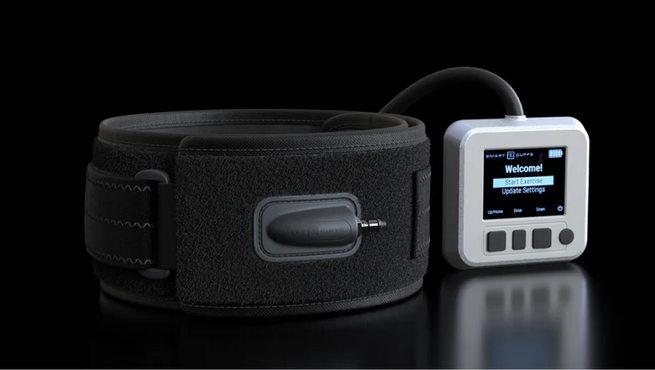
The SmartCuffs 4.0 Standalone Mode runs up to eight cuffs at once, so a training room can move a position group through maintenance during camp or post-game recovery blocks. Quick Start Mode re-inflates each athlete to their stored limb occlusion pressure without opening an app, and pressure accuracy isn't a guess: an independent 2022 study found the SmartCuffs automated reading equivalent to the Doppler ultrasound gold standard across 96 measurements [6]. For a department equipping a roster, the SmartCuffs 4.0 Clinical Set packages eight cuffs across four sizes so you can fit arms and legs across a varied roster from one case.
Do strength coaches need a BFR certification?
A CSCS doesn't automatically cover BFR application, and the skill that matters most, setting and verifying safe pressure, is exactly where untrained use goes wrong. Certification is useful here because BFR carries real safety and dosing considerations: limb occlusion pressure, contraindication screening, cuff placement, and progression are skills that need to be taught and practiced, not assumed.
SmartTools runs Level 1 and Level 2 BFR certification, and its director of education, Dr. Ed Le Cara, holds the CSCS credential along with a doctorate and athletic-training certification, so the instruction speaks the language a strength coach already uses [8]. Getting certified also helps clarify scope: what the strength team can run independently, and where the medical team needs to lead. If your staff is bringing BFR in-house, Level 1 and Level 2 BFR certification is one path to building that competency.
Who clears athletes for BFR in a collegiate setting?
A college setting needs clear roles around who screens, who clears, and who programs. The strength staff programs training load; the sports-medicine staff owns medical clearance, screening, and any post-surgical case. Drawing that line up front keeps athletes safe and keeps coaches inside their scope.
For healthy, previously screened athletes, a trained BFR practitioner or designated strength staff member can typically oversee sessions. New users, athletes returning after a long break, or anyone with a recent injury, illness, or surgery should complete a screening questionnaire first, and some will need medical review before proceeding. Absolute contraindications, including peripheral vascular disease, prior vascular surgery to the affected limb, and an arteriovenous fistula in the affected limb, route the athlete to medical clearance rather than the strength staff; conditions such as hypertension, a history of blood clots, clotting disorders, stroke, or neuropathy also require medical review before clearance [5][9]. Any athlete returning from surgery follows their surgeon's and physical therapist's clearance, not a generic protocol.
Bringing BFR into a collegiate weight room comes down to evidence, equipment, and education. If your program is ready to start, the SmartCuffs 4.0 Clinical Set and a certification course give a staff both halves of what they need.
Frequently Asked Questions
Is BFR safe for healthy athletes?
BFR is generally well tolerated in healthy, properly screened athletes when pressure is calibrated and cuffs are placed high on the limb. During sessions, the cuff should feel tight without erasing the pulse below it; any numbness or sharp pain means stopping and reassessing. Used this way, with calibrated cuffs, proper screening, and a coordinated staff, BFR carries a generally favorable safety profile, though high-quality long-term safety data are still limited and adverse events may be underreported in the literature.
Who is responsible for clearing an athlete to use BFR?
For healthy, previously screened athletes, a trained BFR practitioner or designated strength staff member can typically oversee sessions within institutional policy. Athletes with medical risk factors, recent injury, or post-surgical status need clearance from the sports-medicine team, with the physician and physical therapist setting the timeline and the strength coach supporting load progression once cleared. Defining that line up front is part of why certification matters.
What BFR certification do strength coaches get?
SmartTools offers Level 1 and Level 2 BFR certification covering limb occlusion pressure, contraindication screening, cuff placement, and programming. Its director of education holds the CSCS credential, so the material is built for coaches as well as clinicians. Certification gives a strength staff a documented, consistent standard for how BFR is applied across a roster.
How many BFR cuffs does a college team need?
It depends on roster size and how you run sessions, but multi-cuff systems are the practical choice. The SmartCuffs 4.0 Standalone Mode supports up to eight cuffs at once, which lets a training room move a position group through maintenance or recovery without recalibrating between athletes. The Clinical Set packages eight cuffs across four sizes for a varied roster.
Is BFR allowed under NCAA rules?
BFR is a training and rehabilitation method, not a banned substance or supplement, so it's used openly in many collegiate programs. That said, any specific compliance question should go to your institution's athletics compliance and sports-medicine staff, since policies and clearance procedures vary by school. Treat it like any other staff-supervised training tool.
How does BFR fit return-to-play?
In return-to-play, the medical team leads and the strength staff supports. BFR is valuable here because it lets an athlete keep training the limb at light loads while tissue heals, maintaining muscle that would otherwise atrophy. Orthopaedic rehabilitation guidance references BFR for procedures such as ACL reconstruction, but clearance and progression are a coordinated decision, not the coach's call alone [7].
References
- Li R, et al. Effects of blood flow restriction training on sports performance in athletes: a systematic review with meta-analysis. Journal of Sports Medicine and Physical Fitness, 2024. PubMed 37902798
- Wang X, et al. Effects of Resistance Training with Blood Flow Restriction on Explosive Power of Lower Limbs: A Systematic Review and Meta-Analysis. Journal of Human Kinetics, 2023. PubMed 38053964
- Lixandrão ME, et al. Magnitude of Muscle Strength and Mass Adaptations Between High-Load and Low-Load Resistance Training Associated with Blood-Flow Restriction. Sports Medicine, 2018. PubMed 29043659
- Hughes L, et al. Blood flow restriction training in clinical musculoskeletal rehabilitation: a systematic review and meta-analysis. British Journal of Sports Medicine, 2017. PubMed 28259850
- Patterson SD, et al. Blood Flow Restriction Exercise: Considerations of Methodology, Application, and Safety. Frontiers in Physiology, 2019. PubMed 31156448
- Abbas MJ, et al. An Automated Technique for the Measurement of Limb Occlusion Pressure During Blood Flow Restriction Therapy Is Equivalent to Previous Gold Standard. Arthroscopy, Sports Medicine, and Rehabilitation, 2022. PubMed 35747637
- Blood Flow Restriction Therapy in Orthopaedic Rehabilitation. AAOS Now, American Academy of Orthopaedic Surgeons, June 2023. AAOS Now
- Certified Strength and Conditioning Specialist (CSCS). National Strength and Conditioning Association. NSCA
- Overall Safety and Risks Associated with Blood Flow Restriction Training: A Literature Review. Military Medicine, 2022. Military Medicine
- Yang K, et al. Effects of blood flow restriction training on physical fitness among athletes: a systematic review and meta-analysis. Scientific Reports, 2024. PMC11258269
- Wortman RJ, et al. Blood Flow Restriction Training for Athletes: A Systematic Review. American Journal of Sports Medicine, 2021. PubMed 33196300
- Khurana D, et al. Blood flow restriction therapy with exercise are no better than exercise alone in improving athletic performance, muscle strength, and hypertrophy: a systematic review and meta-analysis. Somatosensory and Motor Research, 2024. PubMed 36825612


