


A patient six weeks out from rotator cuff repair has a tendon that still can't take real load and a shoulder that has been losing muscle since the day of surgery. The surgeon's restrictions protect the repair, but they do nothing to slow the atrophy happening around it.
That gap between tissue healing and muscle conditioning is the central problem in rotator cuff rehab, and it isn't limited to surgical patients. A partial tear managed conservatively has its own load ceiling, set by symptoms and the risk of progression. Blood flow restriction training, or BFR, is one of the few tools that lets physical therapists work on muscle inside that window, because it produces a hypertrophic stimulus at loads around 20 to 30 percent of one-rep max (Patterson et al., 2019).
This guide covers where BFR fits in post-operative and conservative shoulder rehabilitation for rotator cuff patients, what to look for in a cuff system for upper-extremity work, and how four common devices compare.
Why is rotator cuff rehab harder to load than other shoulder conditions?
BFR fits into the restricted-loading phases of a post-op protocol, once the surgeon clears it, and it carries through the transition to active strengthening. It gives the working muscle a growth stimulus at loads the repair can tolerate. Exact timing depends on tear size, tissue quality, and the surgeon's protocol, so the start point is set case by case.
Blood flow restriction (BFR) therapy works through the same mechanism at the shoulder as it does elsewhere in the body. Cuff pressure at the proximal upper arm partially restricts arterial inflow and occludes venous outflow. This creates a hypoxic, metabolically stressed environment in the working muscle, which increases Type II fiber recruitment and cellular swelling at low loads. These are signals associated with muscle growth under heavy loading (Patterson et al., 2019).
The evidence base for BFR after upper-extremity surgery is thinner than it is for the knee. A systematic review and meta-analysis of BFR in clinical musculoskeletal rehabilitation found that low-load BFR improved muscle strength more than low-load resistance training alone. Most of the included populations were lower-limb, so clinicians are applying the same mechanism to the shoulder rather than drawing on a large body of shoulder-specific trials.
Before each session, the clinician measures limb occlusion pressure (LOP) at the proximal upper arm. LOP is any pressure needed to occlude the limb. Calibrated cuffs inflate to a percentage of limb occlusion pressure (LOP), then set the working stimulus. Upper-limb protocols generally sit toward the lower end of the 40 to 80 percent range described in the position stand. LOP varies between patients with limb circumference, blood pressure, and body composition, so a fixed-pressure approach can't deliver a consistent stimulus across a mixed caseload.
Most sessions use four sets of 30, 15, 15, and 15 repetitions with 30-second rests between sets (Patterson et al., 2019). In the early restricted phase, that often means isometrics within the patient's range-of-motion limits. External and internal rotation work follows as the ROM protocol advances. Deflating the cuff between exercises keeps total restriction time manageable, which helps in a session that also has to fit in ROM work and manual therapy.
How is BFR used for rotator cuff tears managed without surgery?
For conservatively managed partial tears and degenerative cuff disease, BFR uses the same low-load protocol as post-op rehab. The reason for it is different, though. The goal is to avoid high tensile stress on intact cuff fibers rather than to protect a repaired tendon. Patients are screened for contraindications first, and BFR is used under a qualified clinician's supervision.
Load management for partial tears. High-resistance shoulder work is often avoided early in partial-tear management because it places tensile stress on the remaining cuff fibers or aggravates impingement symptoms. BFR creates the metabolic conditions for muscle adaptation at 20 to 30 percent of one-rep max, well below the tensile loads of conventional strength work.
Degenerative cuff disease in older adults. Patients over 60 with degenerative partial tears often start with less muscle mass. Aging muscle also tends to respond less to low-load exercise, a pattern called anabolic resistance. That combination is part of the reason clinicians use low-load BFR with this group, which already has a load ceiling and a blunted response to light work.
Screening. Candidates are screened by a qualified professional before BFR begins. Contraindications to upper-extremity limb compression include clotting disorders or a history of DVT, peripheral arterial disease, certain cardiovascular conditions, pregnancy, open wounds at the cuff site, and recent vascular surgery in the limb.
What do BFR shoulder exercises look like in practice?
Ed Le Cara, DC, PhD, MBA, ATC, CSCS, SmartTools' Director of Education, walks through a set of BFR shoulder exercises in a short demo. Most shoulder BFR sessions pair pressing, rowing, and rotational patterns at light resistance.
For post-op patients, we recommend consulting your physical therapist before adding any exercises to your routine.
What should PT clinics look for in a BFR cuff system for rotator cuff rehab?
For shoulder work, four things matter most. The device's peer-reviewed LOP evidence should include the upper extremity. It needs arm cuff sizes that cover the adult range, and it should be FDA-listed under product code KCY. It also needs enough multi-patient capacity to handle a post-surgical caseload.
LOP evidence that includes the upper extremity. Not every validation study on a BFR device covered upper-extremity measurement. Before buying for a practice that treats shoulder patients, check whether the device's published evidence includes arm measurements, not only leg measurements.
Specialized cuff sizing for the arm. Rotator cuff BFR places the cuff on the proximal upper arm. A system with a single arm cuff size won't fit part of a general orthopedic caseload, so look for arm sizing that covers the practical range of adult arm circumference.
FDA listing under product code KCY. Clinical BFR systems are listed with the FDA as Class I pneumatic tourniquets under product code KCY. "FDA-listed" is the accurate term; listing is not the same as FDA approval or clearance.
Multi-patient capacity. A post-surgical shoulder clinic often has several rotator cuff patients in the same session block. A system that lets the clinician measure LOP, set working pressure, and move on to the next patient has a direct effect on daily throughput.
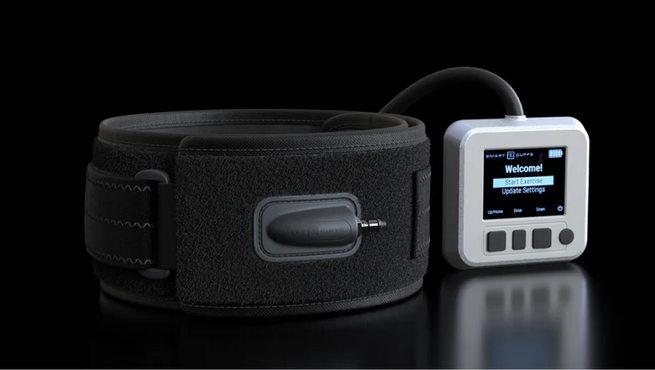
SmartCuffs 4.0 addresses all four points. It offers upper-extremity cuff sizing, FDA listing under KCY, and Standalone Mode for up to eight cuffs at once. Its LOP measurement technology is similar but not identical to the SmartCuffs PRO, the device studied for upper- and lower-extremity accuracy.
How do SmartCuffs 4.0, Delfi PTS, Airbands by Saga, and Suji compare?
|
Feature |
SmartCuffs 4.0 |
Delfi PTS |
Airbands by Saga |
Suji |
|
Peer-Reviewed LOP Validation |
✓ |
✗ |
||
|
Clinical-Grade LOP Repeatability |
✓ |
✓ |
✗ |
✗ |
|
Medical Grade Materials |
✓ |
✓ |
✗ |
✗ |
|
Multi-Cuff Capability |
✓ (up to eight cuffs, Standalone Mode) |
✗ |
✓ (two cuffs) |
✓ (two cuffs) |
|
Quick Start Mode (app-free) |
✓ |
✗ |
✗ |
✗ |
|
Free App (core features do not require a subscription) |
✓ |
✗ |
✓ |
✓ ($5 per month for guided programs; full access is free to verified PTs and trainers) |
|
FDA-Listed* |
✓ |
✓ |
✗ |
✓ |
|
Purpose-Built for BFR |
✓ |
✗ (retrofitted) |
✓ |
✓ |
|
Made in USA |
✓ |
✗ (Canada) |
✗ (China) |
✗ (China) |
|
Price Range |
$499 to $1,699 |
$5,000+ |
$440 to $1,780 |
<$500 |
Delfi comparison is based on publicly available clinical and regulatory information.
Why SmartCuffs 4.0 for rotator cuff rehabilitation
SmartCuffs 4.0 is built for the requirements this guide lays out. The LOP method behind it has published upper-extremity accuracy data, its arm cuffs fit the upper arm, and Standalone Mode lets one clinician run several shoulder patients in the same block.
Upper-extremity evidence behind the LOP method. The personalized LOP method was studied in a 2022 study in Arthroscopy, Sports Medicine, and Rehabilitation, which found automated LOP measurement on the SmartCuffs PRO equivalent to the Doppler ultrasound gold standard on both the upper extremity (P=.29) and the lower extremity (P=.09) across 96 limbs. A 2024 study in Physiological Measurement compared acute physiological and perceptual responses to BFR exercise using a traditional research device and a novel automated system. SmartCuffs 4.0 uses similar but not identical automated LOP measurement technology to the PRO. Clinicians evaluating the 4.0 for a shoulder protocol can confirm generation-to-generation continuity with SmartTools directly.
Arm cuff fit. SmartCuffs 4.0 arm cuffs are sized for proximal upper-arm placement. The cuffs use a neoprene lining and a 100% urethane air bladder that inflates like a gel around the limb. That construction matters on a post-op shoulder patient who is already guarding the arm.
Standalone Mode for post-surgical volume. Standalone Mode runs up to eight cuffs at once. After each patient's LOP is measured and working pressure is set, the cuffs run without the app, so the clinician can move on to the next patient while still supervising the room. App-free Quick Start Mode re-inflates to each user's stored pressure for the next session.
No subscription. Core app features don't require a subscription, so adding BFR to a post-surgical protocol carries no monthly cost.
SmartTools states on its site that SmartCuffs is used in more than 10,000 U.S. clinics, including Mayo Clinic, Cleveland Clinic, Rush, and Hospital for Special Surgery.
Which device fits which rotator cuff patient?
|
Clinical context |
Recommended device |
Rationale |
|
Post-op rotator cuff repair |
Upper-extremity cuff sizing and Standalone Mode for post-surgical session volume. Its LOP technology is similar but not identical to the PRO studied for upper-extremity accuracy. |
|
|
Conservative management of partial tears |
Personalized LOP measurement for a mixed-age outpatient caseload; FDA-listed. |
|
|
Degenerative cuff disease, older adults |
Per-session LOP measurement for a low-load protocol in a population with varied limb and vascular profiles. |
|
|
Medically complex patients (cardiac history, PVD) |
Delfi PTS |
Autoregulation feature positioned for high-risk patients; reserve for this narrow population. |
|
Budget-constrained solo practitioner |
Custom per-patient pressure at a lower price than the 4.0 Clinical Set. |
What's the takeaway for rotator cuff BFR?
Post-op or conservative, rotator cuff rehab comes with weeks of restricted loading while the shoulder deconditions. BFR is used to give the muscle a growth stimulus during that window at loads the tissue can tolerate, under clinical supervision and after screening. The device choice follows three criteria: LOP evidence that includes the upper extremity, FDA listing, and enough capacity for the practice's shoulder caseload.
For clinics building BFR into shoulder protocols, SmartTools brings together evidence, equipment, and education. That means the personalized LOP method studied in peer-reviewed research, SmartCuffs 4.0 for upper-extremity rehab, and the Level 1 BFR certification for clinicians who want a protocol they can use on Monday morning.
Browse all SmartCuffs® options to compare configurations before purchasing. For individual help matching a configuration to your practice volume and patient mix, use the SmartTools cuff selector or reach out to the clinical team directly.
Frequently asked questions: BFR for rotator cuff rehabilitation
Is BFR safe after rotator cuff surgery?
BFR can be used after rotator cuff repair once the surgeon clears it and a qualified professional has screened the patient. Contraindications include clotting disorders or a history of DVT, peripheral arterial disease, certain cardiovascular conditions, pregnancy, open wounds at the cuff site, and recent vascular surgery in the limb. BFR isn't appropriate for every patient, and it's used under clinical supervision.
When can BFR start after rotator cuff repair?
The start point is set by the surgeon's protocol, which depends on tear size and tissue quality. Many clinicians introduce BFR during the restricted-loading phases and continue it through the transition to active strengthening. That is the window when the repair can't yet tolerate conventional loading and the muscle benefits from a low-load stimulus.
Does BFR work for rotator cuff injuries without surgery?
BFR is used for conservatively managed partial tears and degenerative cuff disease with the same low-load protocol as post-op rehab. Here the aim is to limit tensile stress on the remaining cuff fibers rather than protect a repair. Patients are screened for contraindications first, and evidence on low-load BFR in clinical rehab suggests it helps build strength at low loads.
What LOP percentage is used for shoulder BFR?
Published guidance describes working pressures of roughly 40 to 80 percent of LOP, and upper-limb protocols generally sit toward the lower end of that range. LOP is any pressure needed to occlude the limb. It's measured at the proximal upper arm before each session because it varies with limb circumference, blood pressure, and body composition.
Can SmartCuffs be used for upper-extremity rotator cuff rehab?
SmartCuffs 4.0 includes arm cuffs for proximal upper-arm placement. The personalized LOP method was studied on the SmartCuffs PRO in a 2022 study that found automated measurement equivalent to Doppler on the upper extremity (P=.29). The 4.0 uses similar but not identical technology, so clinicians can confirm continuity with SmartTools directly.
What is the difference between SmartCuffs 4.0 and 3.0 for rotator cuff rehab?
SmartCuffs 4.0 is the current flagship, with automatic personalized LOP detection and Standalone Mode for up to eight cuffs without the app. SmartCuffs 3.0 uses three fixed intensity presets with no individualized LOP detection. SmartCuffs 3.0 Pro offers custom per-patient pressure at a lower price point than the 4.0 Clinical Set.
How does BFR help with rotator cuff muscle atrophy?
BFR partially restricts arterial inflow and occludes venous outflow at the proximal upper arm. This creates the metabolic conditions for muscle adaptation at loads around 20 to 30 percent of one-rep max. Those loads stay within what a healing or partially torn cuff can tolerate, so muscle work can continue during the restricted phase.
Which BFR cuff is best for post-op rotator cuff rehabilitation?
For a general PT clinic, the practical criteria are LOP evidence that includes the upper extremity, arm cuff sizing, FDA listing under KCY, and multi-patient capacity. SmartCuffs 4.0 meets them with Standalone Mode and no subscription. Delfi PTS is positioned for medically complex patients in hospital-affiliated settings.
Does BFR increase muscle size in the rotator cuff?
Low-load BFR produces muscle adaptation through metabolic stress and increased muscle activation, and clinical rehab evidence supports strength gains compared with low-load training alone. For rotator cuff patients, BFR is used to preserve or rebuild muscle while conventional loading is restricted. Direct measurement of rotator cuff cross-sectional area with BFR is still an open research question.
How does BFR compare to low-load training without restriction for shoulder rehab?
Low-load training without restriction helps with pain, range of motion, and motor control but gives a weaker hypertrophic stimulus. Adding BFR increases muscle activation, particularly Type II fiber recruitment, and adds metabolic stress. When tissue healing or tear tolerance caps the load, that difference matters.
Why does muscle activation matter for rotator cuff rehabilitation?
The rotator cuff compresses and stabilizes the glenohumeral joint during overhead and rotational movement, in addition to moving the arm. Restoring that function means recovering muscle size and the recruitment patterns that coordinate the cuff. A larger muscle that fires poorly doesn't protect the joint the way a well-activated cuff does.
What does FDA-listed mean for a BFR cuff?
SmartCuffs is listed with the FDA as a Class I device under product code KCY (pneumatic tourniquet), the same classification as Delfi PTS and Suji. FDA listing is not FDA approval or clearance. Listing also doesn't mean a buyer needs a prescription or a medical license to purchase the device.
References
-
Abbas MJ, Dancy ME, Marigi EM, Khalil LS, Jildeh TR, Buckley PJ, Gillett J, Burgos W, Okoroha KR. "An Automated Technique for the Measurement of Limb Occlusion Pressure During Blood Flow Restriction Therapy Is Equivalent to Previous Gold Standard." Arthroscopy, Sports Medicine, and Rehabilitation. 2022;4(3):e1127-e1132. PMID 35747637
-
Hughes L, Paton B, Rosenblatt B, Gissane C, Patterson SD. "Blood flow restriction training in clinical musculoskeletal rehabilitation: a systematic review and meta-analysis." British Journal of Sports Medicine. 2017;51(13):1003-1011. PMID 28259850
-
Moreno EN, Figueroa A, Heath EM, Buckner SL. "Acute physiological and perceptual responses to blood flow restriction exercise with a traditional research device and a novel automated system." Physiological Measurement. 2024. DOI 10.1088/1361-6579/ad548c
-
Patterson SD, Hughes L, Warmington S, et al. "Blood Flow Restriction Exercise: Considerations of Methodology, Application, and Safety." Frontiers in Physiology. 2019;10:533. DOI 10.3389/fphys.2019.00533
-
U.S. Food and Drug Administration. Product Classification: Tourniquet, Pneumatic (Product Code KCY). https://www.accessdata.fda.gov/scripts/cdrh/cfdocs/cfPCD/classification.cfm?id=KCY


