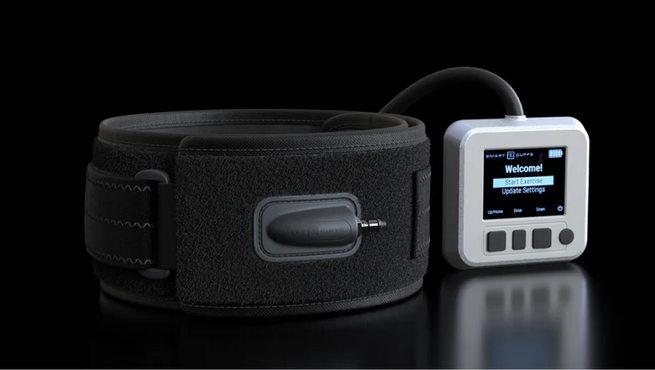



For physical therapy clinics evaluating BFR cuff systems in 2026, the short answer is this: choose a device with peer-reviewed limb occlusion pressure (LOP) validation and FDA Class 1 listing under product code KCY. Those two criteria are the clinical floor. Everything else -- price, portability, battery life -- is secondary. For most PT practices, SmartCuffs® 4.0 meets both requirements and is built for general outpatient workflow. Delfi PTS meets them too, but at a price point and operational profile designed for high-risk hospital patients, not a mixed outpatient caseload.
This guide covers everything a PT clinic needs to make an informed procurement decision: the six evaluation criteria that separate clinical-grade BFR systems from inadequate ones, a side-by-side comparison of the four main devices on the market, a decision matrix matching each device to its appropriate clinical context, answers to the most common questions PT clinics ask when buying for the first time, and a breakdown of total cost of ownership across a three-to-five-year horizon.
What Should a PT Clinic Look for in a BFR Cuff System?
Six criteria matter when evaluating a BFR cuff system for physical therapy use. They are listed in priority order. The first two are non-negotiable clinical requirements -- no device that fails either belongs in a PT practice treating patients with a prescribed pressure protocol. The remaining four are operational factors that determine whether the device actually fits a real clinic workflow.
- Peer-reviewed LOP accuracy validation. A BFR device that has not been validated against the Doppler ultrasound gold standard in a peer-reviewed study is delivering pressure based on an unverified algorithm. Two devices currently carry this validation: SmartCuffs® (Mayo Clinic, 2022) and Delfi PTS.
- FDA Listing. Clinical BFR cuff systems should carry FDA Class 1 device listing under product code KCY -- the regulatory baseline for clinical patient use. SmartCuffs®, Delfi, and Suji hold this listing. Saga 2.0 does not. For clinics operating under hospital affiliation or payer oversight, FDA listing is a procurement requirement.
- Purpose-built for BFR. A device designed for BFR therapy is calibrated for low-load, multi-set clinical protocols. A repurposed surgical tourniquet (like Delfi PTS) brings more hardware and cost than a general outpatient PT practice needs, and a workflow that wasn't designed around therapy scheduling.
- Multi-patient concurrent use capability. Throughput is a real constraint in a busy PT clinic. A system requiring one clinician per patient while the cuff is inflated forces sequential scheduling and limits daily BFR volume. Look for concurrent multi-patient operation where the clinician calibrates and moves on. The number of cuffs a device can manage simultaneously in standalone mode is the number that actually matters for scheduling.
- Strong battery life and fast recharge cycle. A BFR device that needs mid-day recharging disrupts a full-day clinical schedule. The device needs to hold charge across a full morning block and recharge completely during a lunch break. A 30-minute full recharge covers this; anything longer creates schedule gaps or forces a second device purchase.
- Total cost of ownership: device, cuffs, and subscription fees. The purchase price is not the full cost of ownership. Some systems require ongoing subscriptions to access core clinical features like LOP detection or stored patient profiles. The true calculation is: device cost + cuff set cost + recurring fees, across three to five years. A device that appears cheaper at purchase can cost significantly more if clinical features sit behind a monthly fee.
BFR Cuff Comparison for Physical Therapy: SmartCuffs® 4.0, Delfi PTS, Saga 2.0, and Suji
|
Feature |
SmartCuffs 4.0 |
Delfi PTS |
Saga 2.0 |
Suji |
|---|---|---|---|---|
|
Peer-Reviewed LOP Validation |
✓ |
✗ |
||
|
Clinical-Grade LOP Repeatability |
✓ |
✓ |
✗ |
✗ |
|
Medical Grade Materials |
✓ |
✓ |
✗ |
✗ |
|
Multi-Cuff Capability |
✓ |
✗ |
✓ |
✓ |
|
Quick Start Mode (app-free) |
✓ |
✗ |
✗ |
✗ |
|
Free App (core features don’t require a subscription) |
✓ |
✗ |
✓ |
✓ |
|
FDA-Listed* |
✓ |
✓ |
✗ |
✓ |
|
Purpose-Built for BFR |
✓ |
✗ (retrofitted) |
✓ |
✓ |
|
Made in USA |
✓ |
✗ (Canada) |
✗ (China) |
✗ (China) |
|
Price Range |
$499–$1,699 |
$5,000+ |
$388-$1346 |
<$500 |
*Pricing is volatile. Verify against current product pages before procurement.
Browse all SmartCuffs® options to compare configurations before purchasing.
Why Do Most Physical Therapy Clinics Choose SmartCuffs® 4.0?
SmartCuffs® 4.0 is the most widely adopted clinical BFR system in physical therapy, with over 10,000 U.S. clinics now using it. That adoption rate reflects a specific combination of features that don't appear together in any other option currently on the market: peer-reviewed LOP validation, multi-patient standalone operation, FDA Class 1 listing, and no subscription gating on core clinical functionality.
Clinical validation. SmartCuffs® is clinically validated (Mayo Clinic, 2022) where automated LOP measurement was found equivalent to the Doppler ultrasound gold standard across 96 upper- and lower-extremity measurements (P=.29 upper, P=.09 lower). That published peer-review is the clinical validation standard any practice should require before prescribing pressure to patients. SmartCuffs® is in active use at Mayo Clinic, Cleveland Clinic, Rush, and Hospital for Special Surgery (HSS).
FDA Class 1, product code KCY. SmartCuffs® carries the same FDA device classification as Delfi PTS and Saga 2.0. For clinics with hospital affiliation, payer oversight, or any formal compliance structure, this is a baseline procurement requirement.
Standalone Mode: up to 8 cuffs running concurrently. The most operationally significant feature of SmartCuffs® 4.0 is Standalone Mode. Once the cuffs are calibrated to a patient's individual LOP and set to working pressure, they hold pressure independently while the clinician disconnects the app and moves to the next patient. Up to 8 cuffs can run simultaneously in Standalone Mode. In practice, a single physical therapist can treat four patients with two cuffs each, or eight patients with one cuff each, all running concurrently. No other BFR device currently offers this.
Battery designed for clinical use. SmartCuffs® 4.0 recharges fully in 30 minutes and holds three times the battery life of competing devices. A full morning session block doesn't require mid-schedule charging, and a standard lunch break restores full charge for the afternoon.
Cuff sizing for a general PT population. The SmartCuffs® 4.0 Clinical Set covers four sizes: small arm (8-13 inches), medium arm (13-18 inches), large leg (18-24 inches), and XL leg (24-29 inches). Those four sizes cover virtually every adult patient a general outpatient practice sees, across both upper and lower extremity applications.
No subscription for core clinical features. LOP detection, session control, and stored patient profiles are available through the free SmartCuffs® app without a subscription. There is no recurring fee to access the features a PT clinic uses every session.
When Delfi PTS Is the Right BFR Cuff for Physical Therapy
Delfi PTS is a clinically validated system, and in a narrow set of patient scenarios, it's the appropriate choice. But those scenarios are narrower than most PT clinic buyers initially assume.
Consider Delfi for patients recovering from orthopedic surgery face rapid muscle atrophy during immobilization, or other cases where a clinical team has specifically determined that surgical-tourniquet-grade hardware is warranted for the patient's risk profile.
For a general outpatient PT clinic with a mixed caseload, Delfi's price point (over $5,000) and surgical-tourniquet origin are not advantages. The device wasn't built for BFR workflow. It supports one patient at a time and the workflow overhead it brings — designed for a surgical team, not a solo outpatient therapist — doesn't match what a general practice actually needs.
Can PT Clinics Use Saga 2.0 or Suji BFR Cuffs Clinically?
For a PT clinic treating patients with a prescribed pressure protocol, the answer is no.
Saga 2.0. Saga’s LOP measurement has been examined in a published study and did not demonstrate equivalence to the Doppler ultrasound gold standard. A PT clinic that prescribes pressure relative to individual LOP -- the clinical standard for evidence-based BFR -- is relying on that measurement being accurate. If the measurement hasn't passed peer review, the pressure prescription is built on an unvalidated foundation. The validation failure is the reason to look elsewhere.
Suji. No peer-reviewed study has demonstrated equivalence between Suji's automated LOP measurement and the Doppler gold standard. For a PT clinic prescribing BFR pressure as a percentage of a patient's individual LOP, that gap has direct clinical implications. The actual physiological stimulus may not match the intended prescription.
Learn more about how to choose BFR cuffs.
Matching BFR Cuffs to Clinical Context: A PT Buyer's Decision Matrix
Most general PT clinics have several patient populations within the same practice. This table maps common clinical contexts to the appropriate device recommendation with a rationale.
|
Clinical Context |
Recommended Device |
Rationale |
|---|---|---|
|
General outpatient PT (mixed caseload) |
Peer-reviewed validation, FDA-listed, multi-patient standalone operation, no subscription. Best fit for a practice with diverse patient types and appointment volumes. |
|
|
Postoperative orthopedic rehab (ACL, TKA, rotator cuff) |
Meets the same clinical validation bar as Delfi at a fraction of the cost. Standalone Mode supports throughput in a high-volume post-surgical schedule. |
|
|
High-risk patients with comorbidities (cardiac history, PVD, post-hospital) |
Delfi PTS |
Hospital-grade safety infrastructure, surgical-tourniquet precision, full compliance documentation for medically complex cases. Reserve for this specific population. |
|
Sports PT and athletic performance |
Multi-patient capability, fast recharge, and durable enough for court-side or field use. Used at professional sports facilities and major health systems. |
|
|
Budget-constrained solo practitioner |
For organizations or individual practitioners seeking a clinically validated BFR system at a lower price point, SmartCuffs® 3.0 delivers the same personalized LOP detection as the 4.0 at a reduced cost. |
For individual help matching a configuration to your practice volume and patient mix, use the SmartTools cuff selector or reach out to the clinical team directly.
Choosing the Right BFR Cuffs for Your Physical Therapy Practice
The BFR cuff evaluation framework for PT clinics has two gates: peer-reviewed LOP validation and FDA Class 1 listing. Only devices that clear both belong in a clinical practice treating patients with a prescribed pressure protocol. For the general outpatient caseload most PT clinics serve -- mixed ages, mixed diagnoses, mixed loading tolerances -- one option clears both gates and matches the operational demands of a real practice workflow: SmartCuffs® 4.0. The only exception is the high-risk patient with significant comorbidities in a hospital-affiliated or surgical setting, where Delfi PTS is the appropriate call.
If you're buying BFR cuffs for the first time, SmartCuffs® 4.0 is the starting point. If you're upgrading from an unvalidated system, the peer-reviewed LOP validation and multi-patient Standalone Mode are the two features most practices cite when they make the switch.
Find the right SmartCuffs® configuration for your practice or contact the SmartTools clinical team to walk through caseload size, and configuration options.
Frequently Asked Questions: BFR Cuffs for Physical Therapy
Are BFR cuffs FDA-regulated?
Yes. Clinical-grade BFR cuff systems are classified as pneumatic tourniquet devices under FDA product code KCY, Class 1. SmartCuffs® 4.0 and Delfi PTS both hold this listing, as does Suji. Saga 2.0 is not FDA-listed. Class 1 listing means the device is in the regulatory system and subject to general controls, but it does not independently verify LOP measurement accuracy -- which is why peer-reviewed validation is a separate, required criterion.
What is LOP and why does it matter for physical therapy?
LOP stands for limb occlusion pressure -- any cuff inflation level at which arterial blood flow to the limb is fully occluded. Clinical blood flow restriction training protocols prescribe working pressure as a percentage of a patient's individual LOP, typically between 40 and 80 percent. Because LOP varies significantly between patients based on limb circumference, blood pressure, and cardiovascular status, a device that measures individual LOP is required for a repeatable, evidence-based prescription. A cuff set below the therapeutic threshold produces insufficient muscle activation to drive the metabolic response BFR relies on.
How many patients can use BFR cuffs at once with SmartCuffs® 4.0?
SmartCuffs® 4.0 supports up to 8 cuffs simultaneously in Standalone Mode. Once calibrated to a patient's LOP and set to working pressure, the cuffs hold independently while the clinician disconnects the app and moves to the next patient. A single therapist can run four patients with two cuffs each, or eight patients with one cuff each, running concurrently. No other BFR device currently on the market offers comparable multi-patient capacity.
What is the difference between SmartCuffs® 4.0 and SmartCuffs® 3.0 Pro?
SmartCuffs® 4.0 is the current flagship. It adds Standalone Mode (up to 8 cuffs operating independently of the app), a 30-minute full recharge cycle, and improved battery life compared to previous generations. SmartCuffs® 3.0 Pro is a prior-generation system that remains available for practices with a tighter entry budget. Both generations share the core automated LOP technology. For most PT clinics buying new, the Standalone Mode in the 4.0 is the feature that most directly affects daily workflow. Browse both options to compare configurations by caseload size.
Do PT clinics need a subscription to use SmartCuffs®?
No. Core clinical features -- LOP detection, session control, and stored patient profiles -- are accessible through the free SmartCuffs® app without any ongoing subscription. There is no recurring fee to access the features a PT clinic uses in every session. This separates SmartCuffs® from systems that gate clinical functionality behind a monthly charge.
Is SmartCuffs® validated for both upper and lower extremity use?
Yes. The validation study conducted at Mayo Clinic evaluated LOP measurement accuracy across 96 limb measurements, covering both upper and lower extremity. The study found no statistically significant difference between SmartCuffs® PRO automated measurement and Doppler ultrasound results on the upper extremity (P=.29) or the lower extremity (P=.09). The cuff sizing covers both upper-extremity applications (small arm: 8-13 inches; medium arm: 13-18 inches) and lower-extremity applications (large leg: 18-24 inches; XL leg: 24-29 inches).
How much do clinical BFR cuff sets cost?
SmartCuffs® options range from approximately $499 to $1,699 depending on configuration. Single-pair configurations are at the lower end; the full Clinical Set (four cuff sizes for complete adult coverage) is at the higher end. Pricing is volatile -- verify against current product pages before finalizing a procurement decision.
Where can PT clinics get SmartCuffs® training and certification?
SmartTools offers BFR certification courses in both online and live formats, covering Level 1 and Level 2 clinical BFR application. A certified provider directory lists practices and clinicians who have completed formal training. Certification is not required to use SmartCuffs®, but completing structured BFR training is consistently associated with more consistent pressure protocols across staff and better patient outcomes across a mixed caseload.
Can BFR replace high intensity resistance training for muscle strength?
Not as a complete replacement, but as a complement to it. Blood flow restriction training produces meaningful gains in muscle strength and muscle growth at loads that would be insufficient in conventional high intensity resistance training — typically 20 to 30 percent of one-rep max rather than the 70 to 85 percent loads conventional resistance training requires. For post-surgical patients or populations who cannot tolerate high intensity loading, BFR bridges the gap by driving the metabolic stimulus that supports strength adaptation without the mechanical stress heavy loads impose on healing tissue.
Do blood flow restriction cuffs work for upper body muscle growth?
Yes, and the validation evidence covers it directly. The Mayo Clinic study validating SmartCuffs® LOP accuracy evaluated both upper and lower extremity measurements — 96 limbs total — confirming that cuff-based BFR produces a consistent, measurable stimulus across upper body applications. In clinical practice, blood flow restriction cuffs are used for bicep, tricep, and shoulder rehabilitation, including rotator cuff and post-surgical protocols where high intensity loading is contraindicated.
How does BFR differ from standard resistance training?
Standard resistance training builds muscle strength primarily through mechanical tension — the load placed on muscle fibers during high intensity effort. BFR achieves a similar adaptive stimulus through a different mechanism: by restricting venous blood flow return, it creates metabolic stress and cell swelling at low loads that mimics the environment high intensity resistance training produces. The practical result is that patients who cannot tolerate conventional loading — due to injury, surgery, or deconditioning — can still generate the stimulus needed for muscle growth and strength retention.
References
- Abbas MJ, Dancy ME, Marigi EM, Khalil LS, Jildeh TR, Buckley PJ, Gillett J, Burgos W, Okoroha KR. "An Automated Technique for the Measurement of Limb Occlusion Pressure During Blood Flow Restriction Therapy Is Equivalent to Previous Gold Standard." Arthroscopy, Sports Medicine, and Rehabilitation. 2022;4(3):e1127-e1132. PMID 35747637
- U.S. Food and Drug Administration. Product Classification: Tourniquet, Pneumatic (Product Code KCY). FDA 510(k) Product Classification Database. https://www.accessdata.fda.gov/scripts/cdrh/cfdocs/cfPCD/classification.cfm?id=KCY
- Physio-Pedia. "Blood Flow Restriction Training." https://www.physio-pedia.com/Blood_Flow_Restriction_Training


