


A patient comes out of a forearm cast after six weeks with a stiff wrist and a grip that's clearly weaker than the other side. Disuse atrophy starts early in immobilization, often within the first two weeks, while many fractures need considerably longer before the bone can be loaded progressively. That mismatch is the core problem in fracture rehab, because the muscle loses strength faster than the bone can be cleared to rebuild it.
Blood flow restriction (BFR) training has found a role in that gap. Whether the fracture was plated in orthopedic surgery or set and casted without an operation, the constraint holds for weeks. The load the limb can bear is capped while the bone unites, and BFR is designed to train the muscle well below that cap.
The fracture-specific research is concentrated in distal radius fractures, which shapes how far it can be generalized. Below is what those trials found, where the evidence stops short, and how to build BFR into a fracture plan without exceeding the limits set for a healing bone.
Why does BFR fit post-fracture rehabilitation?
BFR lets a recovering muscle train against far less external resistance than conventional strengthening requires. It uses calibrated cuffs inflating pressure to a percentage of limb occlusion pressure (LOP) to restrict blood flow to the working muscle, typically during exercise at 20 to 40 percent of one-repetition maximum. That low load is what makes it useful while a fracture is still uniting.
Keep the exercise load separate from the fracture's weight-bearing status. BFR changes how much force the working muscle contracts against; it doesn't affect how much weight the injured limb may bear or how it can be positioned. The surgeon or treating clinician sets weight-bearing status on its own terms, and BFR is layered onto whatever exercise fits within it.
Disuse after a fracture drives atrophy around the injury, and that weakness can extend the whole recovery. Meta-analyses have found low-load BFR training produces muscle growth comparable to heavy resistance training, with strength gains that are meaningful though generally smaller than high-load training produces (Lixandrão et al., 2018; Hughes et al., 2017). Hughes and colleagues also found low-load BFR more effective than the same low-load work without restriction, which is the comparison that matters most when heavy loading is off the table.
The mechanism is multifactorial. Restricting venous outflow while arterial inflow continues raises metabolic stress in the working muscle, which is thought to drive the growth signaling and motor unit recruitment that heavy loading normally produces. Cellular swelling and greater fast-twitch fiber recruitment under low-oxygen conditions are also proposed contributors (Patterson et al., 2019). In a fractured limb, the practical appeal is a real training stimulus layered on top of standard rehabilitation, within whatever load the bone is currently cleared for.
How should limb occlusion pressure be set in fracture rehab?
LOP is any pressure needed to occlude the limb. It's measured for an individual at a specific point in time and in a specific body position, and a BFR protocol is then prescribed as a percentage of that number rather than as a fixed pressure applied the same way to everyone.
Reported ranges in the literature put upper-extremity protocols around 40 to 50 percent of LOP and lower-extremity protocols higher (Patterson et al., 2019). Treat those as starting points. The actual percentage and its progression depend on the fracture, the stage of healing, and how the patient tolerates each session.
LOP is also position-dependent. A reading taken supine won't match one taken seated or standing, so current guidance is to measure in the position the exercise will be performed in, where the equipment and protocol allow it.
This is where a calibrated pneumatic system matters. An elastic band tightened by feel gives no reliable information about applied pressure, and a patient six weeks out from a fracture leaves less room for guesswork than a healthy athlete does. Calibrated systems are designed to measure an individual's LOP and inflate to a prescribed percentage of it, though not every device does this automatically and measurement accuracy varies by system. The 2019 international position stand on BFR treats individualized, measured pressure as the methodological standard, and more recent implementation guidance takes the same position.
What does the evidence show for BFR after surgical fixation (ORIF)?
The strongest fracture-specific evidence comes from the wrist. In a 2023 randomized controlled trial of operatively managed distal radius fractures, adding BFR to standard physical therapy produced less pain, greater wrist flexion and extension strength, and better wrist function than standard therapy alone.
For patients with hardware in place, the safety findings matter as much as the outcomes. The same trial tracked radiographic healing and found union scores comparable between groups, with no cases of venous thrombosis and no rise in clotting markers.
Surgeon clearance governs when BFR starts and how it advances. A common sequence begins with passive BFR or very-low-load work in the early postoperative window, moves to light resistance as pain settles, and later folds BFR into conventional strengthening as an adjunct. At every stage, the cuff sits proximally on the limb, away from the incision and the fracture site. For a distal radius patient, that usually means the cuff on the upper arm while the forearm and hand work below it.
What does the evidence show for fractures treated without surgery?
Casted and braced fractures have their own evidence. In a randomized trial of non-operatively treated distal radius fractures, adding BFR to hand therapy produced greater reductions in pain with activity and larger patient-rated wrist improvements over eight weeks, and patients tolerated it without complications.
A separate study of patients rehabbing after casting for a Colles' fracture reported better patient-reported outcomes, strength, and range of motion when BFR was added to standard care.
Access is the practical constraint. While the cast or brace is on, BFR goes to the musculature proximal to it, so a forearm cast still leaves the upper arm and shoulder available to train. Once immobilization ends, BFR moves to the muscles that lost the most. Progression follows the treating provider's clearance and the patient's healing markers, and BFR stays an adjunct to the rehab plan throughout.
How should clinicians screen and apply BFR after a fracture?
Screen before the first session. A recent fracture plus a period of immobilization is itself a risk factor for venous thromboembolism, so each patient's history should be checked against known BFR contraindications before any cuff goes on, rather than starting and reassessing later.
Contraindications drawn from the BFR safety literature include a history of clotting disorders or deep vein thrombosis, uncontrolled hypertension, and relevant cardiovascular disease. Peripheral vascular disease, active infection or open wounds, renal disease, diabetes with vascular complications, active malignancy, and lymphedema belong on the same list, as does any unresolved condition that raises vascular risk. Pregnancy is listed as a contraindication in most BFR guidance, given how limited the evidence is, and BFR shouldn't be used during pregnancy without a physician's individual evaluation.
A recent postoperative fracture doesn't exclude a patient automatically. It calls for individualized risk assessment by the treating clinician, weighing the fracture, the fixation, and the patient's clotting risk together.
Application rules protect the healing limb. Place the cuff proximally on the arm or thigh, never over the fracture, the hardware, or a joint. Exercise is performed at the prescribed percentage of LOP, so some arterial inflow continues; partial restriction is the goal. Patients should expect a snug, tight sensation, and pain, numbness, tingling, or a lost distal pulse means stop and reassess.
Set expectations accurately with patients. A critically appraised topic on BFR after extremity fracture found improvements in pain and self-perceived function during the acute-to-subacute period. It found no significant improvement in passive range of motion and no evidence yet that BFR speeds the objective markers of recovery. On safety, a 2020 systematic review of BFR in musculoskeletal rehabilitation reported adverse events in 14 of 322 patients across 19 studies. Serious events such as deep vein thrombosis or rhabdomyolysis were rare and no more frequent than with exercise alone, and most reported issues were mild, like transient muscle soreness or fatigue. That profile supports using BFR in fracture rehab under a qualified physical therapist or sports medicine provider, with home use only after the care team has cleared it.
What should a clinic look for in a BFR system for fracture rehab?
Every feature that matters here traces back to getting the pressure right. The protocol is written as a percentage of LOP, so the device has to measure that pressure accurately and inflate to the prescribed percentage of it, session after session. Four criteria follow from that:
- Automatic, individualized LOP detection, ideally with peer-reviewed research behind the measurement method.
- Wide, non-elastic cuffs that spread pressure evenly and reduce localized stress on tissue and nerves.
- Built-in safety controls, including an emergency pressure release and a configurable pressure ceiling.
- Medical-grade materials and an FDA device listing, both of which procurement teams at clinics and facilities check.
An elastic wrap meets none of these, and after a fracture that lack of precision carries real safety weight. The comparison below covers the four systems clinicians most often weigh.
|
Feature |
SmartCuffs |
Delfi PTS |
Airbands by Saga |
|---|---|---|---|
|
Peer-Reviewed LOP Validation |
✓ |
||
|
Clinical-Grade LOP Repeatability |
✓ |
✓ |
✗ |
|
Medical Grade Materials |
✓ |
✓ |
✗ |
|
Multi-Cuff Capability |
✓ |
✗ |
✓ |
|
Quick Start Mode (app-free) |
✓ |
✗ |
✗ |
|
Free App (core features don’t require a subscription) |
✓ |
✗ |
✓ |
|
FDA-Listed* |
✓ |
✓ |
✗ |
|
Purpose-Built for BFR |
✓ |
✗ (retrofitted) |
✓ |
|
Made in USA |
✓ |
✗ (Canada) |
✗ (China) |
|
Price Range |
$499–$1,699 |
$5,000+ |
$440-$1780 |
Delfi comparison is based on publicly available clinical and regulatory information.
Why SmartCuffs 4.0 for post-fracture rehabilitation
For fracture rehab, the case for SmartCuffs 4.0 starts with measurement. The personalized LOP method behind SmartCuffs was studied in a peer-reviewed study (Mayo Clinic, 2022), which found automated LOP measurement on the SmartCuffs PRO, the prior generation, equivalent to the Doppler ultrasound gold standard across 96 limbs. The 4.0 uses similar but not identical automated LOP measurement technology to the PRO, and clinicians evaluating it can confirm generation-to-generation continuity with SmartTools directly.
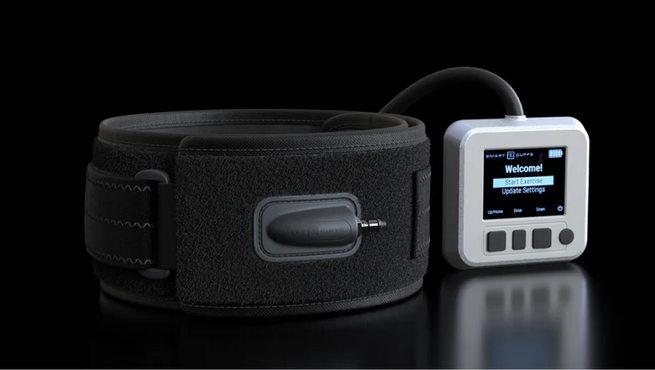
The rest of the system is built around consistent, supervised sessions. The cuffs calibrate automatically in about 30 seconds and store each patient's pressure, and Quick Start Mode re-inflates to that stored pressure without the app. A neoprene lining and 100% urethane air bladder surround the limb without pinching, and the arcuate thigh cuffs are shaped wider at the top to match a conical leg. A built-in emergency pressure release and configurable pressure caps give the clinician direct control over the ceiling.
SmartCuffs 4.0 is FDA-listed as a Class I device and made in the USA. Standalone Mode runs up to eight cuffs at once, which makes the SmartCuffs 4.0 Clinical Set ($1,699 sale price) the fit for a clinic running several fracture patients through the same block.
Browse all SmartCuffs® options to compare configurations before purchasing. For individual help matching a configuration to your practice volume and patient mix, use the SmartTools cuff selector or reach out to the clinical team directly.
Frequently asked questions
Can BFR be used while a fracture is still healing?
In many cases, yes, under supervision. BFR trains muscle at low external loads a healing bone can tolerate, and fracture-specific trials have applied it during active recovery without compromising radiographic healing. The decision to start, the timing, and the pressure belong to the surgeon and treating physical therapist, based on the fracture type, the fixation, and the stage of healing.
Is BFR safe after ORIF?
The evidence in operatively fixed fractures is encouraging. A randomized trial in surgically managed distal radius fractures found that adding BFR improved pain, strength, and wrist function, with union scores comparable to standard care and no clotting complications. Safety still depends on surgeon clearance, screening for clot and vascular risk, and keeping the cuff proximal to the surgical site.
Can BFR be used while a cast or brace is on?
Yes, applied to the musculature proximal to the cast rather than the immobilized segment. A trial in casted, non-operatively treated distal radius fractures added BFR to hand therapy and reported better pain and function scores with no complications. Once the cast or brace comes off, BFR shifts to the muscles that lost the most during immobilization.
Does BFR interfere with bone healing?
The fracture-specific research so far hasn't found that it does. In the operatively managed distal radius trial, radiographic union scores were comparable between the BFR and standard-care groups, with no venous thrombosis or rise in clotting markers. The external load stays low and the cuff sits away from the fracture, so the healing bone isn't the tissue being stressed.
When can BFR start after a fracture?
That's a clinical decision tied to healing, fixation, and clearance. Clinics often begin with passive or very-low-load BFR in the early recovery window and progress as pain settles. The start point depends on the fracture, whether it was surgically fixed, and the surgeon's clearance, and progression should follow the patient's recovery markers.
Who should supervise post-fracture BFR?
Post-fracture BFR belongs under a licensed physical therapist or sports medicine provider. Screening for clot and vascular risk, measuring LOP and setting pressure as a percentage of it, choosing the stage to begin, and placing the cuff correctly are all clinical judgments. Home use makes sense only after the care team has cleared it and taught the patient the setup.
Does BFR build muscle or only slow atrophy?
Both, within its low-load range. BFR produces hypertrophy and strength gains at roughly 20 to 40 percent of one-repetition maximum, against the 70 percent-plus that conventional strengthening typically uses. Hypertrophy is comparable to high-load training, while strength gains are generally smaller. The fracture trials measured strength and function during bone healing rather than hypertrophy as a primary outcome.
Does evidence from ACL or muscle-strain BFR apply to fractures?
Partly. BFR has been studied more extensively after ACL reconstruction and across general musculoskeletal rehab, and that work explains how and why BFR builds strength. Fractures involve different tissues, healing timelines, and injury mechanisms, though, and the fracture-specific evidence is concentrated in distal radius trials. Findings from other injuries shouldn't be assumed to transfer without clinical judgment.
Is SmartCuffs FDA-listed, and does it require a prescription?
SmartCuffs is FDA-listed as a Class I device under the KCY product code (pneumatic tourniquet), the same classification as other FDA-listed BFR systems. FDA listing doesn't mean a buyer needs a prescription or a medical license to purchase it. For post-fracture use, the decision about whether and how to apply BFR still sits with the treating provider.
References
- Fan Y, et al. The effectiveness and safety of blood flow restriction training for the post-operation treatment of distal radius fracture. Annals of Medicine. 2023. PMC10392265
- Cancio JM, et al. Blood flow restriction therapy after closed treatment of distal radius fractures. Journal of Wrist Surgery. 2019. PMID 31404177
- Yang M, et al. Blood flow restriction training improves patients' reported outcomes, strength, and range of motion after casting for Colles' fracture. [OPEN ITEM 9: journal needed]. 2023. PMID 37259253
- Blood flow restriction therapy for use after extremity fracture: a critically appraised topic. 2022. PMID 36137561
- Minniti MC, et al. The safety of blood flow restriction training as a therapeutic intervention for patients with musculoskeletal disorders: a systematic review. American Journal of Sports Medicine. 2020.
- Patterson SD, et al. Blood flow restriction exercise: considerations of methodology, application, and safety. Frontiers in Physiology. 2019. PMC6530612
- Hughes L, et al. Blood flow restriction training in clinical musculoskeletal rehabilitation: a systematic review and meta-analysis. British Journal of Sports Medicine. 2017. PMID 28259850
- Lixandrão ME, et al. Magnitude of muscle strength and mass adaptations between high-load resistance training versus low-load resistance training associated with blood-flow restriction: a systematic review and meta-analysis. Sports Medicine. 2018. PMID 29043659
- Abbas MJ, et al. An automated technique for the measurement of limb occlusion pressure during blood flow restriction therapy is equivalent to previous gold standard. Arthroscopy, Sports Medicine, and Rehabilitation. 2022. PMID 35747637
- Blood flow restriction therapy and its use for rehabilitation and return to sport: physiology, application, and guidelines for implementation. Arthroscopy, Sports Medicine, and Rehabilitation. 2022.

