


During long seasons, athletes commonly don't focus on strength training as play and travel consume more of their time. In-season recovery is limited and full-load sessions often get cut first when the schedule gets tighter.
Blood flow restriction (BFR) gives athletes a way to keep training without that trade-off. BFR for in-season recovery uses light loads, often in the 20 to 30 percent of one-rep max range, with calibrated cuffs inflating pressure to a percentage of limb occlusion pressure (LOP) on the working limb. That combination can provide a maintenance stimulus shown in multiple studies, without the joint and nervous system load of heavy lifting.
Below we summarize the evidence, safety checkpoints, and practical in-season protocols.
What is BFR, and why does it work at such light loads?
BFR uses a snug, calibrated cuff to partially restrict blood flow to a working limb during exercise, typically reducing arterial inflow somewhat while occluding venous outflow more substantially. The effect is local: blood still gets in, but venous return slows, leading to pooling and reduced oxygen availability in the working muscle. That metabolic stress is what makes a light load feel far harder to the muscle than it normally would, recruiting fast-twitch fibers and triggering growth signals that typically only show up under heavier weight.
The research backs the mechanism. A meta-analysis by Loenneke and colleagues found that low-load training with restriction produces meaningful muscle growth at intensities far below traditional lifting [2]. Takarada's work showed that occlusion training can spike growth hormone well above resting levels even at 20 percent of one-rep max [3]. The early fatigue and metabolic stress are the training signal, not the pump alone.
How does BFR aid recovery without piling on more fatigue?
BFR delivers a meaningful training stimulus with relatively low fatigue cost compared to heavy lifting, with generally less joint stress and systemic strain than a heavy session. That tradeoff is useful when an athlete needs to limit loading on a joint or preserve tissue that's still healing, and it's part of why BFR keeps showing up in recovery research, though the evidence on recovery outcomes specifically is still mixed.
A 2024 systematic review found early support for BFR as a strategy used between hard efforts [1]. In rehabilitation settings, where heavy loading is often off the table, low-load restriction has produced strength gains comparable to heavier work and muscle adaptations that approach it [5][6]. Endurance athletes see similar carryover: a 2022 study in male runners found that interval running with restriction improved maximal running performance and muscular fitness [8]. You'll find sport-specific programming in the guide to BFR for runners and endurance athletes.
Programming BFR across a competitive season
One way to organize in-season BFR is around four modes rather than a single fixed workout — this is a practical framework, not a formal standard. Each uses light loads, commonly in the 20 to 30 percent of 1RM range, so the work doesn't compete with games or practices. The numbers below are typical examples drawn from common BFR practice; pressure should always be individualized to each athlete's limb occlusion pressure (LOP) rather than applied as a fixed percentage across the board.
|
Mode |
When to use it |
Load and pressure |
Frequency |
|
Maintenance |
Mid-week, away from games |
~20-30% 1RM, roughly 40-50% LOP arms, 50-80% LOP legs |
~2x per week |
|
Low-intensity recovery work |
Day after a game or hard session |
Light or no load, low pressure |
As needed |
|
Travel |
Limited equipment, road trips |
Bodyweight or bands at light effort |
1-2x per week |
|
Deload week |
Planned volume drop |
Light load, shorter sessions |
~2x per week |
A widely used working-set example is the 30-15-15-15 scheme — one set of 30 reps followed by three sets of 15, with rest kept short — though it's one common protocol among several valid options, not the only standard. Keep occlusion bouts brief and follow established protocol guidance on cuff time rather than a fixed cutoff, and stop a set if form breaks down, which is sound coaching practice even if it isn't itself a research-backed threshold. Exercise selection is typically kept simple, since the goal in-season is maintenance rather than chasing personal records.
Is BFR safe to use during a packed season?
BFR appears relatively safe for most healthy athletes when it's properly screened, individualized to each athlete's limb occlusion pressure, and not pushed to exhaustion — but it's not a free pass, and it's not safe for everyone. A high-performance sports survey found BFR is widely used in rehab and training settings with limited reported adverse effects, though screening and individualized pressure use aren't always applied consistently in practice [10].
A few practical safety points worth following:
- Start with a familiarization session and progress gradually rather than jumping into full protocols.
- Avoid training to exhaustion with BFR.
- Stop immediately if an athlete feels unwell, and don't rely on comfort cues like cuff tightness alone as a safety rule.
- Use extra caution in hot, humid, or dehydrating conditions, since dehydration may raise clot risk.
- Use individualized pressure settings based on each athlete's limb occlusion pressure rather than a fixed number.
A few athletes should clear BFR with a qualified professional before starting. The international BFR consensus statement and a 2022 safety review both flag conditions such as clotting disorders or a history of deep vein thrombosis, uncontrolled high blood pressure, and active infection or open wounds as reasons to screen first [4][9]. Anyone returning from surgery should follow their surgeon's and physical therapist's clearance, not a generic protocol.
Where SmartCuffs fits in an in-season routine
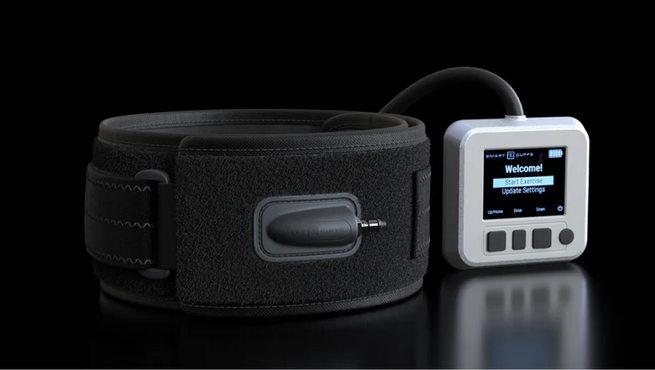
SmartCuffs 4.0 was built for the parts of in-season use that trip up other systems: speed, repeatability, and recovery. Its Resting BFR Mode is made for passive recovery sessions at low pressure, and Quick Start Mode re-inflates each athlete to their stored limb occlusion pressure without opening an app, so it works on a sideline, in a training room, or in a hotel gym. The cuffs detect each athlete's pressure automatically and save the profile, which keeps a roster moving instead of stopping to recalibrate.
That precision isn't a marketing line. An independent study published in 2022 found the SmartCuffs automated pressure reading equivalent to the manual Doppler ultrasound gold standard across 96 measurements [7]. For an athlete cycling through maintenance, travel, and deload weeks, SmartCuffs 4.0 gives a calibrated, repeatable session in about 30 seconds, with a battery that recharges fully in roughly half an hour.
Holding strength through a season isn't about training harder than the schedule allows. It's about training smart enough that game day still gets your best legs. If you want a calibrated, travel-ready way to keep that strength without adding fatigue, SmartCuffs 4.0 is built for exactly that job.
Frequently Asked Questions
Can you build muscle with BFR during the season?
You can maintain and, in some cases, modestly build muscle with in-season BFR. Low-load restriction training has been shown to support hypertrophy at around 20 to 30 percent of one-rep max in multiple studies, which is light enough to avoid the soreness that hurts game-day performance [2][6]. In-season, the realistic goal is usually to hold the muscle and strength built in the off-season rather than chase new maxes.
How often should an athlete do BFR in-season?
Two short sessions per week is a reasonable starting point for maintenance, with extra low-intensity sessions added as the schedule allows. A common working-set example is the 30-15-15-15 scheme, though it's one option among several valid protocols. Occlusion bouts should stay brief, following established protocol guidance rather than a fixed cutoff. Adjust around games so BFR never competes with competition or key practices.
Does BFR help with recovery between games?
Early research supports BFR as a post-exercise recovery strategy, and low-pressure passive work is a common way athletes use it on the day after a hard effort [1]. The appeal is that it delivers a light training signal without adding mechanical load. It's a tool to support recovery, not a guaranteed fix, and it works best inside a complete recovery plan.
What pressure should I use for in-season BFR?
Calibrated cuffs set pressure as a percentage of your limb occlusion pressure (LOP), typically in the range of 40 to 50 percent for the arms and 50 to 80 percent for the legs, though these are common examples rather than fixed numbers. Pressure should always be individualized to your limb rather than guessed or applied as a one-size-fits-all setting, which is why calibrated, LOP-based measurement is the standard.
Is BFR better than a normal deload?
BFR doesn't replace a deload; it makes one more productive. A traditional deload drops volume to shed fatigue, but it can also let strength drift. Adding light BFR work during a deload lets you cut the heavy load while still sending a maintenance signal to the muscle, so you come out the other side fresher without going backward.
References
- Oliva-Lozano JM, et al. Blood flow restriction as a post-exercise recovery strategy: A systematic review of the current status of the literature. Biology of Sport, 2024. PubMed 38952909
- Loenneke JP, et al. Low intensity blood flow restriction training: a meta-analysis. European Journal of Applied Physiology, 2012. PubMed 21922259
- Takarada Y, et al. Effects of resistance exercise combined with moderate vascular occlusion on muscular function in humans. Journal of Applied Physiology, 2000. PubMed 10846023
- Patterson SD, et al. Blood Flow Restriction Exercise: Considerations of Methodology, Application, and Safety. Frontiers in Physiology, 2019. PubMed 31156448
- Hughes L, et al. Blood flow restriction training in clinical musculoskeletal rehabilitation: a systematic review and meta-analysis. British Journal of Sports Medicine, 2017. PubMed 28259850
- Lixandrão ME, et al. Magnitude of Muscle Strength and Mass Adaptations Between High-Load and Low-Load Resistance Training Associated with Blood-Flow Restriction. Sports Medicine, 2018. PubMed 29043659
- Abbas MJ, et al. An Automated Technique for the Measurement of Limb Occlusion Pressure During Blood Flow Restriction Therapy Is Equivalent to Previous Gold Standard. Arthroscopy, Sports Medicine, and Rehabilitation, 2022. PubMed 35747637
- Chen YT, et al. Running interval training combined with blood flow restriction increases maximal running performance and muscular fitness in male runners. Scientific Reports, 2022. Scientific Reports
- Overall Safety and Risks Associated with Blood Flow Restriction Training: A Literature Review. Military Medicine, 2022. Military Medicine
- Clarkson MJ, Scott BR, Patterson SD, Warmington SA. Blood flow restriction exercise in high-performance sport settings: A practitioner survey. Journal of Sports Sciences, 2025;43(19):2133-2144. PubMed 40793934


