


Standard resistance training requires 70 to 85 percent of one-rep max to drive the muscle adaptation that matters in geriatric rehab. That loading range is exactly what most geriatric patients can't safely reach.
Blood flow restriction (BFR) training delivers a high-metabolic stimulus at 20 to 40 percent of one-rep max by restricting venous outflow from the exercising limb. The resulting hypoxia and metabolic accumulation drive muscle hypertrophy and strength gains at loads older adults can actually tolerate. Multiple systematic reviews and randomized controlled trials now support BFR for sarcopenia, fall prevention, balance deficits, and post-surgical recovery in this population. The stimulus is metabolic, not mechanical. That's the clinical reason BFR works when conventional loading protocols don't.
Sarcopenia chips away at muscle mass and strength across every decade of adult life, and the losses accelerate after 65. Falls are the leading cause of injury-related death in adults 65 and older in the United States, and lower-limb weakness is among the few modifiable risk factors. High-load resistance training is the evidence-based answer to that weakness. It's also, for many geriatric patients, the protocol they can't complete.
Here is what the research shows about BFR in geriatric PT, the clinical applications that have the strongest evidence base, and how to match equipment to your practice's caseload.
Why Standard Loading Protocols Break Down in Geriatric Rehab
Standard loading protocols require 70 to 85 percent of one-rep max to drive the muscle adaptation that matters. Most geriatric patients can't reliably reach that threshold because sarcopenia reduces available strength, arthrogenic muscle inhibition suppresses motor recruitment, osteoporosis raises fracture risk, and polypharmacy limits exercise tolerance. That combination is what makes HLRT inadequate as a starting point for this population, not inadequate as a clinical goal.
The EWGSOP2 consensus, published in Age and Ageing by Cruz-Jentoft et al. in 2019, defines sarcopenia as a muscle disease characterized by low muscle strength as the primary criterion, confirmed by low muscle quantity or quality, with poor physical performance indicating severe disease. That definition matters clinically because it shifts the focus from muscle mass alone to muscle function, and it makes the loading problem concrete: the patient who can't generate the force required for meaningful high-load training is the patient who needs a different path to the same metabolic outcome.
Several overlapping factors converge in geriatric rehab to make that standard loading path unreachable.
Progressive muscle atrophy reduces the load the patient can produce in the first place. Arthrogenic muscle inhibition following injury or surgery compounds this by reflexively suppressing motor unit recruitment in the affected limb, so even the strength that remains doesn't fully engage. Osteoporosis, present in a significant share of older adults, raises the fracture risk of high mechanical loads beyond what's acceptable in a typical outpatient setting. And polypharmacy, including beta-blockers, diuretics, and anticoagulants, can blunt heart rate response, reduce exercise tolerance, and complicate the clinical picture further.
Falls are the other half of the constraint. A loading protocol that introduces meaningful fall risk during the session, whether from weight-bearing demand, balance challenge, or cardiovascular stress, isn't viable for this population. The rehab goal is to reduce fall risk, not add to it.
How BFR Delivers a High-Metabolic Stimulus at Low Loads
BFR works by applying a pneumatic cuff to the proximal limb during exercise. The cuff restricts venous outflow from the working limb while maintaining partial arterial inflow. That creates localized hypoxia and metabolic accumulation in the muscle, including elevated lactate and hydrogen ion concentrations. The result is systemic release of growth hormone and IGF-1, along with activation of the mTOR pathway, at a magnitude typically associated with much heavier training loads.
At 20 to 40 percent of one-rep max, those signals drive meaningful muscle hypertrophy and strength gains. The joint stress stays low. The metabolic signal stays high. That's the clinical reason BFR closes the gap that HLRT leaves open in geriatric patients: it delivers the stimulus without the mechanical load.
BFR isn't limited to resistance training in this population, either. A 2025 review published in Frontiers in Physiology reports that ten weeks of BFR walking produced a 3.7% increase in muscle volume and a 5.9% increase in maximal isometric strength in older adults. For geriatric patients who can't yet perform seated or standing resistance exercises, BFR walking offers a way to begin delivering therapeutic stimulus during the earliest, most restricted phase of rehab.
BFR for Sarcopenia: What the Research Shows for Older Adults
BFR at 20 to 40 percent of one-rep max produces clinically meaningful muscle hypertrophy and strength gains in older adults with sarcopenia. Multiple systematic reviews and randomized controlled trials support it as a viable intervention when conventional high-load training is not tolerable, with strength gains of 15 to 40 percent reported across geriatric BFR protocols.
EWGSOP2 criteria define the target population here precisely: patients with confirmed low muscle strength, who may also show low muscle quantity, and who have declining physical performance. That's a substantial share of a geriatric PT caseload. The question for the clinician is whether BFR produces meaningful outcomes in this specific group, at the loads they can tolerate.
The answer, across several layers of evidence, is yes.
Li et al. 2025 (Frontiers in Physiology) synthesizes the current evidence base for BFR and sarcopenia in older adults. Eight weeks of BFR knee extension training at 20 percent of one-rep max produced a 40.1% increase in strength and a 6.3% increase in quadriceps cross-sectional area. Across a nationwide survey cited in the same review, the adverse event rate for BFR was 0.05%, primarily transient numbness, with no cases of paralysis, pulmonary embolism, venous thrombosis, rhabdomyolysis, or cerebral infarction reported.
Kong et al. 2024 (Sports Medicine and Health Science) conducted a systematic review and meta-analysis of 14 randomized controlled trials comparing low-load BFR against high-load resistance training and low-load training alone in older adults at risk for sarcopenia. LL-BFR produced comparable muscle mass gains to HLRT (no significant difference, p=0.74) and superior muscle strength gains versus HLRT (p=0.03, SMD=-0.34). The authors concluded that both LL-BFR and traditional resistance training have potential to improve sarcopenia in older adults.
Zhang et al. 2024 (Scientific Reports) ran a randomized controlled trial with 21 older adults diagnosed with sarcopenia, comparing 12 weeks of low-load BFR (20-30% 1RM) against conventional resistance training (60-70% 1RM). Both groups showed significant improvements in knee extensor strength, 6-meter walk distance, growth hormone levels, and quality of life scores. Conventional RT showed superior gains in appendicular skeletal muscle mass index (ASMI) and Short Physical Performance Battery scores. That nuance matters: BFR is the right tool when conventional loads can't be tolerated, not necessarily a replacement for conventional RT when they can.
Emam et al. 2025 (Journal of Clinical Medicine) reviewed BFR protocols specifically in elderly populations and reported 15 to 35% increases in leg press one-rep max, 5 to 8% increases in quadriceps cross-sectional area, and 9 to 21% improvements in Timed Up and Go and 6-Minute Walk Test performance across included studies.
Geriatric BFR Protocol Parameters for Sarcopenia
|
Parameter |
Geriatric starting point |
Evidence-based range |
Source |
|---|---|---|---|
|
Load |
20% 1RM |
20-40% 1RM |
Li et al. 2025, Emam et al. 2025 |
|
Cuff pressure |
40-50% AOP |
40-80% AOP |
Emam et al. 2025 |
|
Sets and reps |
3 sets (30-15-15) |
3-4 sets (30-15-15-15) |
Li et al. 2025 |
|
Frequency |
2x per week |
2-4x per week |
Emam et al. 2025 |
|
Session duration |
10 min under cuff |
10-20 min |
Emam et al. 2025 |
|
Intervention length |
6 weeks |
6-12 weeks |
Kong et al. 2024 |
Cuff pressure in geriatric patients should start at the conservative end of that range and progress gradually. Emam et al. 2025 recommends increasing by 10 to 20 mmHg per session as tolerated, pairing RPE monitoring with objective vital sign checks throughout.
For a broader review of whether BFR training produces meaningful outcomes across clinical populations, SmartTools' evidence review covers the full research landscape.
BFR for Fall Prevention and Balance Deficits in Geriatric PT
BFR-driven gains in quadriceps strength, hip abductor strength, gait speed, and balance address the functional deficits most linked to fall risk in older adults. Randomized controlled trials show significant improvements on the Berg Balance Scale, Timed Up and Go, and 30-second Sit-Stand. No direct falls-outcome RCT has yet been completed.
Falls are the leading cause of injury-related death in adults 65 and older in the United States (CDC). Lower-limb strength is one of the primary modifiable risk factors. BFR-driven strength and balance gains connect directly to the functional measures that predict fall risk: quadriceps strength, hip abductor strength, gait speed, and static and dynamic balance.
Han et al. 2024 (Cureus, PMC11380551) reviewed the evidence for BFR in enhancing somatic function and fall prevention in older adults. A 12-week randomized controlled trial included in that review showed significant improvements in extensor and flexor strength at the hip, knee, and ankle. Berg Balance Scale scores improved significantly. Get-Up Timed Walk, 30-second Sit-Stand, Functional Forward Reach Distance, and maximal stride length all showed measurable gains.
Gronlund et al. 2020 (Journal of Musculoskeletal and Neuronal Interactions, PMC7716683) conducted a systematic review of eight RCTs, covering 234 participants aged 60 and older. Sixty-seven percent of functional performance tests showed within-group improvements. 42% showed between-group effects compared with controls. The review did not report adverse event data across the included studies.
One critical gap: none of the studies in the Gronlund review reported direct falls incidence as an outcome. BFR's ability to reduce actual falls hasn't been demonstrated in a dedicated RCT yet. The strength and balance improvements are real and clinically meaningful. The mechanistic link to fall prevention is well-supported. But clinicians should frame BFR in fall prevention programs accurately, as an intervention that addresses multiple modifiable fall risk factors, not as a proven falls prevention protocol.
BFR in Post-Surgical and Post-Fracture Rehab for Older Adults
In a 2025 randomized controlled trial published in Age and Ageing, De Smet et al. (PMID 41143861) enrolled 123 patients aged 70 and older admitted to an acute geriatric ward. The intervention group received standard physiotherapy with BFR applied during walking. The BFR group completed 92% of planned sessions, identical in adherence to the standard physiotherapy group. SPPB-balance scores improved in the BFR group. No cases of thrombosis, ischemia, or rhabdomyolysis occurred. Mild dyspnea was slightly more frequent in the BFR group, at 4 percent versus 1 percent, with pain levels comparable between groups.
That's the most relevant finding for clinicians hesitant to introduce BFR to complex geriatric patients: in 123 hospitalized adults aged 70 and older, BFR during walking was safe, adherent, and produced measurable balance improvements.
The most common post-surgical and post-fracture applications in geriatric PT include total knee arthroplasty, total hip arthroplasty, hip fracture (ORIF or hemiarthroplasty), and ankle reconstruction. BFR's value in these contexts is timing: it allows a therapeutic stimulus to begin in the restricted loading window immediately after surgery or fracture, when standard loaded exercises are contraindicated. For TKA and THA-specific protocol depth, see SmartTools' BFR for knee rehabilitation guide.
For older adults with upper-extremity surgical immobilization, including rotator cuff repair and shoulder arthroplasty, BFR applied to the contralateral limb supports strength maintenance during the period when the operative side can't be loaded actively. Cross-education protocols allow the PT to maintain neuromuscular activity and prevent disuse atrophy even when direct loading is off the table.
Which Geriatric Patients Are Ready for BFR, and Who to Screen Out
Across a nationwide survey cited in Li et al. 2025, the adverse event rate for BFR was 0.05%, with adverse events consisting primarily of transient numbness. No paralysis, pulmonary embolism, venous thrombosis, rhabdomyolysis, or cerebral infarction events were reported. That safety profile, combined with the feasibility data from De Smet et al. 2025, supports BFR as a low-risk intervention for appropriately screened geriatric patients.
Positive patient selection criteria for geriatric BFR:
-
Sarcopenia diagnosis or high sarcopenia risk (age 70+, post-hospitalization, prolonged sedentary period)
-
Post-surgical with loading restriction (TKA, THA, hip fracture, shoulder repair)
-
Fall prevention program participant with low-load tolerance due to pain or comorbidity
-
Unable to tolerate HLRT due to joint fragility, pain threshold, or cardiovascular limitation
Contraindications (screen out before starting):
-
Active DVT history or elevated thrombosis risk with multiple compounding factors
-
Severe peripheral vascular disease
-
Uncontrolled hypertension
-
Lymphedema in the target limb
-
Open wounds at or proximal to the planned cuff site
-
Active infection in the limb
For patients with any cardiac history, monitor blood pressure and heart rate before, during, and after each session as standard clinical practice. Set cuff pressure at the conservative end of the evidence-based range: 40 to 50 percent AOP to start, with progressive increases of 10 to 20 mmHg per session as tolerated. Li et al. 2025 notes particular caution above 220 mmHg.
One geriatric-specific consideration that applies across patient selection: Rate of Perceived Exertion as a self-monitoring tool may be less reliable in patients with mild cognitive impairment. For those patients, pair RPE feedback with objective monitoring throughout the session. A visual RPE scale, where the patient points rather than verbalizes their effort level, is often more accurate than a verbal report. This is a small protocol adjustment with meaningful implications for session safety in a cognitively variable population.
For a detailed contraindication reference and screening framework, SmartTools' BFR safety overview covers the full protocol.
SmartCuffs 4.0 vs. Delfi PTS for Geriatric PT Practices
Accurate limb occlusion pressure measurement matters more in geriatric PT than in almost any other clinical population. Older adults show highly variable physiology from patient to patient: limb circumference, tissue composition, vascular tone, and cardiovascular characteristics all shift the pressure required to achieve the intended restriction level. Applying BFR at a percentage of an inaccurate LOP baseline means every session delivers the wrong stimulus. In a population where the therapeutic window is already narrow and the safety considerations are real, that variability compounds directly into clinical risk.
Two BFR systems have peer-reviewed LOP accuracy validation: SmartCuffs and Delfi PTS. SmartCuffs PRO is clinically validated (Mayo Clinic, 2022) where automated LOP measurement was found equivalent to the manual Doppler ultrasound gold standard across 96 upper- and lower-extremity measurements.
|
Feature |
SmartCuffs 4.0 |
Delfi PTS |
|---|---|---|
|
Peer-reviewed LOP validation |
Yes (Mayo Clinic, 2022) |
Yes |
|
Multi-cuff / multi-patient |
Yes (up to 8 cuffs simultaneously) |
No |
|
Quick Start Mode |
Yes |
No |
|
Free app, no subscription |
Yes |
No |
|
FDA-listed |
Yes |
Yes |
|
Purpose-built for BFR |
Yes |
No (retrofitted tourniquet) |
|
Price range |
$499-$1,699* |
~$5,000+* |
*Pricing is volatile. Verify against current product pages before publish.
On Saga 2.0 and Suji: Neither carries peer-reviewed LOP accuracy validation relevant for clinical geriatric BFR use. Saga 2.0 is not FDA-listed; Suji is FDA-listed but has no published LOP validation study. Both are manufactured in China. For a geriatric caseload where accurate LOP measurement is a clinical requirement, not an optional feature, neither meets the standard.
The Delfi exception: For geriatric patients with severe vascular or cardiac comorbidities already managed in hospital systems with existing Delfi infrastructure, Delfi PTS remains a validated clinical alternative. The comparison table is honest: both systems have peer-reviewed LOP validation. The primary differentiators for outpatient PT practices are multi-patient capability, workflow, and cost.
SmartTools' cuff selection guide helps clinicians match cuff size and configuration to their specific patient population.
SmartCuffs 4.0 for Geriatric PT Clinics
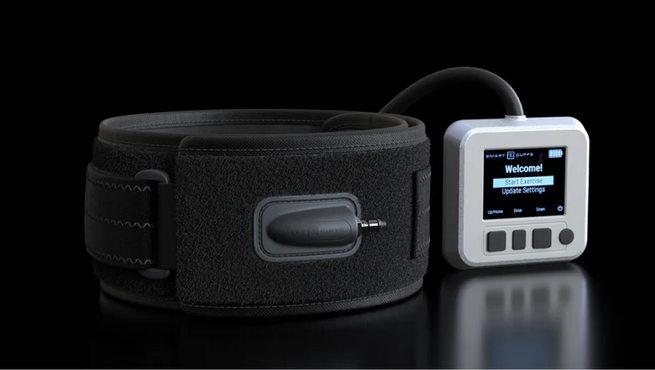
The SmartCuffs 4.0 is designed for the clinical realities of a high-volume PT practice, including the variable physiology and workflow demands of a geriatric caseload.
Automated LOP calibration takes approximately 30 seconds per patient. In a geriatric population where limb characteristics vary significantly from one patient to the next, that automation isn't a convenience. It's what makes individualized pressure prescription consistent across a full day of sessions and across the multiple clinicians who may work with the same patient over a 12-week protocol.
The 8-cuff Standalone Mode supports concurrent multi-patient BFR, which is the workflow that makes fall prevention group programming and parallel post-surgical protocols actually work in a busy outpatient practice. No other BFR system matches this capability.
Cuff sizing covers the full range needed for a geriatric patient population: small arm (8-13"), medium arm (13-18"), large leg (18-24"), and XL leg (24-29"). The wide pneumatic cuff design distributes pressure evenly across the limb, reducing localized tissue stress on patients who may have fragile skin or subcutaneous tissue changes associated with aging.
Additional clinical specs: 30-minute full recharge, free app with no subscription required for core clinical features, Made in USA. SmartCuffs 4.0 is in active clinical use at more than 10,000 U.S. clinics, including Mayo Clinic, Cleveland Clinic, Rush, and Hospital for Special Surgery.
The SmartCuffs 4.0 Clinical Set is available for practices running group programs.
Use Case Table: Matching Device to Geriatric Clinical Scenario
|
Clinical scenario |
Recommended device |
Rationale |
|---|---|---|
|
Community-dwelling seniors, sarcopenia program |
SmartCuffs 4.0 |
Multi-patient, free app, portable, validated LOP |
|
Outpatient post-surgical rehab (TKA, THA, hip fracture ORIF) |
SmartCuffs 4.0 |
Multi-cuff workflow, Quick Start Mode, clinical volume |
|
Group fall prevention programming |
SmartCuffs 4.0 Clinical Set |
8-cuff simultaneous operation for concurrent group sessions |
|
Acute hospital geriatric ward (severe comorbidities) |
Delfi PTS |
Validated; may be embedded in existing hospital infrastructure |
Getting Started with BFR in Your Geriatric Practice
The clinical case for BFR in geriatric PT is straightforward: it delivers the metabolic stimulus for muscle adaptation at loads this population can actually reach. The evidence base across sarcopenia, fall prevention, and post-surgical recovery is substantial and continues to grow.
The practical starting point is cuff selection. SmartTools' cuff selection guide walks through the size and configuration decisions for your patient population. For practices ready to begin, the SmartCuffs 4.0 is in active clinical use at more than 10,000 U.S. clinics treating exactly the patients described in this article.
SmartTools' cuff selection guide matches cuff size and configuration to your patient population. For practices ready to begin, the SmartCuffs 4.0 is available directly from SmartTools.
Frequently Asked Questions
Is BFR safe for older adults with cardiovascular conditions?
For most older adults with cardiovascular history and no active contraindications, BFR is a low-risk intervention when properly screened and monitored. Li et al. 2025 cites a nationwide survey reporting an adverse event rate of 0.05% across BFR applications, primarily transient numbness. Standard clinical monitoring applies: measure blood pressure and heart rate before, during, and after each session for any patient with cardiac history. Screen out patients with uncontrolled hypertension, severe peripheral vascular disease, or active deep vein thrombosis.
What load (% 1RM) should I use for geriatric BFR patients?
Start at 20 percent of one-rep max and progress to 20 to 40 percent as the patient tolerates. That range is supported across multiple geriatric BFR studies, including Emam et al. 2025 [4] and Li et al. 2025 [1]. Beginning at the lower end reduces the risk of cardiovascular stress and cuff-related discomfort during early sessions, which is particularly important for patients who are new to BFR or deconditioned from prolonged disuse or hospitalization.
How does BFR help with sarcopenia in older patients?
BFR produces the metabolic conditions for muscle hypertrophy and strength gains at 20 to 40 percent of one-rep max. That's the load range most geriatric patients can actually reach. Kong et al. 2024 [2], a meta-analysis of 14 randomized controlled trials, found LL-BFR produced comparable muscle mass gains to high-load resistance training and superior strength gains versus HLRT (p=0.03). Li et al. 2025 reports a 40.1% strength increase after 8 weeks of BFR at 20% 1RM in older adults with sarcopenia. For patients who can't tolerate conventional loading doses, BFR is the pathway to the same physiological outcome.
Can BFR be used for fall prevention in a geriatric PT program?
Yes, with an accurate characterization of what the evidence supports. BFR-driven gains in quadriceps strength, hip abductor strength, gait speed, and balance directly address the functional deficits most linked to fall risk. Han et al. 2024 [5] reports significant improvements in Berg Balance Scale scores, Get-Up Timed Walk, and 30-second Sit-Stand in older adults after BFR intervention. What the evidence doesn't yet have: a randomized controlled trial with falls as the primary endpoint. BFR addresses fall risk factors. It hasn't been shown in a direct RCT to reduce fall incidence.
What cuff pressure is appropriate for BFR in elderly patients?
Start at 40 to 50 percent of arterial occlusion pressure (AOP) and progress to 60 to 80 percent AOP as tolerated, increasing by 10 to 20 mmHg per session. Never apply a fixed pressure value without individual LOP measurement first. Older adults show significant variation in limb characteristics, and a fixed pressure that produces 40% restriction in one patient may produce 70% restriction in another. Automated LOP measurement before each session is the clinical-grade standard for this population.
How do I set up BFR for a patient recovering from a hip fracture?
De Smet et al. 2025 (PMID 41143861) provides direct evidence: 123 patients aged 70 and older in an acute geriatric ward completed BFR during walking at 92% adherence, with SPPB-balance improvements and no thrombosis, ischemia, or rhabdomyolysis. For the acute and early post-fracture phases, BFR walking is the most feasible starting point. As the patient progresses and the surgical team lifts weight-bearing restrictions, transition to low-load resistance exercises under BFR following the standard geriatric protocol parameters: 20% 1RM, 40-50% AOP, 3 sets, 2x per week to start.
How does SmartCuffs 4.0 compare to Delfi PTS for geriatric PT?
Both have peer-reviewed LOP accuracy validation. SmartCuffs 4.0 supports up to 8 patients simultaneously, includes a free app with no subscription, runs on a 30-minute full recharge cycle, and is purpose-built for BFR. Delfi PTS at $5,000+ is a retrofitted tourniquet rather than a purpose-built BFR device, with no multi-patient capability. It's the validated choice for hospital systems with existing Delfi infrastructure or for acute surgical patients with severe comorbidities who are already under hospital-based care. For most outpatient geriatric PT clinics managing sarcopenia, fall prevention, and post-surgical protocols, SmartCuffs 4.0 is the more practical clinical tool.
What are the contraindications for BFR in older adults?
The standard contraindications apply with particular attention in a geriatric population: active DVT history or significantly elevated thrombosis risk, severe peripheral vascular disease, uncontrolled hypertension, lymphedema in the target limb, open wounds at or proximal to the cuff site, and active infection in the limb. Additionally, screen for cognitive status. Patients with mild cognitive impairment may have reduced RPE reliability as a self-monitoring tool. Pair RPE with objective vital sign monitoring for any patient with a cognitive history. SmartTools' BFR safety overview covers the full screening protocol.
References
-
Li W, Hu M, Yin Q, Liu Y, Chen L, Ru Q, Xu G, Wu Y. "Blood flow restriction training: a new approach for preventing and treating sarcopenia in older adults." Frontiers in Physiology. 2025. PMC12414948
-
Kong J, Li Z, Zhu L, Li L, Chen S. "Comparison of blood flow restriction training and conventional resistance training for the improvement of sarcopenia in the older adults: A systematic review and meta-analysis." Sports Medicine and Health Science. 2024. PMC10831374
-
Zhang M, Song Y, Zhu J, Ding P, Chen N. "Effectiveness of low-load resistance training with blood flow restriction vs. conventional high-intensity resistance training in older people diagnosed with sarcopenia: a randomized controlled trial." Scientific Reports. 2024. PMID 39558011
-
Emam MA, Elsayed A, Hortobágyi T, Amin WM, Malik S, Ali OI. "Exploring Blood Flow Restriction Exercise Protocols for Elderly Populations: A Scoping Review of Cuff Pressure, Frequency, and Duration for Muscle Strength, Hypertrophy, and Functional Abilities Outcomes." Journal of Clinical Medicine. 2025. PMC12193843
-
Han L, Xi X, Wang H, Kan M, Yu S. "A Review of the Efficacy and Mechanisms of Blood Flow Restriction Training in Enhancing Somatic Function and Preventing Falls in Older Adults." Cureus. 2024. PMC11380551
-
Gronlund C, Christoffersen KS, Thomsen K, Masud T, Jepsen DB, Ryg J. "Effect of blood-flow restriction exercise on falls and fall related risk factors in older adults 60 years or above: a systematic review." Journal of Musculoskeletal and Neuronal Interactions. 2020. PMC7716683
-
De Smet R, Brys ADH, Calders P, Wynendaele E, Van Den Noortgate NJ, De Spiegeleer A. "Implementation of blood flow restriction training in the acute geriatric unit." Age and Ageing. 2025. PMID 41143861
-
Abbas MJ, Dancy ME, Marigi EM, Khalil LS, Jildeh TR, Buckley PJ, Gillett J, Burgos W, Okoroha KR. "An Automated Technique for the Measurement of Limb Occlusion Pressure During Blood Flow Restriction Therapy Is Equivalent to Previous Gold Standard." Arthroscopy, Sports Medicine, and Rehabilitation. 2022. PMID 35747637
-
Cruz-Jentoft AJ, et al. "Sarcopenia: revised European consensus on definition and diagnosis." Age and Ageing. 2019. PMID 30312372


