


BFR for Outpatient Orthopedic Post-Surgical Rehab: A Protocol Guide for PT Practices
|
|
Time to read 13 min
|
|
Time to read 13 min
Outpatient orthopedic PT is where post-surgical rehab actually happens. The hospital stay is short, the home program is brief, and the bulk of supervised loading, motor relearning, and progression to return-to-function takes place in the outpatient clinic over the 6 to 16 weeks after surgery. That window is also where the loading-tolerance gap is widest. The patient needs a heavy enough load to drive the strength adaptations the limb requires, and the joint cannot tolerate that load yet.
Blood flow restriction (BFR) training closes that gap. Across the major orthopedic procedures, peer-reviewed research now supports BFR as an evidence-based adjunct that lets a clinician deliver a high-intensity hypertrophy and strength stimulus at 20 to 30 percent of one-rep max, well within the loading constraints of a healing joint or repaired tendon. For outpatient ortho practices, the question is no longer whether to incorporate BFR. It is how to integrate it cleanly into existing post-surgical protocols without operationalizing a separate workflow that does not pay for itself.
This guide covers where BFR fits in an outpatient post-surgical rehab protocol, the surgery types most commonly using it, what to look for in a clinic-grade BFR system, and how to phase it across the rehab arc.
Quadriceps strength loss after lower-extremity surgery, rotator cuff atrophy after shoulder procedures, and arthrogenic muscle inhibition (the reflexive failure of motor activation following joint trauma or surgery) are the most consistent functional deficits across orthopedic post-surgical populations. Conventional rehab is constrained by the same problem that drove the surgery in the first place: heavy load is contraindicated early, but the rehab clock is short.
Recent systematic reviews and protocol summaries have established BFR's role:
A 2026 JOSPT Open scoping review summarized current BFR protocols and outcome measures used after orthopedic procedures, documenting protocol convergence around personalized limb occlusion pressure (LOP) and low-load resistance work [1].
A 2024 systematic review and meta-analysis of randomized controlled trials in post-operative orthopedic rehabilitation reported that BFR protocols (40 to 80 percent of arterial occlusion pressure, paired with low-load exercise) were generally safe and produced strength and hypertrophy outcomes comparable to conventional high-load training [2].
A comprehensive review of BFR therapy in rehabilitation (PMC8811521) cataloged its use across orthopedic, sports medicine, and post-surgical populations, with personalized LOP delivery the consistent thread across clinical-grade applications [3].
A post-knee-surgery protocol summary (PMC6203234) tabulated the published BFR protocols across ACL reconstruction, meniscectomy, and TKA, with consistency around 1 to 3 days post-op initiation for arthroscopic procedures [4].
For an outpatient ortho clinician, the practical implication is simple: BFR is no longer experimental. It is an evidence-supported tool that closes a known loading-tolerance gap, and it integrates into existing post-surgical protocols at well-defined phases.
For surgery-specific deep dives, see our companion pieces on BFR for total knee replacement rehab, BFR for ACL rehabilitation, and BFR for Achilles rupture rehab.
Most published outpatient orthopedic post-surgical BFR protocols converge on a phased structure that maps to the standard rehab arc. The specifics shift by surgical procedure, but the underlying logic holds across procedures.
Phase 1: Acute post-op (POD 1 to Week 1 to 2). Passive or very-low-load BFR initiated as early as POD 1 has been shown feasible and safe for muscle mass preservation and swelling reduction, particularly in arthroscopic and minimally invasive cases. Active resistance work is limited to non-weight-bearing or partial-weight-bearing isometrics (quad sets, glute sets, isometric external rotation, etc.) under BFR.
Phase 2: Early post-op (Weeks 2 to 6). As pain and swelling subside, the protocol introduces low-load (20 to 30 percent 1RM) resistance work under BFR for the operative limb, with the contralateral limb often used for cross-education. Standard BFR rep schemes (30 to 75 reps over 4 sets, the 30-15-15-15 pattern) become viable. Outcome measures focus on muscle volume preservation and isometric strength.
Phase 3: Strength and progressive loading (Weeks 6 to 12+). BFR transitions from a primary loading modality to an adjunct alongside conventional progressive resistance training. Continuous and intermittent BFR modes support patient-tolerated load progressions without spiking joint stress. Outcome measures shift to dynamic strength testing, single-leg performance, and gait/return-to-task milestones.
Phase 4: Return to function or return to sport (Weeks 12+). BFR continues to support hypertrophy at lower mechanical loads, particularly useful when the patient is cleared for activity but joint or tendon tolerance still caps heavy loading. Discharge criteria typically reference limb symmetry index thresholds, dynamic strength tests, and sport-specific functional batteries. For a reference exercise library across phases, see our BFR exercise reference set.
Across all four phases, the variable that determines clinical reliability is the same: pressure delivery as a defined percentage of the individual patient's limb occlusion pressure, not a fixed number, not an estimate, not a sleeve marking.
BFR has been studied and integrated across the major orthopedic post-surgical populations seen in outpatient PT. The list below is not exhaustive, but it covers the surgical contexts where peer-reviewed support is now well established.
Lower extremity:
Total knee arthroplasty (TKA) — pre-hab and post-op BFR show meaningful improvements in early quad strength and functional recovery. See our TKR-specific protocol guide for phase-by-phase detail.
ACL reconstruction — one of the most studied BFR applications, with multiple RCTs supporting low-load BFR for quad strength preservation during the early post-op window. See BFR for ACL rehabilitation.
Meniscal repair, meniscectomy, articular cartilage procedures — low-load BFR addresses the loading constraints these procedures impose during the protected-loading window.
Patellofemoral procedures and patellar tendon repair — BFR allows quad strengthening without the patellofemoral joint stress of conventional resistance work.
Total hip arthroplasty (THA), femoroacetabular impingement (FAI) surgery, hip labral repair — BFR supports glute and quad strengthening within hip-precaution loading limits.
Achilles tendon rupture or repair, ankle reconstruction — BFR protocols documented for calf and lower-extremity strength preservation during the immobilization and early-loading windows.
Upper extremity:
Rotator cuff repair (small, medium, and large tears) — BFR has been documented for distal upper-extremity work during shoulder-protective phases, and for the operative shoulder once the surgeon clears active-resisted work.
Bankart repair, SLAP repair, biceps tenodesis — similar pattern: distal limb work under BFR during shoulder protection, transitioning to operative-limb BFR as the surgical timeline allows.
Reverse total shoulder arthroplasty (rTSA) — BFR for distal upper-extremity hypertrophy during the protected phase.
Elbow procedures (UCL reconstruction, distal biceps repair) — BFR for forearm and grip work, plus operative-limb BFR once cleared.
For a fuller list of conditions BFR can support beyond post-surgical contexts, see our overview of conditions BFR can help treat.
Procurement guides written for hospital biomed departments emphasize compliance documentation, asset tagging, and capital-equipment cycles. An outpatient PT clinic needs a different list. The criteria below reflect what makes a BFR system actually work in a high-volume outpatient ortho practice.
Personalized LOP detection. Manual estimation, sleeve markings, or fixed-pressure prescription introduces clinical variability across body composition, limb size, and cardiovascular profile. Across a post-surgical caseload that spans 60-year-old TKA patients and 22-year-old ACL reconstructions, fixed pressure simply does not produce a comparable physiological stimulus. Pneumatic systems with automated LOP calibration are the clinical-grade standard.
Repeatability across staff and across the rehab arc. A typical post-surgical rehab protocol spans 8 to 16 weeks of supervised PT, often handed off across multiple clinicians and across return visits. The system must produce the same physiological stimulus on visit 12 as it did on visit 1, regardless of which staff member runs the session. Stored patient profiles and automated re-calibration are clinical requirements, not conveniences.
Safety systems built for clinical use. Emergency pressure release, configurable pressure caps, FDA listing under the appropriate product code, and medical-grade materials rated for daily clinical use are baseline. For a practice screening older adults, post-cardiac patients, and patients on anticoagulation, the safety surface area matters. For a full safety review and contraindication screening, see our BFR safety overview, and for the broader pros and cons of the modality when planning patient education.
Wide, non-elastic pneumatic cuffs. Wider cuffs distribute pressure evenly across the limb, reducing localized nerve and tissue stress. Narrow or elastic cuffs create uneven occlusion patterns that increase discomfort and risk in a healing post-surgical limb.
Peer-reviewed clinical validation. For practices operating under any compliance oversight, including hospital-affiliated outpatient clinics, university health systems, and military or VA-adjacent practices, independent LOP accuracy validation in published research is the procurement standard. Two BFR systems currently meet this bar: SmartCuffs® (Mayo Clinic, 2022) and Delfi PTS.
Multi-patient throughput. A high-volume orthopedic outpatient clinic running post-surgical rehab sees patients on the half-hour. A BFR system that requires one practitioner per patient forces sequential workflow, which is the opposite of what a busy ortho practice needs. Look for a device that supports concurrent multi-patient use under a single practitioner.
No subscription gating on core clinical features. LOP detection, session control, and stored patient profiles should not be locked behind a recurring fee. Subscription-gated clinical features compound across a clinical roster and are not the standard for medical equipment.
For a vendor-agnostic framework that applies to any BFR purchase decision, see our guide to how to choose the best BFR bands or cuffs.
|
Feature |
SmartCuffs® 4.0 |
Delfi PTS |
Saga 2.0 |
Suji |
|---|---|---|---|---|
|
Peer-Reviewed LOP Validation |
Yes |
Yes |
No (failed validation) |
No |
|
Clinical-Grade LOP Repeatability |
Yes |
Yes |
No |
No |
|
Medical-Grade Materials |
Yes |
Yes |
No |
No |
|
Multi-Cuff / Multi-Patient Capability |
Yes (up to 8 cuffs) |
No |
Limited |
Limited |
|
Quick Start Mode (app-free re-inflation) |
Yes |
No |
No |
No |
|
Free App, No Subscription |
Yes |
No |
Yes |
Yes |
|
FDA-Listed |
Yes |
Yes |
No |
Yes |
|
Purpose-Built for BFR |
Yes |
No (retrofitted tourniquet) |
Yes |
Yes |
|
Made in USA |
Yes |
No (Canada) |
No (China) |
No (China) |
|
Price Range |
$499 to $1,699 |
$5,000+ |
$388 to $1,346 |
Under $500 |
Note: Comparison is based on publicly available clinical and regulatory information.
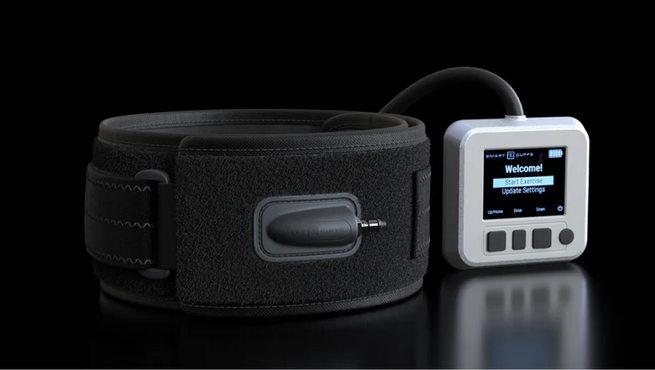
The SmartCuffs® 4.0 is the BFR system most aligned with the realities of an outpatient ortho post-surgical PT practice. Available as a single pair for smaller caseloads or as the full Clinical Set for multi-patient operation, it is the only clinical-volume BFR package on the market with peer-reviewed LOP validation, multi-patient capability, and no subscription gating. SmartCuffs® is in active use across more than 10,000 U.S. clinics, including Mayo Clinic, Cleveland Clinic, Rush, and Hospital for Special Surgery (HSS).
Personalized LOP for every patient. Each cuff automatically calibrates to the individual's limb occlusion pressure in approximately 30 seconds. Across a mixed post-surgical caseload, this means the pressure prescribed for a 65-year-old TKA patient and a 24-year-old ACL reconstruction is set against each individual's physiology, not a clinician's estimate.
Clinically validated. Independent peer-reviewed LOP validation (Mayo Clinic, 2022), which is the procurement standard for hospital-affiliated and compliance-bound practices.
FDA-listed, medical-grade materials. SmartCuffs® is a Class 1 device under the KCY product code (pneumatic tourniquet). The same FDA classification as Delfi, with materials and safety systems rated for daily clinical use on post-surgical limbs.
Stored patient profiles for repeatable progression. A post-surgical patient returning at week 2, week 6, and week 10 receives the same calibrated pressure protocol, regardless of which clinician runs the session. Across a 12-to-16-week rehab arc, this consistency is what separates a real BFR implementation from a guess.
Standalone Mode for clinic throughput. A single practitioner can connect two cuffs to a patient, calibrate to LOP, set the pressure, then disconnect the phone. The cuffs hold pressure independently while the clinician moves to the next patient. A fully equipped clinic can treat up to four patients with two cuffs each, or up to eight patients with one cuff each, all running concurrently. No other BFR system on the market currently matches this.
Quick Start Mode for back-to-back appointments. The cuff re-inflates to the previously stored pressure for that patient without the app, eliminating setup time at the start of each session. For a clinic running 8 to 12 post-surgical patients across a half-day block, this is a meaningful operational difference.
30-minute full recharge, 3x competitor battery life. Built for daily clinical use without mid-day downtime.
Free app, no subscription required. Core clinical features, including LOP detection, session management, and stored profiles, are accessible without an ongoing fee.
Cuff sizing for a mixed post-surgical caseload. The Clinical Set covers four sizes: small arm (8 to 13 inches), medium arm (13 to 18 inches), large leg (18 to 24 inches), and XL leg (24 to 29 inches). The full set covers virtually every adult patient an outpatient ortho practice will see.
Purchase the SmartCuffs® 4.0 Clinical Set or browse all SmartCuffs® options, including the SmartCuffs® 3.0 for budget-conscious practices.
|
Surgical Context |
Recommended Product |
Why |
|---|---|---|
|
ACL reconstruction (early post-op through return-to-sport) |
Strongest BFR evidence base. Stored profiles deliver repeatable pressure across the 6-to-9-month rehab timeline. Cross-references our ACL-specific guide. |
|
|
Total knee arthroplasty (pre-hab and post-op) |
Resting BFR Mode supports POD 1 passive BFR for muscle mass preservation. Standalone Mode supports multi-patient TKA caseloads. See our TKR-specific guide. |
|
|
Meniscal repair, meniscectomy, articular cartilage procedures |
Personalized LOP delivers low-load quad work within the protected-loading window without joint stress. |
|
|
Total hip arthroplasty, FAI surgery, hip labral repair |
Glute and quad strengthening within hip-precaution loading limits. XL leg cuff covers larger thigh circumferences in this population. |
|
|
Achilles tendon repair, ankle reconstruction |
Calf and lower-extremity strength preservation during immobilization and early-loading phases. |
|
|
Rotator cuff repair, Bankart, SLAP, biceps tenodesis |
Distal upper-extremity BFR during shoulder-protective phases, transitioning to operative-limb work as cleared. |
|
|
High-risk post-surgical patients (significant cardiac, vascular, hematologic comorbidities) |
Delfi PTS |
For high-risk patients in a hospital-affiliated outpatient setting, Delfi may be appropriate where institutional procurement requirements or physician preference dictate a higher-cost solution. |
|
Budget-constrained outpatient practices |
SmartCuffs® 3.0 (or 3.0 Pro) |
Same personalized LOP detection as the 4.0 at a reduced cost. Suitable for practices building a BFR service line incrementally. |
When can BFR be initiated in an outpatient post-surgical protocol?
For most arthroscopic and minimally invasive procedures, peer-reviewed research and institutional clinical guidelines support BFR initiation as early as 1 to 3 days post-operative, beginning with passive or low-load isometric work [4]. For more invasive procedures (TKA, THA, multi-ligament knee reconstruction), BFR typically starts in the first 1 to 2 weeks post-op once swelling and pain are managed and the surgical team has cleared the patient. The operating surgeon's clearance and individual recovery markers always govern the start point.
What pressure is appropriate for post-surgical patients?
Most clinical BFR protocols use 40 to 80 percent of personalized limb occlusion pressure, with 40 to 60 percent of LOP being typical for early post-op work and progressing toward 60 to 80 percent as the patient tolerates more loading [1, 2]. SmartCuffs® 4.0 calibrates to each patient's individual LOP in approximately 30 seconds, then allows the clinician to set the target percentage. Manual estimation is not appropriate for a post-surgical population because it ignores individual physiology.
What contraindications should be screened before adding BFR to a post-surgical protocol?
Commonly cited contraindications include venous thromboembolism (active or recent history), peripheral vascular compromise, sickle cell anemia, extremity infection, lymphadenectomy, uncontrolled hypertension, and recent vascular surgery [5]. Always screen each patient against current contraindication guidance and the operating surgeon's clearance. See our BFR safety review for a full breakdown.
Can BFR replace conventional progressive loading in a post-surgical protocol?
No. BFR is an adjunct, not a replacement. It addresses the loading-tolerance gap during the early and mid post-op windows when conventional heavy resistance work is contraindicated. Once the joint or tendon tolerates progressive loading, BFR continues to support hypertrophy at lower mechanical loads but does not substitute for the full progression to heavier work, neuromuscular re-education, manual therapy, or sport-specific reconditioning.
How does BFR fit alongside hospital-issued protocols?
Most hospital and surgeon-issued post-surgical protocols specify the standard rehab arc (precautions, weight-bearing status, range-of-motion progression, and exercise milestones) without prescribing or precluding BFR. Outpatient PT clinics typically integrate BFR into the strengthening and conditioning components of the published protocol once the patient enters the appropriate phase. For practices in hospital-affiliated outpatient systems, peer-reviewed LOP-validated devices are the standard.
How many cuffs does a high-volume ortho outpatient clinic actually need?
A practice running a meaningful post-surgical caseload should plan for sizing coverage across both arm and leg dimensions, plus enough cuffs to support concurrent treatment. The SmartCuffs® 4.0 Clinical Set includes 8 cuffs across 4 sizes (small arm, medium arm, large leg, XL leg), configured to cover the full range of patients without requiring additional pairs. Standalone Mode then makes those 8 cuffs operationally productive: a single clinician can run up to 4 patients with two cuffs each, or 8 patients with one cuff each, all concurrently.
How is BFR documented for billing and clinical records?
BFR is documented as a therapeutic exercise modality within the clinical note, typically referencing the device used, the calibrated LOP percentage, the rep scheme, and the targeted muscle groups. It does not have a dedicated CPT code; treatment is billed under the standard therapeutic exercise or therapeutic activities codes consistent with the rest of the rehab session. Practices new to BFR should align internal documentation templates with their billing and compliance teams before launch.
BFR Training for Knee Rehab — knee-rehab-specific protocol detail.
BFR Training for ACL Rehabilitation — ACL-specific deep dive.
BFR Training for Achilles Rupture Rehabilitation — Achilles-specific protocol.
What Is BFR Training? Benefits and Science (2026) — clinician primer.
BFR Physical Therapy: Conditions It Can Help Treat — full clinical-applications overview.
Is BFR Training Safe? Side Effects and Risks Explained — contraindications and screening.
Blood Flow Restriction Training After Orthopedic Procedures: A Scoping Review of Protocols and Outcome Measures. JOSPT Open, 2026 advance publication. DOI 10.2519/josptopen.2026.0176. https://www.jospt.org/doi/10.2519/josptopen.2026.0176
Blood flow restriction training in post-operative orthopedic rehabilitation: A systematic review and meta-analysis of randomized controlled trials. J Musculoskelet Surg Res, 2024. https://journalmsr.com/blood-flow-restriction-training-in-post-operative-orthopedic-rehabilitation-a-systematic-review-and-meta-analysis-of-randomized-controlled-trials/
Blood Flow Restriction Therapy and Its Use for Rehabilitation: A Comprehensive Review. PMC8811521 / PMID 35141538. https://pmc.ncbi.nlm.nih.gov/articles/PMC8811521/
Blood Flow Restriction Therapy After Knee Surgery: Indications, Safety Considerations, and Postoperative Protocol Recommendations. PMC6203234 / PMID 30377584. https://pmc.ncbi.nlm.nih.gov/articles/PMC6203234/
Overall Safety and Risks Associated with Blood Flow Restriction Training: A Literature Review. Military Medicine, Oxford Academic, 2022. https://academic.oup.com/milmed/article/187/9-10/1059/6548011
Sanford Health Sports Medicine. Personalized Blood Flow Restriction: Clinical Guideline. Institutional clinical guideline document. https://www.sanfordhealth.org/-/media/org/files/medical-professionals/resources-and-education/blood-flow-restriction-training-guideline.pdf
American Academy of Orthopaedic Surgeons. Study Explores Benefits of Blood-flow Restriction Training in Orthopaedic Rehabilitation. AAOS Now, June 2023. https://www.aaos.org/aaosnow/2023/jun/clinical/clinical02/
Use of Blood Flow Restriction (BFR) Therapy in Peri-operative Orthopedic Rehabilitation (Clinical trial protocol, NCT04384120). https://cdn.clinicaltrials.gov/large-docs/20/NCT04384120/Prot_SAP_001.pdf


