


Best BFR Systems for Post-Op Clinical Rehab: A 2026 Buyer's Guide for PT Practices
|
|
Time to read 9 min
|
|
Time to read 9 min
Choosing a BFR system for post-op clinical rehab is harder than it looks. The features that matter for a sports performance gym (portability, price, ease of setup) are almost entirely the wrong criteria for a PT clinic managing post-surgical patients.
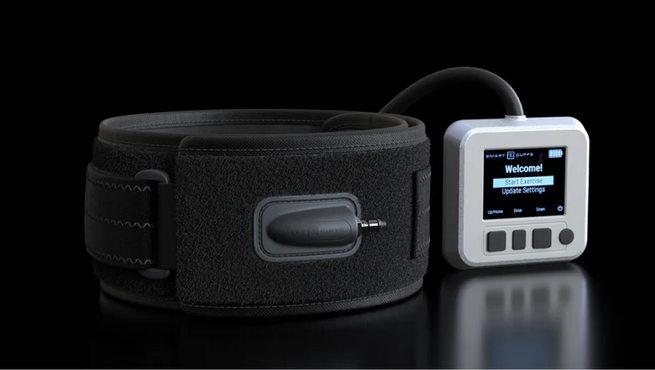
The best BFR systems for post-op clinical rehab share four non-negotiable traits: peer-reviewed LOP measurement accuracy, FDA listing as a Class 1 medical device, a cuff design purpose-built for clinical-volume use, and the ability to support concurrent multi-patient treatment without tying up staff. As of 2026, SmartCuffs 4.0 meets all four for standard post-surgical caseloads. Delfi PTS meets all four but is priced for hospital procurement and is most appropriate for high-risk patients with significant comorbidities. Saga 2.0 and Suji do not meet the peer-reviewed validation bar for clinical post-op use.
The gap between devices that look clinical and devices that perform clinically shows up in two places: the validation literature and the workflow. A BFR system that can't demonstrate LOP measurement accuracy in peer-reviewed research introduces systematic calibration error into every session built on that baseline. A system that forces one-clinician-per-patient throughput doesn't survive a 20-appointment post-surgical block.
This guide walks through the six criteria that separate clinical-grade BFR systems from consumer-adjacent products, compares all four major systems against them, and identifies which device belongs in which clinical context.
For each post-surgical patient, a BFR cuff is a clinical instrument. It needs to measure and deliver a physiologically calibrated pressure prescription, hold up under daily clinical use, and integrate into a workflow that's already running at capacity. These six criteria are the evaluation framework.
1. Peer-reviewed LOP measurement accuracy. Limb occlusion pressure is the measurement every BFR pressure prescription is built on. An inaccurate LOP baseline compounds across every subsequent session, because every percentage-based target is calculated from that starting number. For post-surgical patients with narrow therapeutic windows, this is the first criterion that must be met. Only two BFR systems on the market currently have peer-reviewed LOP accuracy validation published in indexed research: SmartCuffs and Delfi PTS.
2. FDA listing as a Class 1 medical device. FDA listing under product code KCY (pneumatic tourniquet) is the minimum regulatory bar for a device used in a clinical post-op setting. It signals the device has been evaluated under an FDA-recognized product classification and meets the associated safety requirements. Not all BFR devices on the market carry this classification.
3. Purpose-built for BFR vs. repurposed tourniquet. A device designed for BFR therapy integrates LOP detection, pressure prescription, and clinical workflow management in a unified system. A retrofitted surgical tourniquet brings hospital-grade pressure accuracy into an outpatient PT setting, but it wasn't engineered around the workflow, throughput, or cost structure of a rehabilitation practice.
4. Multi-patient concurrent use capability. An outpatient post-surgical clinic running a meaningful caseload can't operate on a one-device-per-patient model without dedicating staff time that isn't available. The ability to support concurrent patient treatment under a single clinician is a practical requirement, not a feature upgrade.
5. Battery life and recharge time. A BFR system used across a full clinical day needs battery duration and recharge cycles that match the schedule. Devices that require mid-day downtime or extended charging windows between patient blocks create a scheduling constraint.
6. Price relative to clinical value. Procurement cost needs to make sense relative to clinical volume and the practice's business model. That includes upfront device cost, any subscription fees on clinical features, and the total cost of the cuff set needed to cover a full adult patient size range.
This table evaluates all four major BFR systems against the six criteria above. SmartCuffs data is drawn from peer-reviewed publications and client-attested brand facts. Competitor data is drawn from publicly available sources. Pricing rows are volatile. Verify against current product pages before any procurement decision.
|
Criterion |
SmartCuffs 4.0 |
Delfi PTS |
Saga 2.0 |
Suji |
|---|---|---|---|---|
|
Peer-reviewed LOP validation |
Yes |
Yes |
No |
No |
|
FDA-listed Class 1 (KCY) |
Yes |
Yes |
No |
Yes |
|
Purpose-built for BFR |
Yes |
No (retrofitted tourniquet) |
Yes |
Yes |
|
Multi-patient concurrent use |
Yes (up to 8 cuffs standalone) |
No |
Limited |
Limited |
|
Country of manufacture |
USA |
Canada |
China |
China |
|
Est. price range |
$499-$1,699 |
$5,000+ |
$388-$1,346 |
Under $500 |
|
Post-op clinical recommendation |
Primary |
High-risk exception |
Not recommended |
Not recommended |
Pricing is volatile. Verify live product pages before procurement.
For post-op clinics running a multi-patient block, SmartCuff’s Standalone Mode is the operational differentiator. A clinician calibrates each cuff to the patient's individual LOP, sets the pressure, and disconnects the phone. The cuffs operate independently while the clinician moves to the next patient. A fully equipped clinic can treat up to four patients with two cuffs each, or up to eight patients with a single cuff each, all concurrently. No other BFR system on the market currently supports this.
Battery and recharge performance are built for daily clinical use: 30-minute full recharge and 3x competitor battery life. The free app with no subscription gates core clinical features, including LOP detection, session management, and stored patient profiles, at no recurring cost.
Here is what SmartCuffs 4.0 looks like in a working post-surgical PT clinic:
The SmartCuffs 4.0 Clinical Set is the standard configuration for post-op PT practices. For smaller practices or those building a BFR service line incrementally, the single pair option and the SmartCuffs 3.0 are available.
|
Clinical Scenario |
Recommended System |
Why |
|---|---|---|
|
Standard post-op outpatient PT (ACL, TKA, meniscal, shoulder, Achilles) |
Peer-reviewed LOP validation, FDA Class 1, standalone multi-patient mode, clinical price point |
|
|
High-volume multi-patient post-op block |
Standalone Mode supports up to 8 concurrent cuffs under a single clinician |
|
|
High-risk post-surgical patients with cardiac, vascular, or hematologic comorbidities |
Delfi PTS |
Hospital-grade procurement, physician or protocol-driven selection for complex cases |
|
Budget-limited practice starting a BFR service line |
Same personalized LOP detection at a lower cost |
The minimum bar for post-surgical clinical use is peer-reviewed LOP measurement accuracy and FDA listing as a Class 1 pneumatic tourniquet (product code KCY). Beyond that, look for automated LOP calibration, a cuff set covering the full range of adult limb circumferences your caseload requires, stored patient profiles for consistent multi-visit prescriptions, and concurrent multi-patient throughput capability if your schedule runs overlapping sessions. Subscription-free core features and a purpose-built BFR workflow rather than a retrofitted tourniquet are worth factoring in as well. For a vendor-agnostic guide on how to evaluate and choose BFR cuffs, see the linked overview.
Yes, on the LOP measurement accuracy criterion. Clinically validated in a study conducted at Mayo Clinic, SmartCuffs PRO automated LOP measurement was found equivalent to the manual Doppler ultrasound gold standard across 96 upper- and lower-extremity measurements (upper extremity P=.29, lower extremity P=.09). SmartCuffs is in active use across more than 10,000 U.S. clinics, including Mayo Clinic, Cleveland Clinic, Rush, and Hospital for Special Surgery. The institutional footprint for post-surgical and orthopedic PT is well established.
SmartCuffs 4.0 is purpose-built for BFR therapy, priced for outpatient PT practices ($499-$1,699 range), and supports concurrent multi-patient treatment in standalone mode. Delfi PTS is a retrofitted surgical tourniquet priced at $5,000 or more, designed for hospital-grade institutional procurement. For a standard post-surgical outpatient PT caseload without significant patient comorbidities, SmartCuffs 4.0 is the more clinically and operationally appropriate choice. Delfi is appropriate when institutional procurement requirements, physician preference, or complex patient comorbidities drive the selection.
Saga 2.0 failed peer-reviewed LOP validation and is not FDA-listed. LOP measurement accuracy is the cornerstone of a calibrated BFR prescription. Every percentage-based pressure target is built on that baseline number. A device that failed independent validation of that measurement introduces systematic calibration error into every session. Add the absence of FDA Class 1 listing, and Saga doesn't meet the minimum clinical bar for a post-surgical patient population, whose therapeutic windows are narrower than general fitness populations.
For most arthroscopic and minimally invasive procedures, peer-reviewed literature and institutional clinical guidelines support BFR initiation as early as 1 to 3 days post-operative, starting with passive or low-load isometric work. For more invasive procedures like TKA or THA, BFR typically starts in the first one to two weeks once swelling and pain are managed and the surgical team has cleared the patient. The operating surgeon's clearance and individual recovery markers always govern the start point. See is BFR training safe for the full contraindication screening framework.
Most clinical post-surgical BFR protocols use 40 to 80 percent of personalized limb occlusion pressure, with 40 to 60 percent typical for early post-op work and 60 to 80 percent as the patient progresses. The key is that pressure must be calibrated to each individual patient's LOP, not estimated or set at a fixed number. SmartCuffs 4.0 calibrates to each patient's individual LOP in approximately 30 seconds and then allows the clinician to set the target percentage. For a broader overview of what BFR training does and how it works, see the Smart Tools primer.
For a practice running a meaningful post-surgical caseload, the SmartCuffs 4.0 Clinical Set is the standard configuration. It includes 8 cuffs across four sizes (small arm, medium arm, large leg, XL leg), covering the full range of adult patient limb dimensions. Standalone Mode makes those 8 cuffs operationally productive: a single clinician can run up to four patients with two cuffs each, or eight patients with one cuff each, concurrently.
Commonly cited contraindications include active or recent venous thromboembolism, peripheral vascular compromise, sickle cell anemia, extremity infection, lymphadenectomy, uncontrolled hypertension, and recent vascular surgery. Always screen each patient against current contraindication guidance and the operating surgeon's clearance before initiating post-surgical BFR. A full breakdown of BFR side effects, safety, and contraindication screening is available on the Smart Tools blog.
SmartCuffs 4.0 is built for the post-surgical caseload: peer-reviewed LOP validation, standalone multi-patient mode that keeps your schedule running, and free core clinical features with no subscription. More than 10,000 U.S. clinics use SmartCuffs.
Explore the SmartCuffs 4.0 Clinical Set or browse all SmartCuffs options. For institutions and volume purchasing, contact Smart Tools directly.


