


Post-THA patients often enter outpatient PT facing meaningful quad and glute deficits, with hip precautions that restrict exercise selection and tissue in a healing phase where high-load resistance is contraindicated. The conventional answer is progressive low-load exercise, and it works over a long enough timeline. For patients with a compressed outpatient window, it is often not enough.
Blood flow restriction training can help address early post-THA strength deficits when when conventional strength training loads are contraindicated. Partial vascular occlusion at the proximal thigh drives hypertrophy and strength gains at loads as low as 20 percent of 1RM, well within what the healing hip can tolerate, making it a clinically useful option when the loading window is short and the strength deficit is real.
Why BFR works for hip replacement recovery
BFR training at 20 to 40 percent of 1RM creates a metabolic and hypoxic environment that can stimulate hypertrophic adaptation at loads that would not ordinarily produce it. By partially occluding venous return while maintaining arterial inflow, BFR therapy generates the cellular stress associated with higher-load work, though the mechanisms are not fully equivalent and outcomes vary by protocol, population, and individual response.
Centner et al., 2019 confirmed in a systematic review that low-load BFR can produce strength and hypertrophy outcomes comparable to high-load resistance training in some contexts. Lixandrao et al., 2018 found comparable hypertrophic results in older adults, a population that shares some characteristics with post-THA patients, though the comparison is imperfect: surgical healing, hip precautions, pain, swelling, and comorbidities all affect how individual patients respond and should inform how any protocol is applied.
The load range of 20 to 40 percent of 1RM sits well within what a healing hip can typically tolerate, making BFR a potentially useful adjunct when appropriately screened and individualized. For a full overview of the mechanism, see the blood flow restriction training primer.
BFR protocol guide for Post-THA putpatient PT
A three-phase protocol maps across the typical six-week outpatient window. Cuff placement is at the proximal thigh throughout all phases.
Setup: two steps before every session
Review hip precautions. The surgical approach determines which movements are restricted. Posterior-approach patients typically carry restrictions on hip flexion beyond 90 degrees, internal rotation, and adduction. Anterior-approach patients typically restrict extension and external rotation. These precautions govern exercise selection in every phase.
Establish LOP. LOP (the pressure needed to occlude the limb) is measured individually for each patient before each session. Working pressure is prescribed as a percentage of that individualized LOP, not a fixed cuff pressure. In a post-THA population where swelling and tissue status shift week to week, this individualization is not optional.
Phase 1: Weeks 1 to 2
Goal: Quad activation, vascular tolerance, and establishing baseline BFR response.
Parameters: LOP 40 to 50 percent; load 15 to 20 percent of 1RM; 4 sets (30-15-15-15); 30-second rest intervals with cuff inflated between sets; cuff deflated between exercise changes.
Exercise selection: Quad sets, supine straight leg raises, supine hip abduction within the range permitted by the surgical approach. No hip flexion beyond precaution limits.
Safety monitoring: Ask about limb sensation at the end of each set. Deflate immediately if the patient reports sharp pain at the surgical site or skin blanching beyond the cuffed segment.
Phase 2: Weeks 3 to 4
Goal: Add posterior chain loading as tissue healing allows.
Parameters: LOP 50 to 60 percent; load 20 to 30 percent of 1RM; 4 sets (30-15-15-15); 30-second rest with BFR cuff inflated. Recalculate LOP if the presentation has changed materially since the last session.
Exercise selection: Progress quad sets to short arc quads. Add prone or standing terminal hip extension where the posterior precaution allows. Introduce glute bridges where surgical clearance permits. Side-lying hip abduction can progress to standing hip abduction once weight-bearing clearance is confirmed.
Phase 3: Weeks 5 to 6 and beyond
Goal: Functional strength integration and return to daily activity.
Parameters: LOP 60 to 80 percent; load 20 to 40 percent of 1RM; 4 sets (30-15-15-15), adjusted by exercise type for step or gait-loaded work. Continue individualized LOP recalculation each session.
Exercise selection: Step-up progressions, lateral step-down work, and gait-loaded exercises appropriate to current surgical clearance. Progress is determined by clearance and clinical response, not solely by week number.
BFR session frequency follows the patient's standard outpatient visit schedule (typically two to three sessions per week). For a reference library of lower-extremity exercises appropriate for each phase, see the guide to BFR exercises for the lower extremity.
Leading BFR systems compared
For the post-THA population, two gates narrow the field: peer-reviewed LOP validation against the Doppler ultrasound gold standard, and FDA Class 1 listing under product code KCY. Only SmartCuffs® and Delfi PTS clear both. Airbands failed published LOP validation. Suji holds FDA listing but has no peer-reviewed LOP validation study. For the patient screening and contraindication framework that determines which post-THA patients are appropriate BFR candidates, see the BFR safety and screening resource.
|
Feature |
SmartCuffs |
Delfi PTS |
Airbands by Saga |
Suji |
|---|---|---|---|---|
|
Peer-Reviewed LOP Validation |
✓ |
✗ |
||
|
Clinical-Grade LOP Repeatability |
✓ |
✓ |
✗ |
✗ |
|
Medical Grade Materials |
✓ |
✓ |
✗ |
✗ |
|
Multi-Cuff Capability |
✓ |
✗ |
✓ |
✓ |
|
Quick Start Mode (app-free) |
✓ |
✗ |
✗ |
✗ |
|
Free App (core features don’t require a subscription) |
✓ |
✗ |
✓ |
✓ ($5/m for guided programs. Full access is free to verified PTs/trainers) |
|
FDA-Listed* |
✓ |
✓ |
✗ |
✓ |
|
Purpose-Built for BFR |
✓ |
✗ (retrofitted) |
✓ |
✓ |
|
Made in USA |
✓ |
✗ (Canada) |
✗ (China) |
✗ (China) |
|
Price Range |
$499–$1,699 |
$5,000+ |
$440-$1780 |
<$500 |
Note: Delfi comparison is based on publicly available clinical and regulatory information.
Why SmartCuffs® for hip replacement recovery
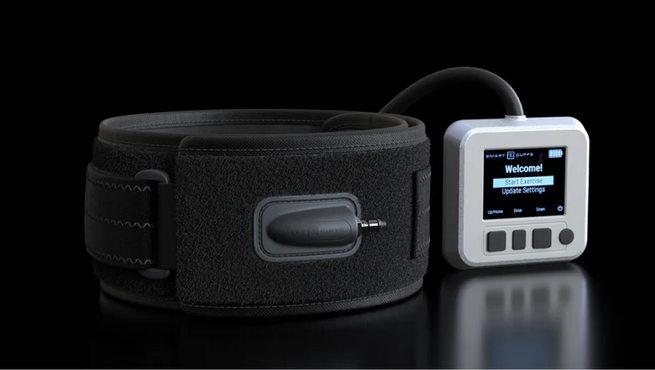
SmartCuffs® 4.0 is the right system for most post-THA outpatient PT programs. It carries peer-reviewed LOP validation (a study conducted at Mayo Clinic, equivalent to the Doppler gold standard across 96 limbs, P=.09 lower extremity), FDA Class 1 listing under product code KCY, and is in active use at more than 10,000 U.S. clinics including Mayo Clinic, Cleveland Clinic, and Hospital for Special Surgery.
The distinguishing operational feature is Standalone Mode: up to 8 cuffs run simultaneously after LOP calibration, without requiring the clinician to stay connected to the app. For a practice running four post-THA patients with two cuffs each, that concurrency is what makes BFR viable on a half-hour schedule. The SmartCuffs® 4.0 Clinical Set includes all four cuff sizes (small arm through XL leg), covering the proximal thigh placement required for THA work across virtually every adult thigh circumference. No subscription is required for core clinical features.
For post-THA patients with significant cardiac, vascular, or hematologic comorbidities, Delfi PTS is the appropriate exception. It carries the same validation and FDA listing, but costs over $5,000, runs one patient at a time, and requires a subscription.
|
Clinical phase and context |
Recommended system |
Rationale |
|---|---|---|
|
Early post-op activation (Weeks 1 to 2) |
Automated, individualized LOP calibration ensures clinically precise pressure control when tissue is healing and loading tolerance is narrow. Validated in a study conducted at Mayo Clinic (PMID 35747637). In active use at Mayo Clinic, Cleveland Clinic, Rush, and HSS. |
|
|
Posterior chain loading (Weeks 3 to 4) |
Standalone Mode supports up to 8 concurrent cuffs after LOP calibration, enabling a PT to run multiple post-THA patients simultaneously without staying tethered to the app. |
|
|
Functional integration (Weeks 5 to 6+) |
Multi-cuff concurrency and 30-minute full recharge support high-throughput step and gait work across a half-day schedule. |
|
|
High-risk patients with comorbidities |
Delfi PTS |
For post-THA patients with significant cardiac, vascular, or hematologic comorbidities in a hospital or high-acuity setting, Delfi carries the same peer-reviewed LOP validation and FDA Class 1 listing with hospital-grade infrastructure. |
|
Budget-constrained practice |
Same peer-reviewed LOP validation and FDA Class 1 listing as the 4.0 at a lower entry cost. Appropriate for practices building BFR capacity incrementally. |
Browse all SmartCuffs® options or use the SmartTools cuff selector to match a configuration to your practice volume and patient mix.
FAQ
Can BFR training be used after hip replacement surgery?
Yes. BFR hip replacement training is appropriate for post-THA patients in the outpatient phase, provided the PT has reviewed hip precautions, screened for absolute BFR contraindications, and is using a system with validated, individualized LOP calibration. The protocol applies BFR at 20 to 40 percent of 1RM, within what the healing hip can tolerate.
When can PTs start BFR after total hip arthroplasty?
There is no single universal start date. BFR may be introduced once the surgeon's precautions, wound status, and clinical screening allow it. Published postoperative rehabilitation literature notes it has been used as early as 2 to 3 weeks postsurgery in some settings, but timing varies by patient, surgical approach, and surgeon guidance. The protocol parameters in Phase 1 reflect a conservative entry point appropriate for early outpatient use; they are not a fixed week-one prescription.
Is BFR safe for post-THA patients who have precautions?
BFR can be used safely in appropriately screened post-THA patients, but exercise selection must follow the patient's specific surgical precautions and contraindication screening. Precautions vary by surgical approach and individual surgeon protocol, so they should not be assumed; confirm them before each phase of the program. Absolute contraindications including active DVT, severe peripheral artery disease, and clotting disorders require screening before any application. See BFR safety and screening for the full screening protocol.
Does BFR help with quad and glute strength after hip replacement?
Yes. BFR may help improve glute and quadriceps strength after THA by allowing lower-load exercise during a phase when heavier loading may not be appropriate. Muscle atrophy is common following musculoskeletal surgery, and published systematic reviews support BFR as a means of generating hypertrophic adaptation at loads well below those typically required for strength gains (Hughes et al., 2017, PMID 28259850). The degree of benefit will vary by patient, protocol, and individual response.
What cuff should physical therapists use for BFR hip replacement rehab?
Use a proximally placed thigh cuff that allows individualized limb occlusion pressure measurement. Cuff width and sizing should match the patient's limb and the device's validated setup guidelines. The BFR position stand recommends individualized pressure based on LOP; both automated and manual Doppler-based systems can support this when applied correctly. SmartCuffs® 4.0 includes multiple leg cuff sizes and carries peer-reviewed LOP validation from a study conducted at Mayo Clinic, covering the proximal thigh placement required for post-THA work.
How does SmartCuffs® compare to Delfi for post-THA physical therapy?
Both carry peer-reviewed LOP validation and FDA Class 1 listing. SmartCuffs® 4.0 supports up to 8 concurrent patients in Standalone Mode, costs significantly less, and requires no subscription. Delfi PTS is appropriate for patients with significant cardiac, vascular, or hematologic comorbidities in high-acuity or hospital-affiliated settings.
Can BFR with light weights produce meaningful muscle growth after hip replacement?
Yes, within limits. BFR is designed to generate the metabolic conditions associated with muscle growth at loads that standard low-load exercise cannot match. By partially restricting venous outflow at the proximal thigh, BFR creates the hypoxic and metabolic stress that drives hypertrophic adaptation, even when the patient is working with light weights that would not ordinarily produce those outcomes. Published systematic reviews support muscle growth and strength gains from low-load BFR compared to low-load exercise alone, though response varies by patient, protocol, and where they are in their recovery.
Does BFR affect growth hormone, and does that matter for post-THA rehab?
BFR exercise has been associated with acute elevations in circulating growth hormone in healthy populations, a response thought to be related to the metabolic stress created by partial occlusion. Whether that hormonal response meaningfully accelerates tissue recovery or muscle adaptation in post-THA patients specifically is not yet well established in the literature. The more clinically relevant benefit for this population is the ability to drive hypertrophic adaptation through low intensity exercise at loads the healing hip can tolerate, rather than any hormonal mechanism.
Can BFR be applied to hamstring exercises after hip replacement?
Potentially, in later phases and where surgical precautions allow it. Proximal thigh cuff placement makes BFR applicable to exercises that load the hamstrings, such as prone hip extension or terminal knee flexion variations, but exercise selection must always be governed by the patient's specific precautions and surgical approach. Posterior-approach patients in particular carry restrictions that may limit prone positioning or hip extension range early in recovery. Hamstring-targeted work under BFR is more appropriate for Phase 2 or Phase 3 of the protocol, once posterior chain loading has been cleared by the surgeon and the patient's clinical response supports progression.
References
- Centner C, et al. (2019). Effects of Blood Flow Restriction Training on Muscular Strength and Hypertrophy in Older Individuals: A Systematic Review and Meta-Analysis. Sports Medicine. PMID 30306467
- Lixandrao ME, et al. (2018). Magnitude of Muscle Strength and Mass Adaptations Between High-Load Resistance Training Versus Low-Load Resistance Training Associated with Blood-Flow Restriction: A Systematic Review and Meta-Analysis. Sports Medicine. PMID 29043659
- Hughes L, et al. (2017). Blood Flow Restriction Training in Clinical Musculoskeletal Rehabilitation: A Systematic Review and Meta-Analysis. British Journal of Sports Medicine. PMID 28259850
- Ferraz RB, et al. (2018). Benefits of Resistance Training with Blood Flow Restriction in Knee Osteoarthritis. Medicine and Science in Sports and Exercise. PMID 29266093
- Patterson SD, et al. (2019). Blood Flow Restriction Exercise: Considerations of Methodology, Application, and Safety. Frontiers in Physiology. PMC6389769
- Abbas MJ, et al. (2022). An Automated Technique for the Measurement of Limb Occlusion Pressure During Blood Flow Restriction Therapy Is Equivalent to Previous Gold Standard. Arthroscopy, Sports Medicine, and Rehabilitation. PMID 35747637


