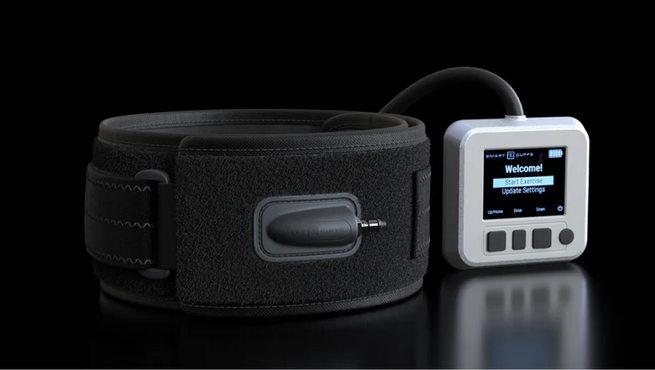



Every BFR pressure prescription is built on one number: limb occlusion pressure. Get that number wrong and every session that follows is systematically miscalibrated.
In post-surgical rehab, that margin matters. Tissue is healing, joint mechanics are altered, and a systematic LOP error of even 15 to 20 mmHg can push a patient outside the therapeutic range on both ends: under-restricting loses the stimulus; over-restricting compounds cardiovascular load on a healing limb. That is why two independent research teams chose LOP accuracy as their primary validation criterion.
The 2022 Mayo Clinic prospective cohort study directly validated automated LOP measurement against the manual Doppler ultrasound gold standard across 96 limbs, finding no statistically significant difference on either upper (P=.29) or lower (P=.09) extremity.
A 2024 counterbalanced study from the USF Muscle Laboratory at the University of South Florida took a different approach: it compared acute physiological and perceptual responses between SmartCuffs PRO and a traditional research-grade device across two LOP conditions, finding similar outcomes in muscle thickness, strength, and cardiovascular measures.
Why does LOP accuracy matter in post-surgical BFR rehab?
LOP is a cuff pressure used to occlude arterial blood flow to a limb. All BFR pressure prescriptions, whether 40% LOP for early post-op tissue loading or 80% LOP for strength-focused phases, use it as the baseline. An inaccurate LOP reading does not produce a small error in one session. It compounds across every subsequent prescription, because every percentage-based target is calculated from that baseline.
For post-surgical patients, the tolerance window is narrower than in general fitness populations. Tissue is healing. Joint mechanics are altered. A systematic LOP error of even 15 to 20 mmHg can shift a patient outside the therapeutic range, either under-restricting (losing efficacy) or over-restricting (increasing discomfort and cardiovascular load). That is why two independent research teams chose LOP measurement accuracy as their primary validation criterion. For an overview of what conditions BFR physical therapy can help treat across post-surgical and outpatient contexts, that reference covers the full clinical scope.
What did the Mayo Clinic study test, and what did it find?
SmartCuffs PRO automated LOP measurement was found equivalent to the manual Doppler ultrasound gold standard across 96 upper- and lower-extremity measurements. The study found no statistically significant difference between the two methods on either extremity: P=.29 for the upper extremity and P=.09 for the lower extremity. No patient reported pain or discomfort during LOP measurement (Mayo Clinic, 2022).
The study was published in Arthroscopy, Sports Medicine, and Rehabilitation in 2022 as a Level II prospective cohort. Researchers from the Department of Orthopedic Surgery at Mayo Clinic, along with athletic training staff from the Minnesota Timberwolves, evaluated the automated measurement technique against the established Doppler method on the same patients under the same conditions. The device evaluated was the SmartCuffs PRO. The authors' conclusion was direct: automated LOP measurement showed no statistically significant difference to the previous gold standard.
For post-surgical and orthopedic clinicians, Level II prospective cohort evidence from a Mayo Clinic orthopedic surgery team carries substantial clinical weight in purchasing and protocol decisions. Clinicians applying these findings in ACL and orthopedic post-surgical rehabilitation will find that evidence-level context directly relevant to device selection.
The USF Muscle Lab study, broken down
The 2024 USF Muscle Laboratory study took a different approach: rather than validating LOP measurement accuracy alone, it tested whether SmartCuffs PRO produced the same acute physiological and perceptual outcomes as a traditional research-grade device across multiple exercise conditions (Physiological Measurement, 2024).
Study design: Counterbalanced, repeated-measures. 44 resistance-trained adults (33 male, 11 female) completed four protocols across two lab visits: unilateral elbow flexion at 30% 1RM to failure at both 40% and 80% LOP using either SmartCuffs PRO (5.5 cm automated cuff) or the Hokanson E20 rapid inflation device (5 cm nylon cuff requiring manual Doppler measurement), the standard laboratory-grade control device.
LOP accuracy: No statistically significant difference between SmartCuffs PRO and Doppler readings (P=0.07).
Muscle outcomes: Comparable ultrasound-measured muscle thickness increases at 40% LOP (P=0.68) and 80% LOP (P=0.14).
Strength outcomes: Equivalent isometric strength reductions in both conditions (40% LOP: P=0.53; 80% LOP: P=0.68). Average decrement was 44 to 47% from baseline in both groups.
Cardiovascular responses: Equivalent post-exercise blood pressure elevations across both devices and both pressure levels (systolic approximately +14 mmHg; diastolic approximately +6 mmHg).
The study was published June 2024 in Physiological Measurement by researchers from the Exercise Science Program at the University of South Florida's Muscle Laboratory. For a primer on how blood flow restriction training works and the role of LOP in automated cuff protocols, SmartTools' BFR overview covers the foundational mechanics.
What both studies confirm about SmartCuffs PRO?
The Mayo 2022 study validated measurement accuracy directly: 96 limbs, Doppler vs. automated, Level II prospective cohort, P values of .29 and .09. The USF 2024 study compared acute responses between devices and found broadly similar physiological outcomes under the tested conditions.
Convergent findings from two independent labs, testing different questions, represent a stronger evidence base than either study alone. When two separate research teams arrive at the same answer through different methodologies, the probability of systematic measurement artifact or study-specific noise drops substantially. For a broader look at whether BFR training works across clinical populations, the SmartTools evidence review covers the full research base.
What do the perceptual and performance findings mean for patient compliance?
The USF study produced a finding the Mayo study was not designed to capture: at 80% LOP, participants using SmartCuffs PRO reported significantly lower discomfort across all four exercise sets compared to the traditional laboratory device (P<0.001). They also completed more repetitions in sets 2 through 4 (57.6 total vs. 52.8; P=0.006).
This matters in post-surgical rehab in practice. At higher restriction levels, which are appropriate for strength-focused phases of recovery, patient-reported discomfort is a real compliance variable. Protocols that exceed a patient's comfort threshold get modified mid-session, abandoned early, or skipped at the next appointment. Lower discomfort at equivalent physiological load means the prescribed protocol can be applied as written.
The repetition difference at 80% LOP suggests the same pressure-based stimulus produces slightly higher training volume with the automated cuff. The researchers noted this may be related to pressure stability during exercise. More volume at the same prescription is a meaningful clinical advantage in the limited session windows typical of post-surgical outpatient PT and orthopedic recovery contexts.
What limitations did the research teams report?
Both studies disclosed limitations that clinicians should understand before drawing clinical conclusions.
From the USF 2024 study: Six of 88 SmartCuffs PRO measurements required a manual Doppler fallback due to device reading errors (6.8% of readings). The stepwise pressure increment method used (10 mmHg steps) limited precise simultaneous pressure confirmation between devices. The auto-regulation feature was not activated during the study, so outcomes under automated pressure adjustment during exercise may differ. The participant cohort was unbalanced by sex (33 male, 11 female), limiting sex-stratified analysis.
From the Mayo 2022 study: The Level II prospective cohort design, while appropriate for a diagnostic study, does not carry the randomization controls of a Level I RCT. The study evaluated the measurement technique specifically; clinical outcome data across populations with post-surgical tissue, older adults, or comorbidities were outside its scope.
Neither limitation undermines the core finding. Both studies found automated LOP equivalent to Doppler. The USF error rate of 6.8% is worth noting: clinicians should have a Doppler available as a backup when measurement errors occur. That is standard practice in any protocol-grade BFR environment regardless of device.
Where SmartCuffs PRO fits in evidence-based post-op protocols
SmartCuffs PRO is the device evaluated in the two studies described in this article. The current generation product is SmartCuffs 4.0, which uses similar but not identical automated LOP measurement technology to the SmartCuffs 3.0 and is FDA-listed as a Class 1 pneumatic tourniquet device (product code KCY), the same regulatory classification as clinical-grade BFR cuffs from other manufacturers.
For post-surgical and orthopedic PT practices, the practical takeaway from both studies is this: automated LOP measurement via SmartCuffs PRO removes the Doppler probe and the manual technique from the clinical workflow without sacrificing measurement accuracy. That means shorter setup time per patient, consistent pressure application across staff with different Doppler experience levels, and a measurement method the peer-reviewed literature supports.
More than 10,000 U.S. clinics currently use SmartCuffs, including sites at Mayo Clinic, Cleveland Clinic, Rush, and Hospital for Special Surgery. The device operates in the same post-surgical and orthopedic PT environments these studies were designed to validate. For a clinical overview of how BFR training works and whether it is safe, see the linked resource.
Frequently Asked Questions
What is limb occlusion pressure, and why does it matter for BFR?
Limb occlusion pressure (LOP) is a pneumatic cuff pressure used to occlude arterial blood flow to a limb. It is the baseline measurement all BFR pressure prescriptions are expressed as a percentage of, typically 40 to 80% LOP depending on the protocol and patient population. An accurate LOP measurement is essential because every pressure setting downstream depends on it. If LOP is off, the therapeutic window shifts, and clinical outcomes (muscle activation, cardiovascular response, and patient safety) shift with it.
Is SmartCuffs validated for both upper and lower extremity LOP accuracy?
Yes. The 2022 study conducted at Mayo Clinic evaluated 96 limbs across both upper and lower extremity and found no statistically significant difference between SmartCuffs PRO automated LOP and the Doppler gold standard in either location. Upper extremity: P=.29. Lower extremity: P=.09. Clinicians working in shoulder and lower-limb post-surgical rehab have peer-reviewed evidence supporting LOP accuracy in both contexts.
How many peer-reviewed studies support SmartCuffs LOP accuracy?
Two independent peer-reviewed studies support SmartCuffs PRO LOP accuracy as of 2024. The first was published in 2022 in Arthroscopy, Sports Medicine, and Rehabilitation by researchers at Mayo Clinic (PMID 35747637). The second was published in 2024 in Physiological Measurement by the USF Muscle Laboratory at the University of South Florida (DOI: 10.1088/1361-6579/ad548c). Both found automated LOP equivalent to the manual Doppler gold standard across different study designs and participant populations.
What happens if LOP is measured inaccurately during post-surgical BFR?
Inaccurate LOP creates a systematic error in every pressure prescription built on it. A reading that runs too high results in overprescription, increasing discomfort, cardiovascular load, and the risk of adverse responses in patients whose tissue is still healing. A reading that runs too low means the therapeutic restriction threshold is never reached and the session produces less muscle stimulus than intended. For post-surgical patients with narrow therapeutic windows, this difference is clinically significant rather than acceptable variance.
Is the SmartCuffs 3.0 Pro the same as the current SmartCuffs 4.0?
No. SmartCuffs 3.0 Pro is a prior generation and is the device evaluated in both peer-reviewed studies cited in this article. SmartCuffs 4.0 is the current flagship model. Its automated LOP measurement technology is similar to the 3.0's, but not identical. The 4.0 adds standalone mode supporting up to 8 simultaneous cuffs, 30-minute full recharge, and expanded cuff sizes. The peer-reviewed LOP accuracy validation applies to the 3.0 generation. Clinicians evaluating the 4.0 should confirm generation-to-generation technology continuity with SmartTools directly.
Explore SmartCuffs 4.0 for Your Practice
References
- Abbas MJ, Dancy ME, Marigi EM, Khalil LS, Jildeh TR, Buckley PJ, Gillett J, Burgos W, Okoroha KR. "An Automated Technique for the Measurement of Limb Occlusion Pressure During Blood Flow Restriction Therapy Is Equivalent to Previous Gold Standard." Arthroscopy, Sports Medicine, and Rehabilitation. 2022;4(3):e1127-e1132. DOI: 10.1016/j.asmr.2022.04.002. PMID 35747637
- Moreno EN, Figueroa EC, Heath AW, Buckner SL. "An examination of acute physiological and perceptual responses following blood flow restriction exercise using a traditional research device or novel, automated system." Physiological Measurement. 2024 Jun 18. DOI 10.1088/1361-6579/ad548c


