


That constraint is where BFR fits. Blood flow restriction training (BFR) has become a practical tool in outpatient musculoskeletal physical therapy, particularly where load tolerance is compromised. By delivering a therapeutic stimulus at 20 to 40% 1RM, BFR helps patients tolerate loading when pain limits conventional resistance training. Two scoping reviews covering 24 studies (Burton and McCormack, 2022 and Öberg et al., 2025, both discussed below) report consistent functional improvements across patellar, Achilles, and other tendinopathies at loads patients can actually tolerate.
Why do patients with tendinopathy struggle with traditional heavy loading?
Heavy-load resistance training (HLRT) is the current standard for tendinopathy rehabilitation, with most protocols prescribing 70 to 85% of 1-repetition maximum. The evidence base supports this dose: tendons require high mechanical strain to stimulate the collagen remodeling and structural adaptation that leads to recovery. The clinical problem is compliance. When load-induced tendon pain exceeds a patient's tolerance threshold, they reduce range of motion, stop the set, or skip sessions entirely. The therapeutic dose is never delivered.
This is the problem BFR targets. If a patient cannot tolerate what heavy resistance training requires, whether from pain, recent surgery, or concurrent joint pathology, the rehab plan stalls. BFR provides a route to therapeutic stimulus without a loading ceiling.
How does BFR stimulate tendon adaptation at loads patients can actually tolerate?
BFR restricts venous outflow while maintaining partial arterial blood flow, creating localized hypoxia and metabolic accumulation in the exercising limb. At 20 to 40% 1RM, this environment is hypothesized to support muscular adaptations through metabolic stress and other mechanisms. For tendons, the mechanism is less characterized than in muscle, but the downstream evidence is clear.
Centner et al. (2019) demonstrated in a controlled study that low-load BFR training induced comparable morphological and mechanical Achilles tendon adaptations to high-load resistance training over a 14-week intervention, including similar increases in tendon cross-sectional area and stiffness (J Appl Physiol, PMID 31725362). The finding establishes that the tendon, not just the surrounding muscle, responds to BFR stimulus at low loads.
The tendinopathy evidence base, broken down
Two scoping reviews define the current state of the evidence.
Burton and McCormack (2022), published in Frontiers in Sports and Active Living (PMC9083008), identified five studies examining BFR in pathological tendons: three patellar tendinopathy, one Achilles rupture, and one biceps tendon rupture. All five reported clinical improvements in pain, function, and muscle strength, with athletes returning to sport. No adverse events were reported across these five studies. The authors identified the absence of randomized controlled trials in tendon pathology populations as the primary gap. [1]
Öberg et al. (2025), published in BMC Musculoskeletal Disorders (PMC12096532), reviewed 19 studies covering 122 participants with tendon disorders. Functional outcomes were consistent: pain decreased and strength increased across rehabilitation studies. Structural tendon changes were contradictory, with some studies showing tendon adaptation and others showing no significant structural change. Three serious adverse events were reported across all included studies: two Achilles tendon re-ruptures and one deep vein thrombosis. These underscore the importance of appropriate patient selection and contraindication screening before introducing BFR. [2]
The combined picture: consistent functional improvements with the available evidence, no RCTs in pathological tendon populations, and an adverse event record that requires clinical judgment in patient selection
Which tendinopathies have the most clinical evidence for BFR?
Patellar tendinopathy has the most reported clinical evidence in pathological populations. Three of the five tendon pathology studies in the Burton and McCormack review involved patellar tendinopathy, and all three reported improvements in pain, strength, and function. One case series documented sonographic improvements alongside clinical outcomes, including improved quadriceps strength, decreased tendon vascularization and reduced tendon thickness.
Achilles tendinopathy has the strongest mechanistic foundation. Centner et al. (2019) found that low-load blood flow restriction training induced comparable morphological and mechanical Achilles tendon adaptations to high-load resistance training in healthy men. Clinical application in Achilles tendinopathy is supported by case-series evidence. (See SmartTools’ clinical guide on BFR for Achilles rupture rehabilitation.)
Lateral elbow tendinopathy is a developing application area. The current evidence is limited to case reports and small series; no published RCTs in this tendon adaptation subtype have been confirmed as of this writing.
Rotator cuff and hamstring tendinopathies have theoretical support from the mechanistic evidence but limited clinical case data as of 2025.
What protocol parameters should outpatient PTs use?
The Burton and McCormack scoping review catalogued the parameters used across BFR tendon studies. These represent the current best-evidence starting point, not a rigid prescription. Rest periods between sets ranged from 30 seconds to 3 minutes across the reviewed studies, with 30 to 60 seconds being most common.
|
Parameter |
Reported Range |
Most Common |
|---|---|---|
|
Training load |
20-40% 1RM |
30% 1RM |
|
Cuff pressure |
40-80% LOP |
40-60% LOP |
|
Sets and reps |
3-6 sets |
4 sets (30/15/15/15) |
|
Rest between sets |
30 sec to 3 min |
30-60 seconds |
|
Session frequency |
2-7x per week |
2-3x per week |
|
Intervention duration |
Single session to 14 weeks |
6-12 weeks |
Cuff pressure should always be set as a percentage of each patient's individual limb occlusion pressure (LOP), not as an absolute mmHg value. Limb circumference, tissue condition, and vascular characteristics all affect the pressure required to produce the intended restriction level. Applying BFR at a percentage of an inaccurate LOP baseline means every session is under- or over-restricted relative to the intended stimulus. For a tendinopathy population where load tolerance is already narrow, that variability has direct clinical consequences. Clinicians selecting a cuff for their practice can use SmartTools' BFR cuff selection guide to match sizing and configuration to their patient population.
What do patients typically experience when BFR is applied to a painful tendon?
Patients should expect two distinct sensations and learn to distinguish between them before the first session. Cuff-related discomfort, described as pressure, tightness, or a "pumping" sensation in the muscle, is expected and typically resolves within minutes of cuff removal. This is not a warning sign. Tendon pain during the BFR exercise itself is the variable that requires clinical management.
The standard working guideline is to keep tendon pain during exercise at or below a tolerable threshold, commonly operationalized as 3 to 4 out of 10 on a numeric pain scale, with full resolution within 24 hours after the session. Pain that exceeds this threshold, or that lingers beyond 24 hours, signals a load level or restriction pressure that requires adjustment.
Patient education before the first session meaningfully reduces early dropout. Patients who understand that cuff discomfort is expected and separate from tendon pain are more likely to complete the protocol as prescribed.
Where BFR fits in a tendinopathy plan of care
BFR is an adjunct for load-compromised patients, not a replacement for heavy resistance training. The current evidence supports its use when a patient cannot tolerate the loading doses required for standard tendinopathy rehab: when pain prevents compliance, when surgical or joint constraints limit loading, or when tendon tolerance has not yet been established in early-stage recovery.
As tolerance improves, progressive overload toward higher loads remains the clinical goal. Progressive strength training, where tolerated, continues to be the best-supported long-term intervention for tendinopathy. BFR creates the path to that endpoint for patients who cannot start there.
How to Evaluate BFR Cuffs for Tendinopathy Protocols
Choosing the right cuff system for tendinopathy work comes down to one non-negotiable: the device must measure and apply pressure as a percentage of each patient's individual arterial occlusion pressure — also referred to as limb occlusion pressure (LOP) — not a fixed number. That requirement alone disqualifies most consumer bands from clinical use in blood flow restriction therapy.
Beyond arterial occlusion pressure, tendinopathy patients present a specific set of clinical constraints. Many are load-intolerant, anxious about the cuff, and seen repeatedly over a multi-week protocol. Whether the application is patellar tendon rehabilitation, Achilles recovery, or rotator cuff loading, the cuff system has to be reliable session to session, easy to adjust as limb girth changes, and accurate enough that a clinician can document and replicate the exact pressure used. Six criteria separate clinical-grade systems from the rest in sports medicine and outpatient PT settings:
- Automated arterial occlusion pressure measurement — automated pneumatic calibration
- Consistent accuracy across sessions — essential for any multi-week tendinopathy protocol
- FDA listing — Class I device, product code KCY (pneumatic tourniquet)
- Cuff sizing for the affected limb — upper and lower extremity coverage required for Achilles, patellar tendon, and rotator cuff populations
- No subscription cost — a recurring fee changes the economics of high-volume outpatient use
- Standalone mode — ability to use multiple cuffs simultaneously across clients
Any system that checks all six can be used with confidence in a blood flow restriction therapy protocol. Systems that miss on occlusion pressure automation or pressure-as-percentage introduce variability that compounds across every session of a multi-week program.
Why SmartCuffs for Tendinopathy Protocols
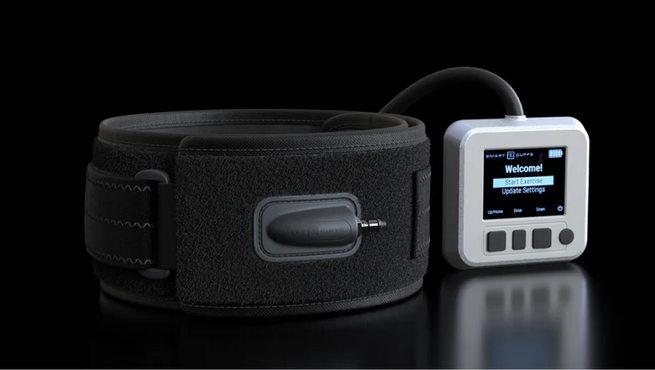
SmartCuffs 4.0 meets all six criteria above. It uses personalized arterial occlusion pressure measurement, sets pressure as a user-defined percentage of AOP/LOP, and is FDA-listed (Class I, product code KCY). Cuff sizes cover small arm (8–13"), medium arm (13–18"), large leg (18–24"), and XL leg (24–29"), giving clinicians full upper and lower extremity coverage for the tendinopathy populations most likely to present in outpatient PT and sports medicine: Achilles, patellar tendon, and rotator cuff.
Accuracy is clinically validated: a study conducted at Mayo Clinic found that SmartCuffs PRO automated arterial occlusion pressure measurement was equivalent to the manual Doppler ultrasound gold standard. For tendinopathy patients where the therapeutic window is already narrow and accurate pressure calibration compounds across the full intervention duration, that validation is the relevant benchmark.
Smart Cuffs comes with a standalone mode, in which PTs can use up to 8 cuffs simultaneously, no app required. And the core clinical app is free with no subscription.
Clinicians evaluating options can use SmartTools' BFR cuff selection guide to match sizing and configuration to their patient population.
Explore the SmartCuffs 4.0 Clinical Set or browse all SmartCuffs options. For institutions and volume purchasing, contact Smart Tools directly.
Frequently Asked Questions
Is BFR safe for patients with chronic tendinopathy?
For most patients with chronic tendinopathy and no contraindications, BFR is a low-risk intervention when protocols are appropriately calibrated. The 2025 Öberg scoping review reported three serious adverse events across all 19 included studies: two Achilles tendon re-ruptures and one deep vein thrombosis. Standard contraindication screening applies: deep vein thrombosis history, compromised peripheral circulation, and uncontrolled hypertension warrant exclusion or specialist consultation before BFR is introduced.
Should BFR replace heavy loading in tendinopathy rehab?
No. BFR is a bridge for load-compromised patients, not a replacement for heavy resistance training sessions. Heavy-load protocols (70-85% 1RM) remain the best-supported intervention for tendinopathy where patients can tolerate them. BFR provides a path to therapeutic stimulus when pain or surgical constraints prevent that loading. The clinical goal of BFR in tendinopathy is to build tolerance toward progressively heavier loading, not to avoid it indefinitely.
How many sessions are typically needed before patients see improvement?
The studies in the Burton and McCormack 2022 review reported improvements over durations ranging from single sessions to 14-week programs. Most case-series evidence in patellar tendinopathy reported functional improvements within 6 to 12 weeks of twice-weekly BFR sessions. Pain reduction has been reported within the first few sessions in some cases. Structural tendon changes, where measured, appear over longer timeframes than functional improvements.
Can BFR be used for both acute flare-ups and chronic tendinopathy?
The current evidence base applies primarily to chronic tendinopathy presentations and post-surgical tendon contexts. BFR is not generally indicated for acute inflammatory flare-ups. Standard tendinopathy loading principles apply: if the tendon is in an acute reactive phase, exercise prescription of any kind should be managed conservatively until the reactive period resolves. Use in acute or highly irritable presentations should be cautious and individualized.”
Does accurate LOP measurement matter for tendinopathy protocols?
Yes. BFR tendinopathy protocols are prescribed as a percentage of limb occlusion pressure (40-80% LOP), not as absolute pressure values. A patient's LOP varies with limb circumference, tissue condition, and vascular status. Applying BFR at a percentage of an inaccurate LOP baseline produces a systematically wrong restriction level in every session. For tendinopathy patients where the therapeutic window is already narrow, that error compounds across the full intervention duration.
Can isometric resistance exercise be used alongside BFR in tendinopathy rehab?
Yes, and the combination is a logical fit for early-stage tendinopathy management. Isometric resistance exercise is frequently used as a first-line loading strategy when tendons are reactive or highly irritable, partly for its pain-inhibitory effects. BFR can be layered in as the patient transitions toward isotonic loading — allowing low-intensity resistance exercise to produce a meaningful stimulus without requiring the mechanical loads that isometric-only protocols cannot always replicate for muscle adaptation. The sequencing decision depends on the individual patient's pain response and load tolerance at the time of assessment.
Does the use of BFR at low intensity preserve muscle mass during tendinopathy rehab?
This is one of the more clinically useful aspects of BFR for load-compromised patients. When high-intensity resistance exercise is off the table — due to tendon pain, post-surgical restrictions, or concurrent joint pathology — muscle mass is at risk of declining over the course of rehabilitation. Low-intensity BFR resistance exercise, applied at 20 to 40% 1RM, has been shown to support muscle hypertrophy and attenuate muscle loss in populations unable to train at conventional loads. For tendinopathy patients who must reduce overall training volume, incorporating BFR helps maintain the muscular base that progressive loading will eventually build on.
Explore SmartCuffs 4.0 for Your Practice
References
- Burton I, McCormack A. "Blood Flow Restriction Resistance Training in Tendon Rehabilitation: A Scoping Review on Intervention Parameters, Physiological Effects, and Outcomes." Frontiers in Sports and Active Living. 2022. DOI: 10.3389/fspor.2022.879860. PMC9083008
- Öberg S, von Schewelov L, Tengman E. "The impact of blood flow restriction training on tendon adaptation and tendon rehabilitation: a scoping review." BMC Musculoskeletal Disorders. 2025. DOI: 10.1186/s12891-025-08734-5. PMC12096532
- Centner C, Lauber B, Seynnes OR, Jerger S, Sohnius T, Gollhofer A, König D. "Low-load blood flow restriction training induces similar morphological and mechanical Achilles tendon adaptations compared with high-load resistance training." J Appl Physiol. 2019. DOI: 10.1152/japplphysiol.00602.2019. PMID 31725362


