


Is BFR Training Good for Plantar Fasciitis?
|
|
Time to read 9 min
|
|
Time to read 9 min
If you’ve ever dealt with plantar fasciitis, you know how deceptively limiting it can be. That sharp, stabbing pain under the heel, especially with the first steps in the morning, can quickly turn everyday walking, standing, or exercise into a frustrating experience.
From a physical therapy perspective, plantar fasciitis is not simply an inflammation problem. In most cases, it’s a load tolerance issue. The plantar fascia is a thick connective tissue structure designed to absorb and release force with every step. When the load placed on it exceeds what the tissue can tolerate, often due to tight calves, poor foot mechanics, sudden increases in activity, or prolonged standing, pain develops.
Many traditional approaches focus heavily on:
Rest
Stretching
Ice
Orthotics
While these can help calm symptoms, they often fail to address the underlying problem: the tissue’s reduced capacity to handle load.
Research consistently shows that progressive strengthening, particularly of the calf–Achilles–foot complex, is one of the most effective long-term treatments for plantar fasciitis. The challenge, however, is that high-load strength training is often too painful early on, causing many patients to stall or abandon rehab altogether.
This is where BFR training for plantar fasciitis becomes an important option, allowing patients to begin meaningful loading without aggravating heel pain.
Blood flow restriction (BFR) training is a method that uses specialized cuffs placed around the upper thigh or arm to partially restrict venous blood flow while still allowing arterial blood to enter the limb. This controlled restriction creates a unique environment in the working muscles.
Here’s why that matters:
Under normal conditions, building strength in muscles and connective tissue requires relatively heavy resistance. With BFR, however, the body responds to very light loads as if they were much heavier.
This happens because BFR increases:
Local metabolic stress
Muscle fiber recruitment (including fast-twitch fibers)
Growth-related signaling pathways
In practical terms, blood flow restriction training for plantar fasciitis allows patients to:
Strengthen the calf and foot muscles using light resistance
Reduce compressive and tensile stress on the heel
Continue rehab even when traditional loading is painful
This approach has already gained strong support in physical therapy for other tendon-related conditions like:
Achilles tendinopathy
Patellar tendinopathy
Post-surgical tendon rehab
Plantar fasciitis shares many of the same mechanical and biological challenges, which is why clinicians are increasingly exploring BFR as part of a smarter, more tolerable loading strategy.
When applied correctly, BFR training benefits for plantar fasciitis go far beyond symptom relief. The goal isn’t just to reduce pain, it’s to restore the tissue’s ability to handle everyday forces.
Here’s how BFR can support that process:
One of the biggest advantages of BFR is that it allows strengthening to begin earlier in the rehab process. Exercises like seated calf raises or foot intrinsic work can be performed with very light loads while still producing meaningful adaptations.
This helps prevent the cycle of “try to strengthen → pain spike → stop exercising.”
Weakness or poor endurance in the calf muscles, especially the soleus, is strongly linked to plantar fasciitis. BFR allows targeted strengthening of these muscles while minimizing stress on the plantar fascia itself.
Stronger calves = better force distribution through the foot.
BFR is not meant to replace traditional strength training forever. Instead, it acts as a bridge, helping patients tolerate loading until they’re ready to progress to heavier calf raises and functional movements.
Clinically, this often leads to smoother transitions and fewer setbacks.
Low-load exercise combined with BFR increases local blood flow and metabolic activity, which may support tissue remodeling and healing in chronic plantar fasciitis cases.
Perhaps one of the most underrated benefits: patients stick with BFR-based programs. When exercises feel manageable, and don’t immediately worsen pain, people are far more likely to stay consistent. And consistency is the single most important factor in long-term recovery.
Taken together, these benefits explain why blood flow restriction training for plantar fasciitis is gaining attention in physical therapy clinics as a way to keep patients progressing when traditional approaches fall short.
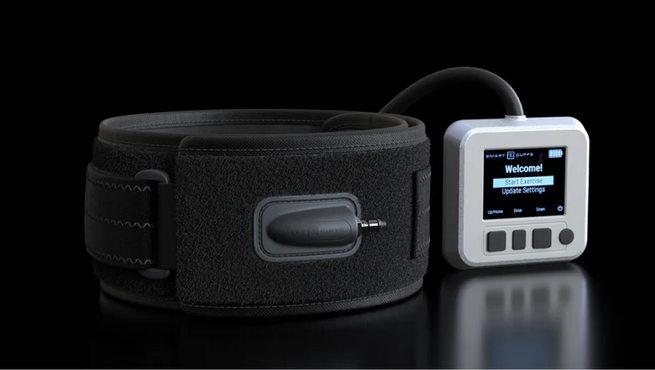
Unlock the full potential of blood flow restriction (BFR) training with SmartCuffs® 4.0—the most advanced BFR system from Smart Tools. Whether you're an athlete, trainer, or recovering from injury, these cuffs are designed to boost muscle growth, improve endurance, and accelerate recovery.
Backed by research and built for performance, SmartCuffs® 4.0 offers wireless control, customizable pressure settings, and seamless integration with the SmartCuffs app to track your progress in real time.
While every patient is different, and rehab should be individualized, there are several low-load BFR protocols that physical therapists commonly use to build strength and improve tissue tolerance in plantar fasciitis cases, even during the early, painful stages.
Here are a few effective strategies using SmartCuffs by Smart Tools:
Goal: Activate and strengthen the soleus (a key stabilizer of the ankle and foot).
How to do it:
Sit with knees bent at 90°
Place light weight (or no weight) on knees
Perform slow calf raises while wearing SmartCuffs on upper thighs
BFR setting: 50–60% limb occlusion pressure (LOP)
4 sets: 30 reps, then 15-15-15 with 30 sec rest between sets
Why it works: The soleus plays a major role in controlling foot mechanics during gait. Strengthening it without high load is crucial early in rehab.
Goal: Strengthen foot intrinsic muscles, which help support the arch and distribute load across the plantar fascia.
How to do it:
Place a towel on the floor
Sit upright and slowly scrunch the towel toward you using your toes
Alternate with marble pickups or resistance-band toe curls
Use BFR on upper thigh (same limb) to enhance the training effect
Why it works: Intrinsic foot strength often goes overlooked, yet it’s critical in long-term resolution of plantar pain.
Goal: Promote mid-range isometric loading of the calf complex without compressing the heel.
How to do it:
Perform a shallow wall sit
Lift heels slightly off the ground
Hold for 30 seconds, rest, repeat
Add BFR to thighs to increase demand without adding weight
Why it works: Isometrics help modulate pain and begin to restore load capacity safely.
Goal: Improve circulation, metabolic activity, and maintain function during flare-ups.
How to do it:
Walk slowly on a treadmill or flat surface
Apply BFR cuffs to upper thighs
Walk for 5–10 minutes at a low speed
Remove cuffs and cool down
Why it works: Even low-intensity movement with BFR can stimulate healing, reduce inflammation, and promote tissue adaptation.
Reminder: Always follow your physical therapist’s guidance and use clinically validated systems like SmartCuffs to ensure safe, precise pressure settings.
While there is limited direct research on BFR training for plantar fasciitis specifically, there is strong evidence supporting its use in tendon and soft tissue rehab, especially in cases where traditional high-load protocols are painful or not yet tolerated.
A 2016 study published in the American Journal of Sports Medicine found that low-load BFR training produced similar outcomes to high-load strength training in individuals with patellar tendinopathy, a condition that, like plantar fasciitis, is characterized by load sensitivity and degenerative tissue changes.
Other findings include:
Improved muscle strength and size in tendon-injured populations
Enhanced tendon remodeling and load capacity
Reduced pain during exercise compared to traditional strength programs
Recent research has also shown positive effects of BFR in Achilles tendon rehab, which shares similar loading characteristics with the plantar fascia.
Bottom line: BFR creates a therapeutic environment that supports strength, healing, and tissue remodeling, without the need for high resistance that might aggravate the injury.
This is especially important in chronic plantar fasciitis, where traditional stretching and passive modalities often fall short. BFR gives clinicians and patients a science-backed way to apply progressive load, safely and early in the healing process.
Not all BFR tools are created equal and when you're dealing with something as sensitive as plantar fasciitis, precision and comfort become non-negotiable.
Here’s why SmartCuffs 4.0 BFR Cuffs from Smart Tools are trusted by physical therapists, athletes, and rehab specialists around the country:
SmartCuffs use integrated sensors to determine each user’s unique limb occlusion pressure (LOP), critical for safe and effective rehab. This ensures that you're never guessing, over-restricting, or applying less-than-therapeutic pressure.
Especially in lower limb rehab (like plantar fasciitis), customized pressure is essential to get the benefits without the risks.
SmartCuffs 4.0 connect to the Smart Tools app, making it easy to:
Adjust pressure on-the-go
Follow rehab-focused exercise routines
Time your sets and recovery
Track your progress over time
This is especially valuable for at-home users and clinics looking to streamline rehab delivery.
The cuffs are designed with soft, durable materials that won’t slip, pinch, or irritate the skin, even during longer sessions. This is key when working with patients who may be new to BFR or have sensitive tissues.
SmartCuffs are used in outpatient clinics, pro sports training rooms, and academic research facilities. They're FDA-listed, clinically validated, and proudly made in the USA.
For plantar fasciitis patients and providers alike, SmartCuffs offer the safety, functionality, and reliability that DIY elastic bands simply can’t match.
Explore SmartCuffs 4.0 BFR Cuffs
When it comes to treating plantar fasciitis, the old model of rest, ice, and hope simply isn’t enough. Long-lasting recovery requires smarter loading strategies, ones that respect the healing process but still challenge the tissue to adapt and rebuild.
That’s where blood flow restriction training comes into play.
BFR provides a unique opportunity to start strengthening earlier, when pain would normally prevent traditional loading. It’s not a magic fix, but it’s an evidence-informed tool that bridges the gap between pain relief and long-term resilience.
For physical therapists, BFR expands what’s possible in both early and advanced stages of plantar fasciitis rehab. And for patients, tools like the SmartCuffs 4.0 make it easier to take control of the process, at home or in the clinic, with precision, safety, and confidence.
Whether you’re struggling with chronic heel pain or trying to get back to the activities you love, remember this: tissue adapts to load and BFR lets you load smarter.
Yes, BFR can be a helpful tool for plantar fasciitis rehab, especially when high-load strength training is too painful. It allows patients to build muscle and tendon strength using light resistance, which reduces strain on the plantar fascia.
BFR increases muscle activation and metabolic stress with low loads. This helps strengthen the calf and foot muscles, which play a key role in offloading stress from the plantar fascia. It also improves circulation, which may support tissue healing.
Yes, as long as you're using a clinically safe system like SmartCuffs that can accurately calibrate pressure. Home BFR programs should be based on guidance from a licensed physical therapist or rehab specialist to ensure safety and effectiveness.
Some of the most effective exercises include:
Seated calf raises
Toe curls or towel scrunches
Heel-elevated wall sits
Short walking intervals with BFR cuffs
These can all be performed with low resistance while wearing BFR cuffs on the upper thighs.
Yes, numerous studies have shown BFR to be safe and effective for tendon-related injuries when used properly. It’s widely used in physical therapy for Achilles tendinopathy, patellar tendon issues, and increasingly, plantar fasciitis.
The SmartCuffs 4.0 by Smart Tools are one of the best options available. They offer:
Precise, limb occlusion pressure
Bluetooth app control and guided rehab protocols
Comfortable, secure fit for daily use
Clinician-trusted reliability
Jackson H. - Masters of Exercise Physiology & Teaching Assistant at the University of North Carolina.
Jackson holds a Master’s in Exercise Physiology from UNC Chapel Hill, where he served as a teaching and research assistant. A former student-athlete with a strong foundation in performance research, data analysis, and coaching, Jackson is passionate about health and wellness


