


Blood Flow Restriction Training for Cyclists
|
|
Time to read 7 min
|
|
Time to read 7 min
Cyclists are known for their endurance, discipline, and capacity to push through discomfort. Whether you’re logging weekend miles on scenic roads or grinding through structured FTP intervals on a smart trainer, your body is constantly adapting to repetitive movement and cardiovascular stress.
But here’s the challenge: cycling is a high-volume, low-impact sport that often lacks resistance-based loading, especially in the lower body. Over time, this can lead to:
Muscle imbalances (underdeveloped hamstrings or glutes)
Weakness in stabilizing muscles around the hips and knees
Overuse injuries due to repetitive strain
Reduced muscle mass or power, particularly in aging athletes
Enter blood flow restriction (BFR) training, a technique that allows you to build strength, endurance, and recovery capacity without needing heavy weights or excessive mechanical load.
Originally developed in rehabilitation settings, BFR has quickly become a go-to tool for physical therapists and performance coaches, and now, cyclists are starting to realize its untapped potential.
Whether you're recovering from an injury, trying to improve your off-bike strength, or looking for smarter ways to cross-train, BFR training for cyclists offers a low-impact, high-reward strategy that integrates seamlessly into a training routine.
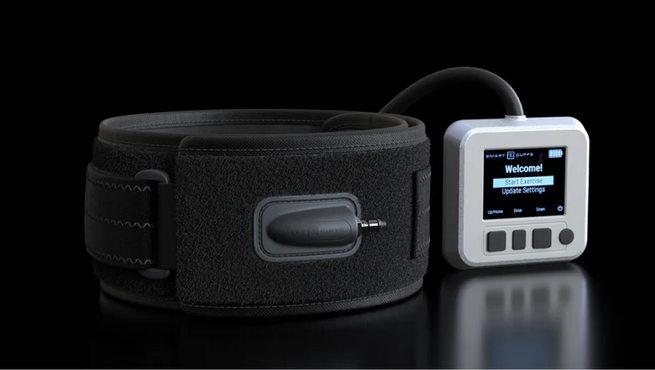
Blood flow restriction (BFR) training involves using a specialized cuff system, like the SmartCuffs 4.0, to partially restrict venous blood flow from the working limb while allowing for arterial inflow. In simpler terms, it creates a safe, temporary “backup” of blood in the muscle during low-load exercise.
The result? Your body responds as if it’s working much harder than it actually is, even when using very light weights or low-intensity activity.
This is especially useful for cyclists who:
Avoid heavy resistance training
Need to train through an injury
Are in-season and trying to reduce recovery time
Want to strengthen joints and muscles without joint stress
From a physiological standpoint, here’s what happens with BFR:
Metabolic stress increases, creating the environment needed for muscle growth
Fast-twitch muscle fibers are recruited more quickly
Growth hormone and IGF-1 levels rise, supporting tissue repair and hypertrophy
Capillary density and mitochondrial adaptations improve with BFR cycling
All of this means you can get stronger, improve muscular endurance, and reduce wear and tear, which is exactly what every cyclist should be aiming for.
Let’s get practical. What does BFR actually do for cyclists, and why should it be part of your training, recovery, or rehab toolbox?
Most cyclists don’t love the gym. Many avoid it altogether, often because of concerns about joint stress, lack of time, or fear that strength work might interfere with riding performance.
BFR allows you to train at 20–30% of your max load and still get similar strength-building benefits to traditional heavy resistance training.
This is particularly effective for targeting:
Quads
Hamstrings
Glutes
Calves
Whether you’re doing bodyweight squats, glute bridges, or leg extensions, BFR helps bridge the strength gap without compromising your ride schedule.
BFR training increases muscular efficiency and oxygen utilization, particularly when applied during light cycling sessions or low-resistance intervals.
This can lead to improvements in:
Time-to-exhaustion
Lactate buffering
Pedaling economy
That means you’ll fatigue less quickly, especially useful in long-distance events or hill-heavy courses where fatigue accumulation becomes a limiting factor.
Got knee pain? Coming back from an overuse injury or crash? BFR is widely used in physical therapy settings to help injured athletes maintain strength without placing too much stress on healing tissues.
Because it works with such low loads, BFR is ideal for:
Patellofemoral pain (cyclist’s knee)
Hamstring or quad strains
Post-operative rehab (ACL, meniscus, hip labral repairs)
Ankle or Achilles injuries
SmartCuffs make it easy to integrate BFR into your rehab program, even if you're still in early stages and can't perform weight-bearing movements.
Low-intensity cycling with BFR can be used on recovery days to enhance blood flow, nutrient delivery, and waste removal, without creating additional muscular damage.
It’s like a passive flush for your legs, with the added benefit of maintaining some neuromuscular activation.
In short: BFR helps cyclists train smarter, recover faster, and stay stronger — all without adding unnecessary volume or joint stress.
Unlock the full potential of blood flow restriction (BFR) training with SmartCuffs® 4.0—the most advanced BFR system from Smart Tools. Whether you're an athlete, trainer, or recovering from injury, these cuffs are designed to boost muscle growth, improve endurance, and accelerate recovery.
Backed by research and built for performance, SmartCuffs® 4.0 offers wireless control, customizable pressure settings, and seamless integration with the SmartCuffs app to track your progress in real time.
Although BFR was initially popularized in strength training and rehab settings, recent research shows it has tremendous benefits for endurance athletes, including cyclists.
A 2019 study published in the Journal of Strength and Conditioning Research investigated the effects of cycling with BFR cuffs applied to the upper thighs.
The study found that participants who trained with BFR experienced:
Increased muscular endurance
Improved oxygen utilization
Enhanced time-to-exhaustion during aerobic exercise
Even more interestingly, these results were achieved using low-intensity pedaling protocols, meaning riders didn’t need to push at max power to see aerobic and muscular adaptations.
You don’t need to overhaul your training plan to use BFR. In fact, one of the biggest advantages of blood flow restriction training for cyclists is how easily it fits into strength, rehab, or recovery blocks.
Here are three real-world ways to use it:
Use case: Build or maintain lower-body strength without heavy gym equipment.
Recommended exercises:
Bodyweight squats
Glute bridges
Seated leg extensions
Calf raises
Step-ups or lunges with light dumbbells
Protocol (general BFR strength training):
4 sets (30-15-15-15 reps)
30 seconds rest between sets
Use 20–30% of 1-rep max
50–80% LOP for lower limbs using SmartCuffs
This method is especially effective during off-season base building or taper periods when joint loading should be minimized.
Use case: Improve muscular endurance and aerobic efficiency with less training stress.
Example protocol:
Warm-up for 5–10 minutes without BFR
Apply SmartCuffs at 50–60% LOP to the upper thighs
Pedal at 40–60% of FTP for 10–20 minutes
Keep cadence consistent (85–95 rpm)
Remove cuffs during cool-down
This is ideal for:
Recovery rides
Low-volume days
Returning from injury
Indoor trainer sessions
Note: BFR cycling is best performed on a stationary bike or trainer to avoid balance and safety issues.
Use case: Preserve leg strength and stimulate healing while avoiding overload.
Applications:
Early-stage ACL or meniscus rehab
IT band syndrome
Knee or hip overuse injuries
Achilles tendon loading with minimal impact
Because BFR creates a hypertrophic and circulatory response without high loads, it’s a go-to modality in physical therapy settings for injured cyclists.
SmartCuffs make home-based rehab possible, especially important for cyclists recovering from injury while staying engaged in their training process.
When it comes to BFR, the tool you use makes all the difference, especially in a precision sport like cycling, where performance, comfort, and data matter.
Here’s why SmartCuffs 4.0 by Smart Tools is trusted by physical therapists, cycling coaches, and athletes across the country:
SmartCuffs calculate limb occlusion pressure (LOP) for each leg, ensuring safe, effective, and consistent training. This eliminates the guesswork, especially important for cyclists concerned with over-restricting or under-stimulating the muscle.
Cyclists can use the Smart Tools app to:
Adjust and monitor exercise session in real-time
Time BFR intervals or recovery sessions
Follow guided rehab or performance protocols
Track usage data — great for structured training
This functionality is ideal for riders training remotely or following programs prescribed by a coach or PT.
SmartCuffs are made with durable, comfortable materials that stay in place, even during pedaling or dynamic exercises. The design minimizes pinching or skin irritation, which is key for longer recovery sessions or indoor rides.
Unlike generic elastic bands or knock-off BFR cuffs, Smart Tools offers FDA-registered, research-backed BFR equipment made in the U.S. and used by:
Pro and amateur athletes
Orthopedic and sports rehab clinics
Cycling-focused physical therapists
Yes, BFR is great for cyclists looking to improve muscular strength, endurance, and recovery with minimal joint stress. It's especially useful for off-season strength work, recovery days, and rehab from injury.
Yes, but it's best to do BFR cycling on a stationary bike or indoor trainer. This allows for safe application of the cuffs and consistent intensity without risking balance or control issues.
Most cyclists can benefit from 2–3 BFR sessions per week, depending on their goals. This could include strength training, short BFR cycling intervals, or recovery sessions with light pedaling.
Absolutely. BFR enhances circulation, promotes oxygen delivery to muscles, and stimulates recovery without added training stress. Many athletes use BFR walking or cycling as part of active recovery days.
Yes, when used properly with calibrated pressure from clinical-grade systems like SmartCuffs, BFR is safe and well-tolerated by endurance athletes, including cyclists. Avoid DIY solutions, which can be unsafe or ineffective.
Jackson H. - Masters of Exercise Physiology & Teaching Assistant at the University of North Carolina.
Jackson holds a Master’s in Exercise Physiology from UNC Chapel Hill, where he served as a teaching and research assistant. A former student-athlete with a strong foundation in performance research, data analysis, and coaching, Jackson is passionate about health and wellness


