


BFR Training for Total Knee Replacement Rehab: A Buyer's Guide for Post-Op PT
|
|
Time to read 11 min
|
|
Time to read 11 min
Total knee replacement is one of the most common orthopedic procedures performed in the United States, and post-op rehab is fundamentally a loading problem. The patient needs a heavy enough load to rebuild quadriceps strength and reverse arthrogenic muscle inhibition, but the joint cannot tolerate that load for weeks. Blood flow restriction (BFR) training closes that gap. Used correctly, it lets a post-op PT deliver a hypertrophy and strength stimulus comparable to high-load resistance training at 20 to 30 percent of one-rep max, well within the loading tolerance of a healing knee.
The question for any post-op or medical rehab PT clinic is no longer whether BFR belongs in a TKR protocol. It does. The question is which BFR system is built for the realities of clinical use, and how to operationalize it without compromising clinical standards.
Quadriceps strength loss is the most consistent functional deficit after total knee arthroplasty (TKA), driven in large part by arthrogenic muscle inhibition (AMI), the reflexive failure of quadriceps motor activation following joint trauma or surgery [1, 2]. Conventional rehab is constrained by the same problem that drove the surgery: the patient cannot load the joint heavily enough, early enough, to drive the strength adaptations the limb needs.
BFR addresses the constraint directly. Recent peer-reviewed research in the TKA population has shown:
Pre-habilitation with BFR before TKA shows considerable potential to enhance early postoperative muscle strength and functional recovery [3].
Knee loading with BFR can enhance recovery via low-intensity protocols in both pre-operative and post-operative TKA populations [4].
Passive BFR initiated on the first postoperative day is feasible, safe, and effective in preserving muscle mass and reducing swelling after TKA [5].
Six weeks of low-load BFR training produced significant improvements in KOOS subscales (pain, symptoms, ADL, quality of life), Knee Society Scores, EQ-5D-5L, and Pain Catastrophizing Scale in patients with persistent dissatisfaction after TKA, often referred to in the literature as the "unhappy TKA" population [6].
Case-report evidence in a former triathlete TKA patient documented gains in function, strength, and power and reduced pain following structured BFR therapy [7].
The American Academy of Orthopaedic Surgeons has reviewed BFR as an emerging adjunct to orthopaedic rehabilitation, including post-arthroplasty applications [8].
An active clinical trial at the University of Texas Health (NCT06111690) is studying BFR pre-habilitation in patients awaiting TKA [9].
For a post-op PT, the practical implication is straightforward: BFR is no longer experimental in this population. It is an evidence-supported tool that closes a known clinical gap. The clinical applications extend well beyond TKR. We cover the broader scope in BFR for knee rehab, BFR for ACL rehabilitation, and the full list of conditions BFR can help treat. What still varies, and matters operationally, is the system you choose to deliver it.
Not every BFR device is built for clinical post-op use. A system used in a post-op TKR protocol is delivering pressure to a healing limb, in a population that often includes older adults with cardiovascular comorbidities, often within days of surgery. The criteria below distinguish clinical-grade BFR systems from consumer or prosumer devices.
Personalized LOP detection. Limb occlusion pressure varies meaningfully across patients based on body composition, limb size, and cardiovascular profile. Manual estimation, sleeve markings, or fixed-pressure prescription introduces clinical variability that is unacceptable in a post-surgical population. Only pneumatic systems with automated LOP calibration deliver pressure as a defined percentage of the individual patient's occlusion point.
Repeatability across staff and across the rehab arc. A TKR protocol typically spans 8 to 12 weeks of supervised PT, often handed off across multiple clinicians. The system must produce the same physiological stimulus on visit 12 as it did on visit 1, regardless of which staff member runs the session. Stored patient profiles and automated recalibration are clinical requirements, not conveniences.
Safety systems built for medical use. Emergency pressure release, configurable pressure caps, FDA listing, and medical-grade materials rated for daily clinical use are baseline. A device used on a post-op patient with possible cardiovascular comorbidities is not the same product category as a consumer fitness band. For a full review of contraindications and screening for BFR, and the broader pros and cons of the modality, see our safety and decision-support primers.
Wide, non-elastic pneumatic cuffs. Wider cuffs distribute pressure evenly across the limb, reducing localized nerve and tissue stress. Narrow or elastic cuffs create uneven occlusion patterns that increase discomfort and risk in a healing post-op limb.
Peer-reviewed clinical validation. For institutional procurement, hospital-affiliated practices, and any clinic operating under compliance oversight, independent LOP accuracy validation in published research is the standard. Two BFR systems currently meet this bar: SmartCuffs® (Mayo Clinic, 2022) and Delfi PTS.
Multi-patient throughput. A high-volume orthopedic PT clinic running TKR rehab sees patients on the half-hour. A system that requires single-patient operation forces sequential workflow, which is the opposite of what a post-op practice needs. Look for a device that supports concurrent multi-patient use under a single practitioner.
No subscription gating on core clinical features. LOP detection, session control, and stored patient profiles should not be locked behind a recurring fee. Subscription-gated clinical features compound across a clinical roster and are not the standard for medical equipment.
For a vendor-agnostic framework that applies to any BFR purchase decision, see our guide to how to choose the best BFR bands or cuffs.
The table below compares the BFR systems most commonly evaluated in post-op orthopedic PT settings against the criteria above.
|
Feature |
SmartCuffs® 4.0 |
Delfi PTS |
Saga 2.0 |
Suji |
|---|---|---|---|---|
|
Peer-Reviewed LOP Validation |
Yes |
Yes |
No (failed validation) |
No |
|
Clinical-Grade LOP Repeatability |
Yes |
Yes |
No |
No |
|
Medical-Grade Materials |
Yes |
Yes |
No |
No |
|
Multi-Cuff / Multi-Patient Capability |
Yes (up to 8 cuffs) |
No |
Limited |
Limited |
|
Quick Start Mode (app-free re-inflation) |
Yes |
No |
No |
No |
|
Free App, No Subscription |
Yes |
No |
Yes |
Yes |
|
FDA-Listed |
Yes |
Yes |
No |
Yes |
|
Purpose-Built for BFR |
Yes |
No (retrofitted tourniquet) |
Yes |
Yes |
|
Made in USA |
Yes |
No (Canada) |
No (China) |
No (China) |
|
Price Range |
$499 to $1,699 |
$5,000+ |
$388 to $1,346 |
Under $500 |
Note: Comparison is based on publicly available clinical and regulatory information.
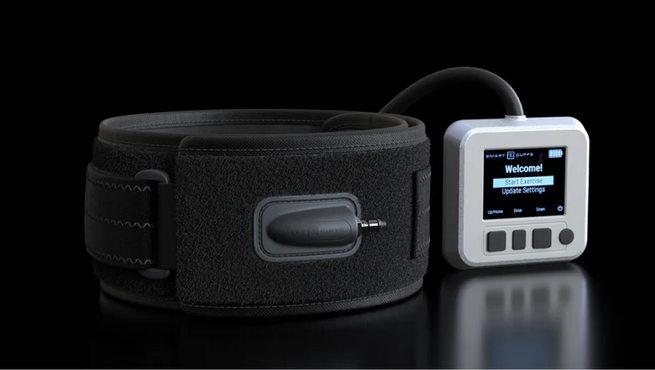
The SmartCuffs® 4.0 is the BFR system most aligned with the realities of a post-op TKR rehab practice. Available as a single pair for smaller caseloads or as the full Clinical Set for multi-patient operation, it is the only clinical-volume BFR package on the market with peer-reviewed LOP validation, multi-patient capability, and no subscription gating. SmartCuffs® is in active use across more than 10,000 U.S. clinics, including Mayo Clinic, Cleveland Clinic, Rush, and Hospital for Special Surgery (HSS).
Personalized LOP for every patient. Each cuff automatically calibrates to the individual's limb occlusion pressure in approximately 30 seconds. For a TKR patient, this means the pressure prescribed on day 7 is delivered against that patient's actual physiology, not a clinician's estimate.
Clinically validated. Independent peer-reviewed LOP validation (Mayo Clinic, 2022), which is the procurement standard for hospital-affiliated and compliance-bound practices.
FDA-listed, medical-grade materials. SmartCuffs® is a Class 1 device under the KCY product code (pneumatic tourniquet). The same FDA classification as Delfi, with materials and safety systems rated for daily clinical use on post-surgical limbs.
Stored patient profiles for repeatable progression. The same patient returns at week 2, week 6, and week 10 to the same calibrated pressure protocol, regardless of which clinician runs the session.
Standalone Mode for clinic throughput. A single practitioner can connect two cuffs to a patient, calibrate to LOP, set the pressure, then disconnect the phone. The cuffs hold pressure independently while the clinician moves to the next patient. A fully equipped clinic can treat up to four patients with two cuffs each, or up to eight patients with one cuff each, all running concurrently. No other BFR system on the market currently matches this.
Quick Start Mode for back-to-back appointments. The cuff re-inflates to the previously stored pressure for that patient without the app, eliminating setup time at the start of each session. For a clinic seeing 8 to 12 TKR patients across a half-day block, this is a meaningful operational difference.
30-minute full recharge, 3x competitor battery life. Built for daily clinical use without mid-day downtime.
Free app, no subscription required. Core clinical features, including LOP detection, session management, and stored profiles, are accessible without an ongoing fee.
Cuff sizing for a post-op TKR population. The Clinical Set covers four sizes: small arm (8 to 13 inches), medium arm (13 to 18 inches), large leg (18 to 24 inches), and XL leg (24 to 29 inches). The leg sizes cover the vast majority of adult TKR patients, including the larger thigh circumferences common in this population.
|
Phase |
Recommended Product |
Why |
|---|---|---|
|
Pre-habilitation (4 to 8 weeks pre-op) |
Peer-reviewed evidence supports BFR pre-hab for stronger early post-op quad recovery [3, 4]. Personalized LOP calibration ensures the same physiological stimulus across the prehab window. |
|
|
Acute post-op (POD 1 through Week 2) |
Passive BFR has been shown feasible and safe from POD 1, supporting muscle mass preservation and swelling reduction [5]. Resting BFR Mode is built for this exact application and is not available on competing systems. |
|
|
Early post-op (Weeks 2 to 6) |
Stored patient profiles deliver repeatable low-load BFR at the same calibrated pressure across visits and across staff. See our reference set of BFR exercises for the lower extremity for protocol-building. |
|
|
Strength and return to function (Weeks 6 to 12+) |
Continuous and Intermittent training modes support progressive low-load resistance work as the patient is cleared for higher activity, without compromising joint loading limits. |
|
|
Persistent dissatisfaction or limited gains after standard rehab |
Six weeks of structured BFR has been shown to improve KOOS, KSS, EQ-5D-5L, and pain catastrophizing scores in the "unhappy TKA" population [6]. |
|
|
High-risk TKA patients (significant cardiac, vascular, or hematologic comorbidities) |
Delfi PTS |
For high-risk patients in a hospital or surgical setting, Delfi may be appropriate where institutional procurement requirements or physician preference dictate a higher-cost solution. |
|
Budget-constrained PT practices |
SmartCuffs® 3.0 (or 3.0 Pro) |
For practices seeking a clinically validated BFR system at a lower price point, SmartCuffs® 3.0 delivers the same personalized LOP detection as the 4.0 at a reduced cost. |
When can I start BFR after a total knee replacement?
Recent peer-reviewed research has shown that passive BFR initiated as early as the first post-operative day is feasible, safe, and effective in preserving muscle mass and reducing swelling after TKA, provided the surgical team has cleared the patient and the wound is healing without complication [5]. Active BFR with low-load resistance work (quad sets, SLRs, terminal knee extension) is typically introduced in the first one to two weeks post-op once swelling and pain are managed. Always confirm timing with the operating surgeon and use clinical judgment based on the individual patient's recovery.
What pressure should I use for a post-op TKR patient?
Most clinical BFR protocols use 40 to 80 percent of personalized limb occlusion pressure, with 40 to 60 percent of LOP being typical for early post-op rehab and progressing toward higher percentages as the patient tolerates more loading. SmartCuffs® 4.0 calibrates to each patient's individual LOP in approximately 30 seconds, then allows the clinician to set the target percentage. Manual pressure estimation or sleeve-based prescription is not appropriate for a post-surgical population because it ignores individual physiology.
Which SmartCuffs® size do I use for a post-op TKR leg?
The vast majority of adult TKR patients fit into either the large leg cuff (18 to 24 inches mid-thigh circumference) or the XL leg cuff (24 to 29 inches). The cuff is placed as proximally on the thigh as comfortably possible, well above the surgical site. For step-by-step setup on the lower extremity, see our guide to using BFR bands on the legs. The SmartCuffs® 4.0 Clinical Set includes both leg sizes plus arm sizes for upper-extremity work, covering the full range of patients a TKR-volume practice will see.
Is BFR safe for older patients recovering from a knee replacement?
BFR has been studied in older adult and post-arthroplasty populations and is generally well tolerated when standard contraindications are screened. Commonly cited contraindications include venous thromboembolism, peripheral vascular compromise, sickle cell anemia, extremity infection, and lymphadenectomy [10]. Personalized LOP-based pressure prescription is what makes the intervention reliable in this population, because pressure is set against the individual's actual occlusion point rather than a fixed target. Always screen each patient against current contraindication guidance and the operating surgeon's clearance. See our deeper review of BFR safety, side effects, and risk screening for a full breakdown.
How does BFR compare to standard post-op TKR rehab without BFR?
Standard post-op TKR rehab is constrained by what the joint can load. The result is a known quad strength deficit that often persists at 6 and 12 months. BFR adds a low-load hypertrophy and strength stimulus that the joint can tolerate, in service of the same end goal: restoring quad strength, knee extension, gait, and stair-climbing capacity. BFR is an adjunct, not a replacement, for progressive loading, manual therapy, neuromuscular re-education, and the rest of the standard protocol.
How many cuffs does a TKR-volume PT clinic actually need?
A practice running a meaningful TKR caseload should plan for sizing coverage across both arm and leg dimensions, plus enough cuffs to support concurrent treatment. The SmartCuffs® 4.0 Clinical Set includes 8 cuffs across 4 sizes (small arm, medium arm, large leg, XL leg), configured to cover the full range of patients without requiring additional pairs. Standalone Mode then makes those 8 cuffs operationally productive: a single clinician can run up to 4 patients with two cuffs each, or 8 patients with one cuff each, all concurrently.
BFR Training for Knee Rehab — the broader-knee-rehab companion piece this article specializes from.
What Is BFR Training? Benefits and Science (2026) — primer for clinicians new to the modality.
BFR Training for ACL Rehabilitation — adjacent post-op knee application.
BFR Physical Therapy: Conditions It Can Help Treat — full clinical-applications overview.
Is BFR Training Safe? Side Effects and Risks Explained — contraindications and screening.
Sonnery-Cottet B, Saithna A, et al. Arthrogenic muscle inhibition: A prevalent issue in knee surgery rehabilitation. Knee Surg Sports Traumatol Arthrosc, 2025. PMID 40704642. https://pubmed.ncbi.nlm.nih.gov/40704642/
Sonnery-Cottet B, et al. The past and future of peri-operative interventions to reduce arthrogenic quadriceps muscle inhibition after total knee arthroplasty: A narrative review. J ISAKOS, 2024. https://www.sciencedirect.com/science/article/pii/S2665913123000961
Muntean RI, et al. Blood Flow Restriction Training in Knee Arthroplasty: A Systematic Review of Current Evidence on Postoperative Muscle Strength and Function. Medicina, 2025. PMID 41155865. https://pmc.ncbi.nlm.nih.gov/articles/PMC12566041/
Hughes L, et al. Knee Loading With Blood Flow Restriction Can Enhance Recovery After Total Knee Arthroplasty. Cureus, 2023; DOI 10.7759/cureus.37895. PMID 37214015. https://pmc.ncbi.nlm.nih.gov/articles/PMC10199744/
Franz A, Heiß R, et al. Passive Blood-Flow-Restriction Exercise's Impact on Muscle Mass and Swelling After Total Knee Arthroplasty. J Clin Med, 2025; 14(15):5218. PMID 40806840. https://www.mdpi.com/2077-0383/14/15/5218
Stroobant L, Jacobs E, et al. Can blood flow restriction therapy improve quality of life and muscle strength in patients with persistent symptoms after total knee arthroplasty? The Bone & Joint Journal, 2024. https://boneandjoint.org.uk/Article/10.1302/0301-620X.106B12.BJJ-2024-0553.R1
Keating C, et al. Utilization of Blood Flow Restriction Therapy with a Former Triathlete after Total Knee Arthroplasty: A Case Report. Int J Sports Phys Ther (IJSPT), 2024. PMID 39267627. https://ijspt.scholasticahq.com/article/122488-utilization-of-blood-flow-restriction-therapy-with-a-former-triathlete-after-total-knee-arthroplasty-a-case-report
American Academy of Orthopaedic Surgeons. Study Explores Benefits of Blood-flow Restriction Training in Orthopaedic Rehabilitation. AAOS Now, June 2023. https://www.aaos.org/aaosnow/2023/jun/clinical/clinical02/
The University of Texas Health Science Center. Blood Flow Restriction Training in Individuals Awaiting Total Knee Replacement. ClinicalTrials.gov ID NCT06111690. https://clinicaltrials.gov/study/NCT06111690
Patterson SD, Hughes L, et al. Blood Flow Restriction Exercise: Considerations of Methodology, Application, and Safety. Front Physiol, 2019. (Contraindications also reviewed in PMC6203234, BFR Therapy After Knee Surgery.) https://pmc.ncbi.nlm.nih.gov/articles/PMC6203234/


