


BFR Cuffs for Pro Athletes & High-Performance Centers: A 2026 Buyer's Guide
|
|
Time to read 4 min
|
|
Time to read 4 min
Blood flow restriction training is now standard practice at elite performance centers, professional sports organizations, and sports medicine clinics worldwide. Not all BFR devices are built for this context. Here's what separates the right tool from the rest.
Not all BFR systems deliver the same clinical standard. In a professional setting, the following criteria are non-negotiable.
Precise, personalized pressure control: Elite BFR training requires pressure set at a percentage of limb occlusion pressure (LOP), which varies by individual and session. Only pneumatic systems with automated LOP detection can deliver the individualized pressure required by clinical and performance protocols.
Repeatability: Professional athletes need the same physiological stimulus every session, which means a device that automatically detects and stores each athlete's LOP is essential. Manual calibration or fixed pressure settings introduce uncontrolled variables across practitioners, sessions, and locations.
Safety systems: Baseline requirements: any device used in a duty-of-care setting requires emergency pressure release, configurable pressure caps, and medical-grade materials rated for daily clinical use.
Wide, non-elastic cuffs: Wider pneumatic cuffs distribute pressure more evenly across the limb, reducing localized nerve and tissue stress. Narrow or elastic cuffs create uneven restriction patterns that increase discomfort and risk, particularly at higher training loads.
Peer-reviewed clinical validation: For organizations with compliance requirements, independent LOP accuracy validation in published research is a procurement standard, not a preference. Currently, only two BFR systems meet this bar: SmartCuffs® (Mayo Clinic, 2022) and Delfi.
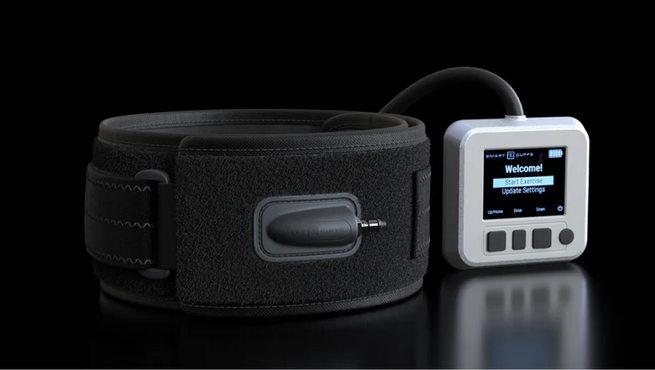
Multi-cuff capability: High-performance centers manage rosters, not individuals, so a system that supports simultaneous control of multiple cuffs is an operational necessity. (SmartCuffs® 4.0 Standalone Mode supports up to eight cuffs at once. No competing system offers this.)
The table below compares the four most commonly evaluated BFR systems in professional and clinical settings across the criteria that matter most in a high-performance environment.
Feature |
SmartCuffs 4.0 |
Delfi PTS |
Saga 2.0 |
Suji |
|---|---|---|---|---|
Peer-Reviewed LOP Validation |
✓ |
✓ |
✗ |
|
Clinical-Grade LOP Repeatability |
✓ |
✓ |
✗ |
✗ |
Medical Grade Materials |
✓ |
✓ |
✗ |
✗ |
Multi-Cuff Capability |
✓ |
✗ |
✓ |
✓ |
Quick Start Mode (app-free) |
✓ |
✗ |
✗ |
✗ |
Free App (core features don’t require a subscription) |
✓ |
✗ |
✓ |
✓ |
FDA-Listed* |
✓ |
✓ |
✗ |
✓ |
Purpose-Built for BFR |
✓ |
✗ (retrofitted) |
✓ |
✓ |
Made in USA |
✓ |
✗ (Canada) |
✗ (China) |
✗ (China) |
Price Range |
$499–$1,699 |
$5,000+ |
$388-$1346 |
<$500 |
Note: Delfi comparison is based on publicly available clinical and regulatory information.
The SmartCuffs® 4.0 is a ground-up hardware refresh, built on feedback from 10,000+ clinicians using the 3.0 in daily practice.
Charging port: Changed from Micro USB (3.0) to USB-C
Battery life: The 4.0 uses an upgraded Li-Ion battery that recharges fully in 30 minutes and lasts three times longer than competing systems.
Bluetooth connectivity: The 4.0 features improved Bluetooth stability with built-in pumps in each cuff, enabling simultaneous control of multiple cuffs without the connectivity issues reported by some 3.0 users.
App and UI setup: 30% to 50% reduction in setup to exercise time. Connect up to two cuffs at once.
Multiple studies show BFR can promote hypertrophy and reduce mechanical/joint load during training, making it a useful tool for in-season maintenance, rehab, or when heavy loading is contraindicated.
In most cases, SmartCuffs® 4.0 is the ideal choice for professional environments.
Use Case |
Recommended Product |
Why |
|---|---|---|
Post-surgical rehab |
SmartCuffs® 4.0 |
Personalized LOP detection ensures clinically precise, repeatable pressure, critical when tissue is healing and loading tolerance is narrow. Validated by Mayo Clinic (2022). Used at Mayo Clinic, Cleveland Clinic, Rush, and HSS. |
In-season load management |
SmartCuffs® 4.0 |
Quick Start Mode re-inflates to each athlete's stored pressure without the app, enabling fast deployment in training rooms, hotel gyms, or on the sideline. |
Post-game recovery |
SmartCuffs® 4.0 |
Dedicated Resting BFR Mode is designed for passive recovery at low occlusion pressures. Not available on any competing system. |
High-risk patients |
Delfi PTS |
For high-risk patients with complex comorbidities in a hospital or surgical setting, Delfi may be appropriate where institutional procurement requirements or physician preference dictate a higher-cost solution. |
Return-to-sport / multi-athlete |
Standalone Mode supports up to eight cuffs simultaneously, enabling small-group return-to-sport progressions under a single control interface. |
|
Budget-constrained general training |
For organizations or individual practitioners seeking a clinically validated BFR system at a lower price point, SmartCuffs® 3.0 delivers the same personalized LOP detection as the 4.0 at a reduced cost. |
Xiaolin Wang et al., "Effects of Resistance Training with Blood Flow Restriction on Explosive Power of Lower Limbs" — J Hum Kinet (2023). pubmed.ncbi.nlm.nih.gov
Rui Li et al., "Effects of blood flow restriction training on sports performance in athletes: a systematic review with meta-analysis" — J Sports Med Phys Fitness (2024). pubmed.ncbi.nlm.nih.gov
José M. Oliva-Lozano et al., "Blood flow restriction as a post-exercise recovery strategy: A systematic review" — Biol Sport (2024). pubmed.ncbi.nlm.nih.gov
Dimple Khurana et al., "Blood flow restriction therapy with exercise are no better than exercise alone…" — Somatosens Mot Res (2024). pubmed.ncbi.nlm.nih.gov
"Effects of blood flow restriction training on physical fitness among athletes: a systematic review and meta-analysis" (2024). pmc.ncbi.nlm.nih.gov
Do we need a prescription or medical license to purchase SmartCuffs®?
No. SmartCuffs® is available directly to clinicians, performance staff, and organizations without a course enrollment requirement. This distinguishes it from some competitors that have historically required certification course completion prior to sale.
What does "FDA-listed" actually mean, and why does it matter?
FDA-listed (also called FDA-registered) means the device and its manufacturer are registered with the FDA under a specific product classification. SmartCuffs® is a Class 1 device under the KCY product code (pneumatic tourniquet). This is the same classification as Suji and Delfi, meaning neither are "more FDA-certified" than the other, despite the significant price difference. Saga is not FDA-listed. For organizations with compliance requirements, such as hospital systems, military, professional sports organizations with team physician oversight, FDA listing is a standard procurement requirement, not a preference.
How many cuffs can we run at once for team settings?
SmartCuffs® 4.0 supports up to eight cuffs simultaneously in Standalone Mode. No other BFR system on the market offers this capability. For a training room managing a full roster during camp, pre-season, or post-game recovery blocks, this scalability is a meaningful operational advantage.


