


BFR Clinical Sets for Physical Therapy Practices
|
|
Time to read 5 min
|
|
Time to read 5 min
Physical therapy practices are increasingly recognizing BFR training as a meaningful tool for improving patient outcomes across post-surgical rehab, chronic pain management, and return-to-sport progressions. As adoption grows, so does the question of how to equip a practice efficiently without compromising clinical standards.
Price is often where the conversation starts, and understandably so. A practice evaluating BFR equipment for the first time may be tempted to start with a single pair of cuffs in one size. The problem is that cuff sizing isn't optional; it's clinical. When PTs use a single cuff size for all patients, the result is LOP errors, excessive pressure readings, and unreliable measurements. A practice that buys fewer cuffs than it needs isn't saving money; it's introducing clinical variability that undermines the intervention entirely.
The practices getting the most out of BFR are treating it as a service line, not a single-patient tool. A full clinical set (with the right sizing coverage and a system built for concurrent use) allows a practice to see more patients per session, reduce setup time between appointments, and build BFR into a sustainable revenue model without compromising the clinical standards that make the intervention worth offering in the first place.
Beyond sizing, coverage, and throughput, the following criteria distinguish clinical-grade BFR systems from consumer devices.
Personalized LOP detection. Manual calibration or fixed pressure settings are not appropriate for a patient population with varying diagnoses, body compositions, and loading tolerances.
Repeatability across practitioners. Results must be consistent regardless of which staff member runs the session.
Safety systems. Emergency pressure release, configurable pressure caps, and medical-grade materials rated for daily clinical use are baseline requirements.
Wide, non-elastic cuffs. Wider pneumatic cuffs distribute pressure evenly, reducing localized nerve and tissue stress across a varied patient population.
Peer-reviewed clinical validation. Currently, only two BFR systems have independent LOP accuracy validation in published research: SmartCuffs® (Mayo Clinic, 2022) and Delfi.
No subscription required for core features. LOP detection and session management should not be gated behind a recurring fee.
SmartCuffs® and Saga are the only two BFR brands that publicly offer multi-cuff bundles, but they solve different problems.
Saga's "All Sizes Bundle" packages eight cuffs across four size and limb variants — regular arm, large arm, regular leg, large leg — so a practitioner has the right fit on hand for any patient. It's a practical convenience for sizing coverage, not a capacity solution. Saga's system has no multi-cuff simultaneous control, meaning patients are still seen one at a time regardless of how many cuffs are in the cabinet.
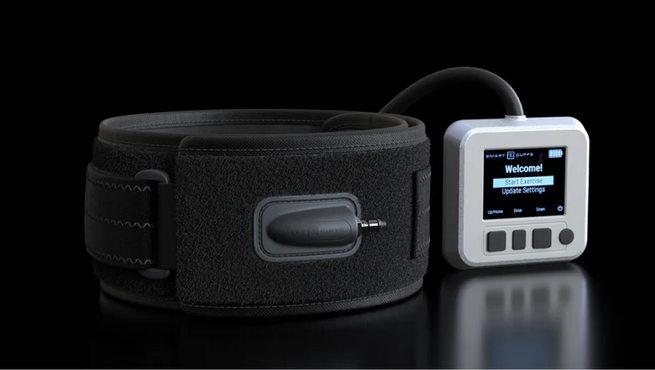
SmartCuffs® 4.0 solves both problems. The Clinical Set covers the same four size and limb variants, but also supports simultaneous multi-patient treatment through Standalone Mode. The workflow: connect two cuffs to a patient, calibrate to their LOP, set the pressure, then disconnect the phone. The cuffs hold pressure independently while you move to the next patient. A single practitioner can treat up to four patients with two cuffs each, or up to eight patients with one cuff each, all running concurrently.
For larger practices running multiple patients through BFR in the same session, this is a meaningful operational difference and one that no other BFR system on the market currently matches.
The table below compares the most commonly evaluated BFR systems in professional and clinical settings across the criteria that matter most in a clinical setting.
|
Feature |
SmartCuffs 4.0 |
Delfi PTS |
Saga 2.0 |
Suji |
|---|---|---|---|---|
|
Peer-Reviewed LOP Validation |
✓ |
✓ |
✗ |
|
|
Clinical-Grade LOP Repeatability |
✓ |
✓ |
✗ |
✗ |
|
Medical Grade Materials |
✓ |
✓ |
✗ |
✗ |
|
Multi-Cuff Capability |
✓ |
✗ |
✓ |
✓ |
|
Quick Start Mode (app-free) |
✓ |
✗ |
✗ |
✗ |
|
Free App (core features don’t require a subscription) |
✓ |
✗ |
✓ |
✓ |
|
FDA-Listed* |
✓ |
✓ |
✗ |
✓ |
|
Purpose-Built for BFR |
✓ |
✗ (retrofitted) |
✓ |
✓ |
|
Made in USA |
✓ |
✗ (Canada) |
✗ (China) |
✗ (China) |
|
Price Range |
$499–$1,699 |
$5,000+ |
$388-$1346 |
<$500 |
Note: Comparison is based on publicly available clinical and regulatory information.
Multiple studies show BFR can promote hypertrophy and reduce mechanical and joint load during exercise, making it a valuable clinical tool for post-surgical rehabilitation, chronic pain management, and return-to-sport progressions where heavy loading is contraindicated or not yet appropriate.
|
Use Case |
Recommended Product |
Why |
|---|---|---|
|
Chronic pain / osteoarthritis |
Low-load BFR allows meaningful strength stimulus without the joint stress of conventional resistance training, making it well-suited for patients where heavy loading is contraindicated long-term. |
|
|
Return-to-sport progressions |
Stored LOP profiles allow consistent pressure prescription across the full rehabilitation timeline, from early-stage loading through functional discharge criteria. |
|
|
Budget-constrained practices |
For organizations or individual practitioners seeking a clinically validated BFR system at a lower price point, SmartCuffs® 3.0 delivers the same personalized LOP detection as the 4.0 at a reduced cost. |
|
|
High-risk patients |
Delfi PTS |
For high-risk patients with complex comorbidities in a hospital or surgical setting, Delfi may be appropriate where institutional procurement requirements or physician preference dictate a higher-cost solution. |
The SmartCuffs® 4.0 Clinical Set is the only BFR package on the market configured for simultaneous multi-patient use, built around the same personalized LOP technology validated by Mayo Clinic and trusted across more than 10,000 U.S. clinics.
Personalized LOP for every patient. Each cuff automatically calibrates to the individual's limb occlusion pressure in approximately 30 seconds, with stored profiles for repeatable results across sessions and staff.
Mayo Clinic-validated accuracy. The only clinical-volume BFR package backed by peer-reviewed LOP validation (Mayo Clinic, 2022).
FDA-listed, medical-grade materials. Meets the procurement and compliance requirements of hospital-affiliated and institutional PT practices.
Free app, no subscription required. Core clinical features, including LOP detection and session management, are accessible without an ongoing fee.
30-minute recharge, extended battery life. Rated for high-use clinical environments without mid-day downtime.
What's included. Each Clinical Set contains 8 SmartCuffs® 4.0 across four sizes — small arm (8–13"), medium arm (13–18"), large leg (18–24"), and XL leg (24–29") — along with 2 power adapters, 4 charging cables, 2 carrying cases, and a user manual.
How many BFR cuffs do I need for a high-volume PT practice?
At minimum, a practice needs cuffs across multiple sizes to cover the range of patients it's likely to see: pairs for arms and legs in both standard and large sizes. A single pair covers one size and one limb, which isn't practical for clinical use. The SmartCuffs® 4.0 Clinical Set includes eight cuffs across four sizes, configured to cover the full range of patients without needing to purchase additional pairs separately.
What cuff sizes work for treating patients across different body types and limb sizes?
SmartCuffs® 4.0 are available in four sizes covering arms and legs: small arm (8–13"), medium arm (13–18"), large leg (18–24"), and XL leg (24–29"). The Clinical Set includes a pair of each size, giving a practice the full range on hand for any patient presentation.
What are some clinical workflow tips for using multiple SmartCuffs® during back-to-back appointments?
Quick Start Mode re-inflates each cuff to its stored patient pressure without requiring the app, reducing setup time at the start of each session. For back-to-back scheduling, the 30-minute full recharge means cuffs can cycle between patients without mid-day downtime. For practices running concurrent sessions, Standalone Mode allows a single practitioner to connect two cuffs to a patient, set their pressure, and disconnect the phone while the cuffs hold pressure independently — then move immediately to the next patient. A fully equipped practice can treat up to four patients with two cuffs each, or up to eight patients with one cuff each, all running at the same time.


