


A solo athletic trainer or small training space can run blood flow restriction (BFR) training. It takes supplying what an institution would: a clear state scope, a written screen for every client, pressure set from each client's own limb occlusion pressure, and a device one person can run.
Most athletic trainers don't carry that list alone. The Bureau of Labor Statistics counted about 35,200 athletic trainer jobs in 2025. Educational services held 40 percent, hospitals 16 percent, therapy and audiology offices 14 percent, and physicians' offices 11 percent [1].
Education is one of the gaps. In one convenience sample of 72 North American clinicians who use BFR, 65.7 percent of athletic trainers reported formal BFR education, against 90.3 percent of physical therapists [2]. What follows takes each piece in turn, from what BFR adds and how state scope works through pressure, device choice, and documentation.
What BFR can add when heavy loading isn't an option
Low-load BFR gives a solo practitioner a way to keep training a muscle when a client can't yet tolerate heavy loads [5]. Resistance exercise with BFR commonly uses 20 to 40 percent of one-rep max [5][7]. That is a typical range in published guidance, not a set prescription, and the training professional sets the load.
A Journal of Athletic Training commentary describes BFR as a possible bridge between early rehab and the later stages that lead back to sport [5]. For a client whose healing tissue isn't ready for heavy loading, it may help limit strength loss and atrophy [5]. Whether it fits depends on the screen and the professional's judgment.
Some in-season athletes are candidates as well. Low-load BFR during in-season recovery may help an athlete maintain strength with less joint loading, though not every athlete or schedule calls for it.
The same commentary notes that higher loads still produce the largest strength and size gains [5]. So treat BFR as a bridge. Use it while heavy loading isn't appropriate, then progress back to heavier work as the client tolerates it.
Why individualized pressure fits a one-person setup
Anchoring pressure to the client's own occlusion pressure is meant to account for differences between clients' limbs and between cuffs [6]. It narrows that variation rather than removing it. Wider cuffs reach occlusion at lower absolute pressures, so one fixed number doesn't suit every client [5][7].
Cuff width is one of the differences that separate bands from cuffs. The Journal of Athletic Training commentary also advises measuring in the position used for the exercise, because body position changes occlusion pressure [5].
Handheld Doppler and pulse oximetry can also find occlusion pressure, though pulse oximetry is less accurate on the legs [5][6]. Each adds a step and a second piece of equipment to a session you're running alone.
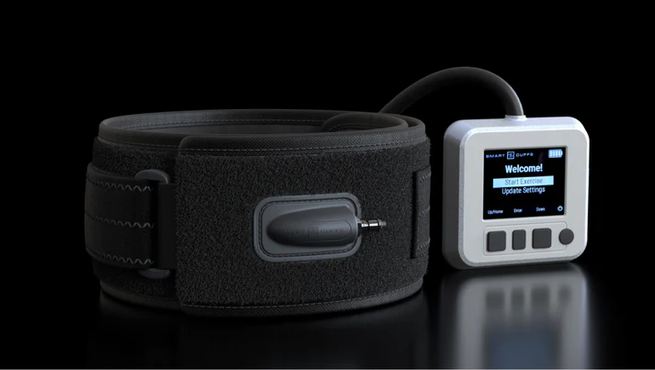
LOP is any pressure needed to occlude the limb. An automated system measures it for you, then inflates calibrated cuffs to a percentage of that limb occlusion pressure (LOP). Two peer-reviewed studies have validated automated systems against Doppler ultrasound.
A 2022 study in Arthroscopy, Sports Medicine, and Rehabilitation validated an automated system, the SmartCuffs 3.0 Pro, against Doppler ultrasound across 96 limbs, with no statistically significant difference between the two [8].
A 2026 study in Physiological Measurement validated another automated system, the SmartCuffs 4.0, against Doppler ultrasound in the seated and standing positions, with good agreement in each [9].
Your state determines what you can offer with BFR
Your state's law sets what you can offer, and no course changes that. The Board of Certification reports that 49 states and the District of Columbia regulate athletic training [3]. It calls compliance with state requirements "the only avenue to legal athletic training practice" [3].
Florida shows how a practice act can shape BFR. It defines athletic training as care provided under the direction of a physician [4]. That physician gives direction through oral or written prescriptions or protocols [11]. Other states use different terms, so read your own act rather than borrowing another state's [3].
Training can carry legal weight as well. Florida's act bars a licensed athletic trainer from providing care they lack the education, training, or experience to provide [4]. Practice acts govern licensed professions, so a coach working under a fitness credential should check whether state law lets them screen for medical contraindications at all. A BFR certification course may help you document that training, though it can't widen what your act allows.
A larger organization may have an administrator for those questions. In a solo practice or independent training space, that's you. Before the first session, get the requirements of your state board, your liability carrier, and any host facility in writing. If your act calls for physician direction, line up that physician, and file every answer with your client screening forms.
BFR should be used under, or after screening by, a qualified professional. In this article, that means a licensed clinician whose state scope covers health screening before exercise. Examples include a physician, a physical therapist, or an athletic trainer working under the physician direction their state requires. This comes from published BFR safety guidance [5][6], not from any one law.
What to look for when buying BFR cuffs
BFR systems differ in how they set pressure and how well they repeat it. For a solo ATC or small training space, these five criteria separate a system you can document from one that leaves you estimating.
Personalized pressure. Published guidance sets pressure as a percentage of each client's limb occlusion pressure (LOP), which varies by person [6][7]. A system can measure LOP on the limb, estimate it, or rely on a separate Doppler check [5][6]. Fixed settings skip that step.
Repeatability. A device that stores each client's LOP lets every session start from the same reading. Measuring by hand at each visit adds time and room for error when you work alone.
Safety features. Ask how the device releases pressure quickly if a client reports symptoms, and whether it caps pressure. Materials should withstand daily cleaning between clients.
Cuff width and design. Wider cuffs reach occlusion at lower pressures, though they may restrict movement [5][6]. Elastic bands give no pressure reading to record, which leaves the dose to guesswork.
Cuff count. Check whether a set covers both arms and legs without swapping cuffs between sessions. SmartCuffs 4.0 comes in two- and four-cuff sets.
How the main BFR options compare for a solo ATC or training space
This comparison sets four BFR systems side by side on LOP validation, multi-cuff use, app-free start, regulatory status, country of manufacture, and price.
|
Feature |
SmartCuffs 4.0 |
Delfi PTS |
Saga Airbands 2.0 |
Suji |
|---|---|---|---|---|
|
LOP measurement validated vs. Doppler ultrasound (positions) |
4.0: Seated and standing [9] |
Supine only [12] |
Supine only [13] |
No published study found |
|
Multi-Cuff Capability |
✓ (up to eight cuffs, Standalone Mode) |
✓ |
✓ (two cuffs) |
✓ (two cuffs) |
|
Quick Start Mode (inflates without opening the app) |
✓ |
N/A (no app) |
✗ |
✗ |
|
Free App (core features do not require a subscription) |
✓ |
N/A (no app) |
✓ |
✗ |
|
FDA-Listed* |
✓ |
✓ |
✗ |
✓ |
|
Purpose-Built for BFR |
✓ |
Adapted from surgical tourniquet |
✓ |
✓ |
|
Country of Manufacture |
Designed & assembled in USA |
Canada |
China |
China |
|
Price Range |
$499 to $1,699 |
$5,000+ |
$440 to $1,780 |
<$500 |
Also available: SmartCuffs 3.0 Pro, our clinical-model system, with LOP validated against Doppler ultrasound in a peer-reviewed study (2022).
*Pricing is volatile. Verify against current product pages before procurement.
Browse all SmartCuffs® options to compare configurations before purchasing.
How to document BFR sessions
Record every BFR session the same way, on one log kept with the client's screening form. A consistent record shows what you set and how the client responded. That is what a carrier or referring physician may ask to see, and it gives you a baseline for the next session.
|
Field |
What to record |
Why it belongs on the log |
|---|---|---|
|
Screen and clearance |
Date of the written screen, plus physician clearance if a condition was flagged |
Shows the client was screened before BFR started [5][6] |
|
LOP reading |
The reading and the body position it was measured in |
Body position changes occlusion pressure [5] |
|
Training pressure |
Percentage of LOP used and the resulting pressure |
Ties the set pressure to the client's own LOP [6][7] |
|
Cuff and limb |
Cuff size, limb, and placement |
Cuff width changes the pressure a limb needs [5][6] |
|
Exercise and load |
Exercise, load, sets, and reps |
Repetitions that don't drop across sets may mean pressure is too low [6] |
|
Inflation time |
Continuous inflation time for each limb |
Lets you check each session against your protocol's limit [5][6] |
|
Monitoring checks |
Skin color, capillary refill, and pulse |
Flags pressure that may be too high [6] |
|
Symptoms and stop events |
Any symptom, the time it started, and the action taken |
Shows your stop rules were followed |
Keep the log next to the written answers from your state board, liability carrier, and any host facility. Your carrier or state may set its own record rules, so ask about records when you request those answers. If a physician directs the client's care, note any protocol change and who approved it.
A stop event needs more detail than a routine session. Record the symptom, when it started, what you did, and whether you referred the client for evaluation. A printed template is faster to fill in mid-session than free text, so set one up before your first client.
Which SmartCuffs fits your training space
SmartCuffs 3.0 Pro and SmartCuffs 4.0 both find each client's limb occlusion pressure automatically and set the training pressure as a percentage of it. Both have their LOP measurement validated against Doppler ultrasound in a peer-reviewed study. The practical difference is in how you run them: the 3.0 Pro is controlled on the pump with no phone involved, while the 4.0 runs from the free SmartCuffs app.
SmartCuffs 4.0 runs from the One Pair at $499 to the Clinical Set at $1,699. The SmartCuffs 3.0 Pro Standard Set includes one pump and a pair of cuffs in each of three sizes for $999, with the Elite Set at $1,499.
|
Feature |
SmartCuffs 3.0 Pro |
SmartCuffs 4.0 |
|---|---|---|
|
Peer-reviewed LOP validation |
✓ (supine) [8] |
✓ (seated and standing) [9] |
|
Controls |
Pump screen and buttons, no phone needed (non-Bluetooth) |
Free SmartCuffs app over Bluetooth |
|
Pump |
One detachable Pro pump (two in the Elite Set) |
Built into every cuff |
|
Training modes |
Continuous, plus built-in IPC |
Continuous, Intermittent, Resting |
|
Setting each patient's pressure |
Custom % of LOP on the pump, or manual mode |
Custom % of LOP in the app |
|
Saved session history |
No |
Yes, each patient's LOP and sessions |
|
Waterproof (pool use) |
Yes |
No |
|
Leg cuffs and sizes |
Straight; S, M, L (XL sold separately) |
Contoured; S, M, L, XL |
|
Charging |
Pump only, Micro-USB |
Every cuff, USB-C |
|
Clinic set |
Standard $999 (6 cuffs) / Elite $1,499 |
Clinical Set $1,699 (8 cuffs, all sizes) |
Choose the SmartCuffs 3.0 Pro if:
- You want to set custom pressure for each patient right on the pump, with no phone or tablet (it runs without Bluetooth, which suits hospital and clinic networks that block app updates)
- IPC is part of your protocols and you want it built in
- You use cuffs with patients in the pool
- You want a pair each of Small, Medium, and Large for your clinic at the lowest upfront cost
Choose the SmartCuffs 4.0 if:
- You want pumps built into the cuffs, nothing to connect between limbs
- You want Intermittent and Resting modes alongside Continuous
- You want to change pressure mid-set and keep a saved session history
- You want contoured leg cuffs, with XL in every set
- You want a clinic setup with saved patient history, Quickstart and Standalone mode
Browse all SmartCuffs® options to compare configurations before purchasing. For individual help matching a configuration to your practice volume and patient mix, use the SmartTools cuff selector or reach out to the clinical team directly.
Frequently Asked Questions
How many cuffs does a solo practitioner need?
Two cuffs cover one limb pair, and four let you work arms and legs without swapping cuffs between exercises. One 2026 review advises never inflating cuffs on the upper and lower limbs at the same time [6], so four cuffs speed up changeovers rather than doubling what runs at once. SmartCuffs 4.0 comes in One Pair and Two Pairs configurations.
What should I record for each BFR session?
Log the screen date and any physician clearance, the LOP reading and the position it was measured in, the percentage used, cuff size and limb, inflation time, and any symptoms or stop events. A 2026 review also lists skin color, capillary refill, pulse strength, and repetition decline as checks on whether pressure is tolerable [6]. Ask your carrier and state board whether they set their own record rules.
Do I need a Doppler or pulse oximeter if my cuffs measure LOP?
A system that measures LOP on the limb doesn't need a separate device to find that number. A 2022 study validated the SmartCuffs 3.0 Pro's automated LOP measurement against Doppler ultrasound across 96 limbs, with no statistically significant difference [8], though that result applies to the system tested. A handheld Doppler or pulse oximeter can still serve as a cross-check, but pulse oximetry is less accurate on the legs [6].
What are the contraindications for BFR?
Published guidance flags several conditions for careful assessment or medical clearance before BFR [5][6]. They include a history of deep-vein thrombosis, clotting disorders, impaired circulation, hypertension, active infection, cancer, renal disease, and pregnancy [5][6]. Sources don't classify these the same way, and some treat certain conditions as reasons to avoid BFR entirely [6]. Screen every client in writing first, and let a physician decide whether BFR fits a client who screens positive.
Can a strength coach offer BFR in an independent training space?
A Journal of Athletic Training commentary says BFR certification is not specifically required [5]. It puts responsibility for knowing the mechanisms, precautions, contraindications, and risks on the clinician [5]. In one survey, 65.7 percent of athletic trainers reported formal BFR education, against 90.3 percent of physical therapists [2].
References
- U.S. Bureau of Labor Statistics. Occupational Outlook Handbook: Athletic Trainers. bls.gov
- Colapietro MA, Lee JZ, Vairo GL. Survey of Blood Flow Restriction Training Applications in Sports Medicine and Performance Practice Across North America. Journal of Strength and Conditioning Research, 2024. PubMed 38241466
- Board of Certification for the Athletic Trainer. State Regulation. bocatc.org
- State of Florida. Florida Statutes, Section 468.701, Definitions. leg.state.fl.us
- Lorenz DS, Bailey L, Wilk KE, Mangine RE, Head P, Grindstaff TL, Morrison S. Blood Flow Restriction Training. Journal of Athletic Training, 2021. PMC8448465
- Gaviglio C, Cook CJ, Bird SP. Blood Flow Restriction in Athletic Populations, Part 1: Safety Considerations, and Methodological Frameworks. Journal of Functional Morphology and Kinesiology, 2026. PMC13214901
- Patterson SD, et al. Blood Flow Restriction Exercise: Considerations of Methodology, Application, and Safety. Frontiers in Physiology, 2019. PubMed 31156448
- Abbas MJ, et al. An Automated Technique for the Measurement of Limb Occlusion Pressure During Blood Flow Restriction Therapy Is Equivalent to Previous Gold Standard. Arthroscopy, Sports Medicine, and Rehabilitation, 2022. PubMed 35747637
- Yang J, Gubler T, Kenneally E, et al. Validity, tolerability, and feasibility of automated arterial occlusion pressure across body positions. Physiological Measurement, 2026;47(8). DOI 10.1088/1361-6579/ae9034
- U.S. Food and Drug Administration. Product Classification: Tourniquet, Pneumatic (KCY). FDA product classification database
- State of Florida. Florida Statutes, Section 468.713, Responsibilities of Athletic Trainers
- Masri BA, Day B, Younger ASE, Jeyasurya J. Technique for measuring limb occlusion pressure that facilitates personalized tourniquet systems: a randomized trial. Journal of Medical and Biological Engineering, 2016;36(5):644-650. DOI 10.1007/s40846-016-0173-5
- Zhang W-Y, Zhuang S-C, Chen Y-M, Wang H-N. Validity and reliability of a wearable blood flow restriction training device for arterial occlusion pressure assessment. Frontiers in Physiology, 2024;15:1404247. DOI 10.3389/fphys.2024.1404247

